Definition
Temperament is the innate, biologically rooted baseline you are born with; personality is the relatively stable pattern that develops on top of it over years; attitude is the situational stance you can choose right now. Posture is attitude made physical.
Origin
The four-temperaments scheme descends from Hippocrates and Galen. Modern differential psychology separates the layers: Gordon Allport’s trait theory (1937) framed personality as organised, developed dispositions; Hans Eysenck tied core temperament to biological arousal systems; Jerome Kagan’s longitudinal work (Galen’s Prophecy, 1994) showed temperament — e.g. high-reactive infancy — as an early, partly heritable substrate that shapes but does not dictate later personality.
Mechanism
The layers differ in how trainable they are:
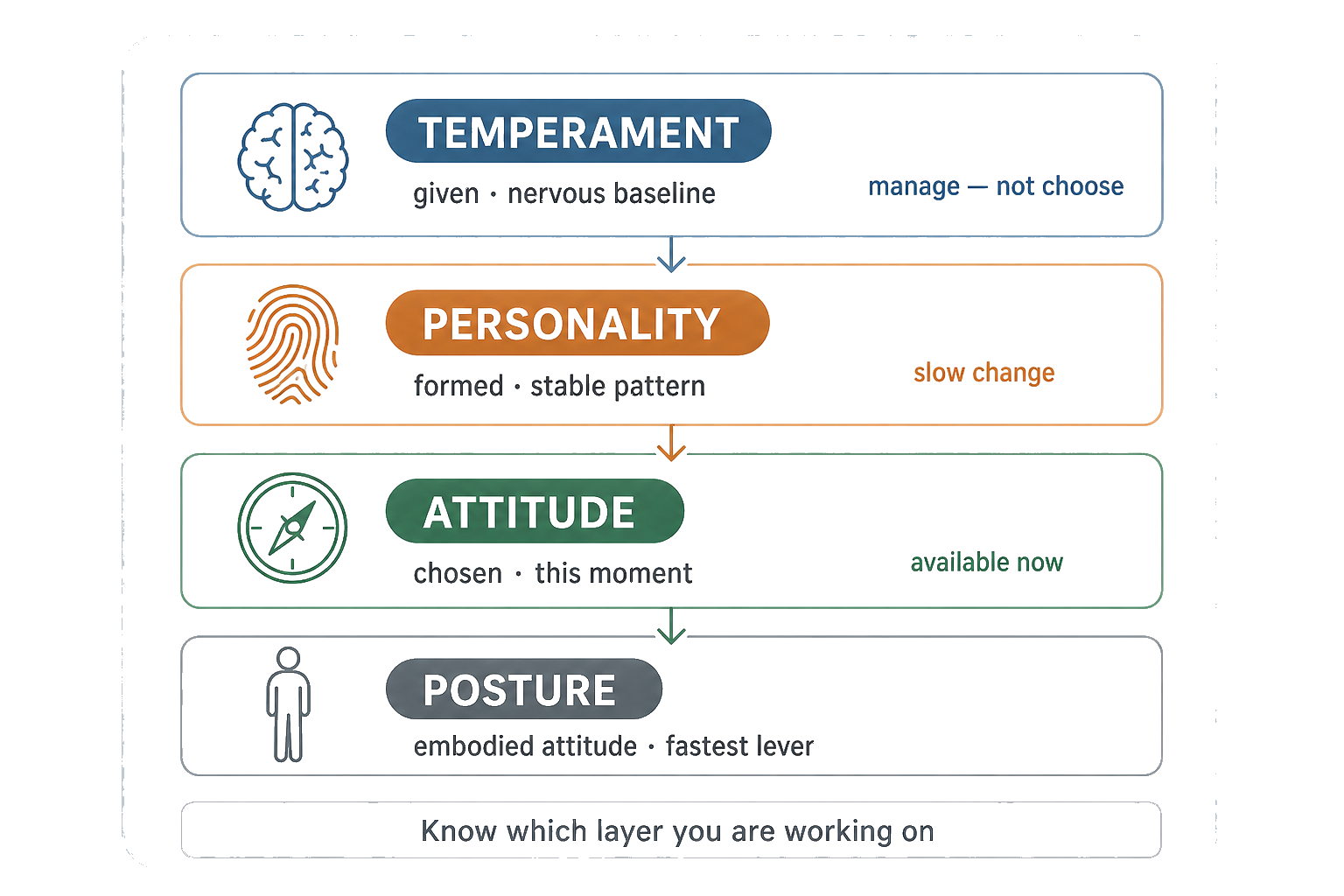
Given Temperament · formed Personality · chosen Attitude · embodied Posture. Pair Conditioning · Agentic properties.
- Temperament — given. The nervous-system baseline (reactivity, sensitivity, basic tempo). You manage it; you do not choose it.
- Personality — formed. Stable patterns built over time on the temperament substrate through experience and conditioning. Slow to change, but not fixed.
- Attitude — chosen. The orientation you bring to this situation. The most malleable layer — available in the moment even when temperament is not.
- Posture — embodied attitude. The stance, breath, and carriage that both express and feed an attitude.
Knowing which layer you are working on prevents two errors: fighting Temperament as if it were Attitude, and treating a chosen Attitude as if it were fixed Personality.
Identity link
The four layers map onto the Identity pillar from substrate to signal:
| Layer | Identity relation |
|---|---|
| Temperament | Constitutional floor — below narrative identity; manage, do not moralise |
| Personality | Slow consolidation — traits and habits feed Narrative identity and Identity coherence |
| Attitude | Situational try-on — bridge to Identity Gap and Performed identity |
| Posture | Embodied signal — fastest audience read; pairs Interoception |
Mythopoiesis authors the story; this stack names which layer you are actually moving when identity feels stuck.
Applications
Separating what is given from what is trainable; choosing an attitude even when the temperamental pull is strong; using posture as the fastest lever on attitude; building finer distinctions so the words you have match the differences that matter.
Sources
Cite
- Allport, G. W. (1937). Personality: A psychological interpretation. Henry Holt.
- Kagan, J. (1994). Galen’s prophecy: Temperament in human nature. Basic Books.
- Eysenck, H. J. (1967). The biological basis of personality. Charles C. Thomas.
Related doctrine
Adjacent
Temperament · Personality · Attitude · Posture · Identity · Narrative identity · Agentic properties · Person in context