Definition
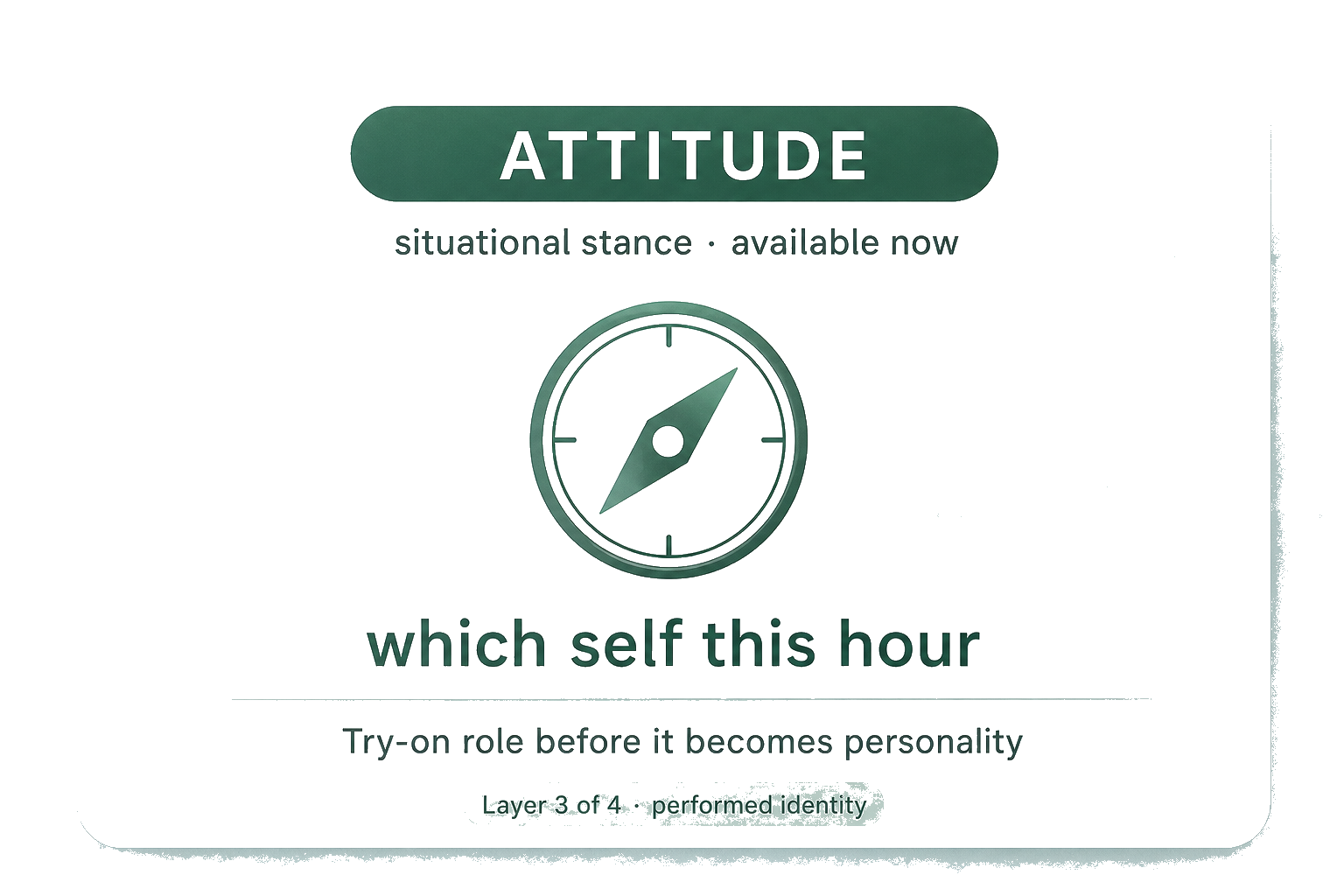
An attitude is a relatively enduring evaluative orientation toward an object, person, or situation — and, in the Club layer model, the stance you can reset in the present even when deeper layers resist.
Origin
Social psychology treats attitudes as evaluative associations (favourable/unfavourable) that guide attention and behaviour. Humanistic and human-potential frames (Rogers, Branden) stress chosen orientation — the stance you adopt toward your own experience and toward the task. In the four-layer map (Temperament, attitude and personality), attitude is the executive layer: not the body you were born with (Temperament) nor the decade-long pattern (Personality), but the now.
Mechanism
Attitude works through appraisal and readiness:
- Appraisal — what you judge the situation to mean (threat, opportunity, indignity, invitation).
- Readiness — which actions feel permitted or forbidden before you act.
- Expression — tone, facial set, and language that feed back into appraisal (see Posture).
Depth psychology: attitude is where ego function meets the room — not yet full character change, but the point where consciousness can intervene between impulse and act. You can hold a fearful Temperament and a cautious Personality yet choose a working attitude for one rep (“I will run this block as an experiment, not a verdict on me”).
Attitude is trainable in the moment but not free of depth: repeated attitudes become personality over time — which is why stance discipline compounds.
Identity link
Attitude is the executive bridge between Identity doctrine and this hour’s rep. Identity Gap work names the tension, then chooses a working attitude before evidence exists — a deliberate performed identity try-on (parent, expert, leader) until audience and logs mirror it back into Personality and Narrative identity. Attitude is not the full life story; it is the stance that keeps the story honest under cost.
Applications
- Pre-commit a stance before high-friction entry (meeting, publish, hard conversation).
- Separate I feel (temperament/affect) from I orient (attitude) before behaviour.
- Fastest embodied lever: pair with Posture — breath and carriage shift appraisal within seconds.
Sources
Cite
- Branden, N. (1994). The six pillars of self-esteem. Bantam.
- Ajzen, I. (1991). The theory of planned behavior. Organizational Behavior and Human Decision Processes, 50(2), 179–211.
Related doctrine
Adjacent
Temperament, attitude and personality · Temperament · Personality · Posture · Identity · Performed identity · Levels of consciousness