Definition
A level of consciousness is the degree of reflective awareness brought to an act — how much of the mind is observing, rather than simply running, the behaviour.
Origin
The idea that awareness comes in degrees recurs across traditions and psychology. John Flavell (1979) formalised metacognition — thinking about one’s own thinking — as a measurable capacity. The contemplative literature describes an observing self or witness (Arthur Deikman) and the cultivation of present-moment awareness (Jon Kabat-Zinn). All converge on a continuum from automatic, unexamined processing to deliberate, self-aware processing.
Mechanism
Most behaviour runs on low awareness: cues trigger habitual responses with little reflection.
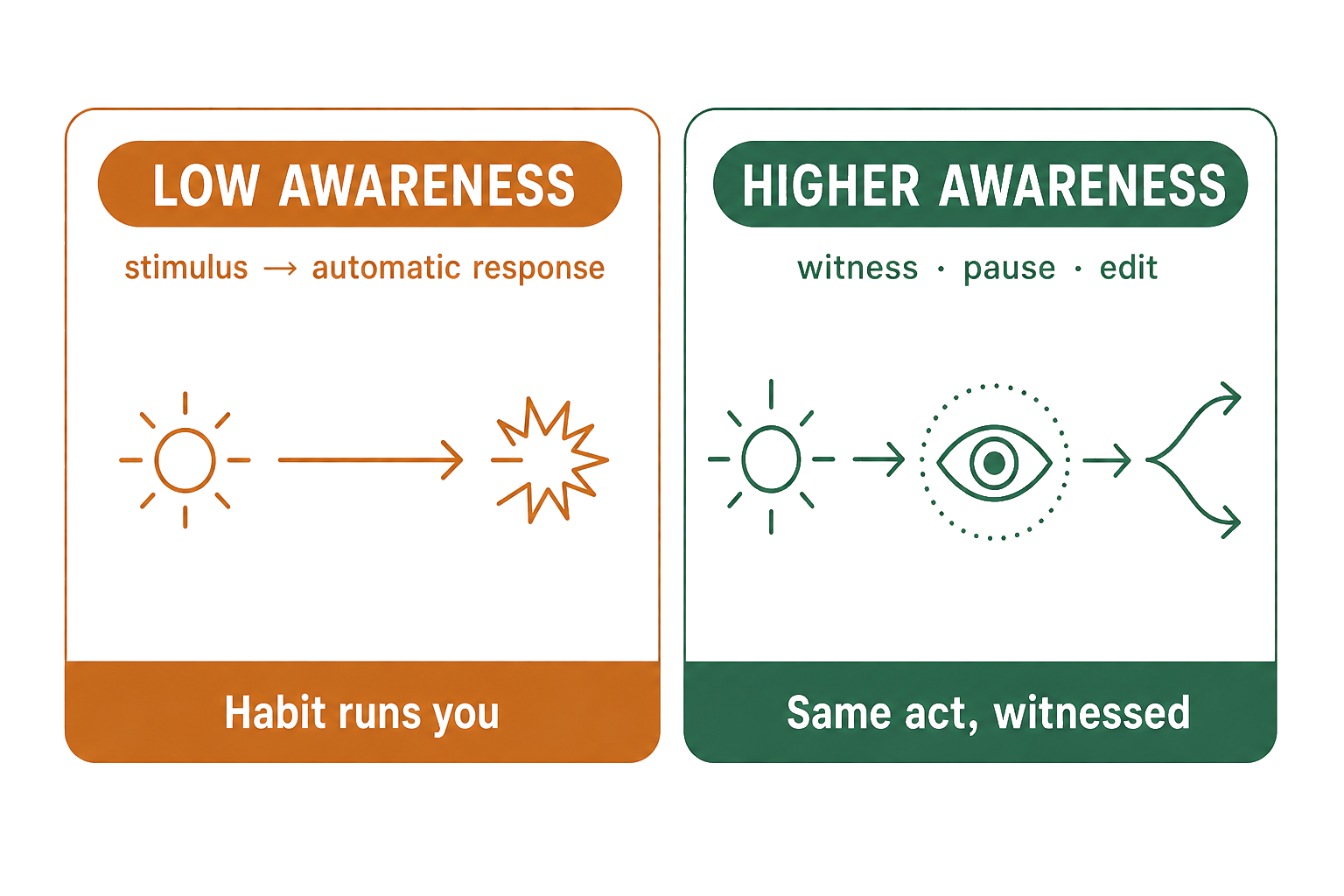
Automatic reflex versus witnessed pause — same act, different awareness. Pair Quality of Questions · Interoception.
Raising the level of consciousness inserts an observing step between stimulus and response — the same act is now witnessed, and therefore editable. The quality of an action depends not only on what is done but on the awareness with which it is done; the same question asked from a higher level of awareness yields a different answer, because a different part of the self is doing the asking and answering.
Applications
- Metacognitive monitoring improves learning and self-regulation.
- A brief pause to witness a reaction converts an automatic response into a chosen one.
- Distinguishing which internal “self” is acting (reactive, reflective) changes the outcome of the same situation.
Sources
Cite
- Flavell, J. H. (1979). Metacognition and cognitive monitoring. American Psychologist, 34(10), 906–911.
- Deikman, A. J. (1982). The Observing Self. Beacon Press.
- Kabat-Zinn, J. (1990). Full Catastrophe Living. Bantam.