Working definition
The quality of your life depends on the quality of the questions you ask. The first move of every training is to sharpen the question itself.
How it works
A bad question generates fluent but useless answers. A sharp question forces the system to move. The doctrine treats the question as the upstream variable: change it, and the entire downstream cascade — emotion, effort, calibration, memory — changes shape.
The session-2026-02-11 demonstration: Do I want to train myself to be a troublemaker? and Do I want to train myself to be comfortable being perceived as a troublemaker? sound the same to a casual ear. They are not the same question.
- The first measures behaviour. Was I annoying enough? The answer is performative.
- The second measures internal state. Was I at ease while the perception happened? The answer is identity-grade.
Spend six months on the first question and you will harvest fluency in being annoying. Spend six months on the second question and you will harvest a transformed relationship with social discomfort. Same effort. Opposite return.
The rule of thumb:
- Write the question down before you start the week.
- Read it. Does it measure the right axis?
- If two phrasings exist, pick the one whose answer would change you, not the one whose answer would describe you.
Signature
The image is the question that changes the Battle — Yann’s move What would I ask you? on 2026-04-17 — Did you celebrate? beats Why did you fail?
More room passes mention this doctrine in replay narrative — search the Codex for Quality of Questions or start from the latest entry on Weekly Sessions.
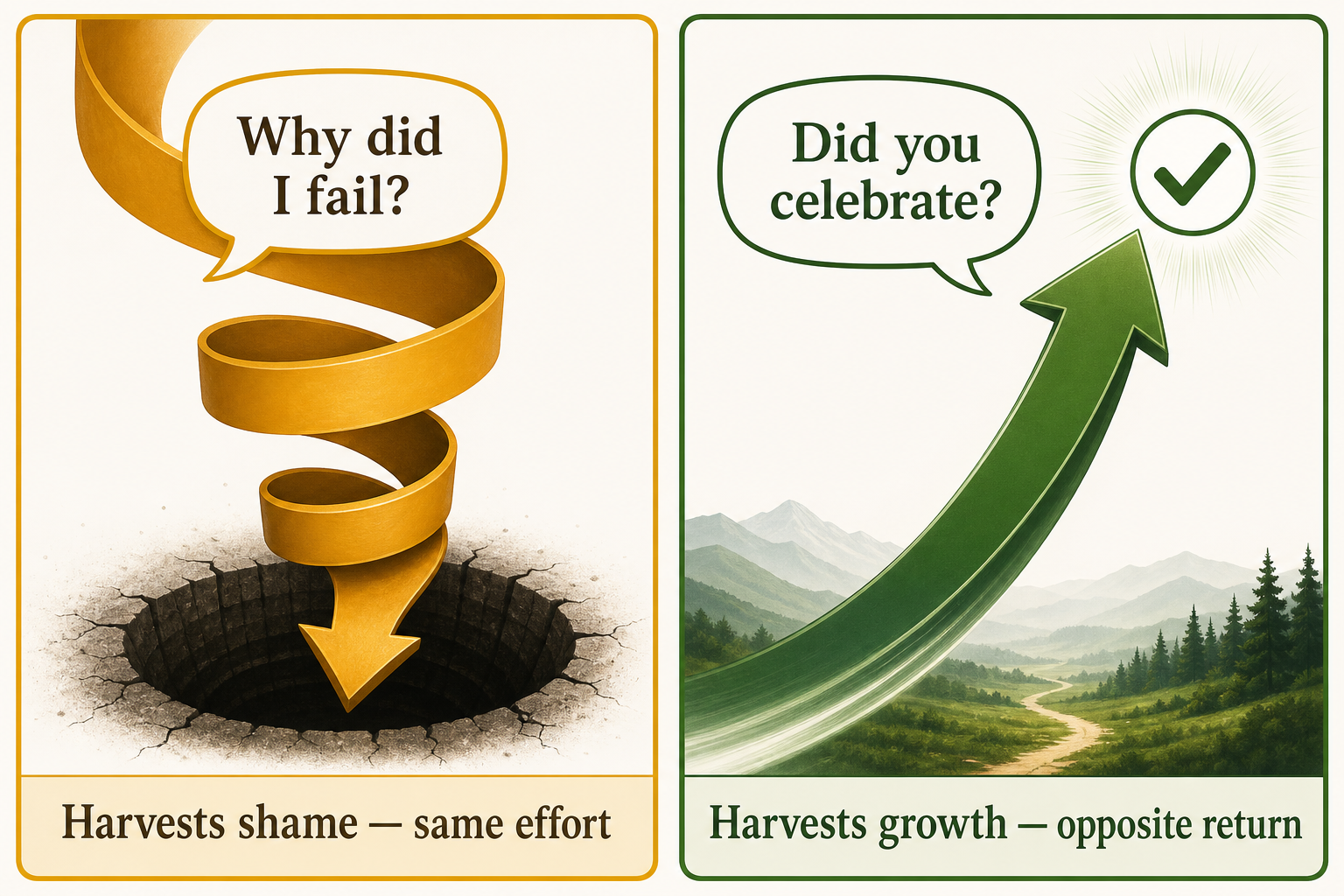
Why fail? versus did you celebrate? — sharpen the question before the week runs. Your move: Your move this week.
Your move this week
This week’s micro-action (24–72 hours):
- Take your current Battle question.
- Write it down word for word.
- Then write a second version that targets internal state instead of behaviour.
- Run the week on that one.