Definition
Projected regret is regret you assign to your future self in advance — a conviction that you will fail, so you pre-refuse the move and call it wisdom.
Origin
Anticipated emotion research studies how people forecast future feelings before choosing. Anticipated regret is decision-specific: people simulate a counterfactual outcome, compare it to what they might get, and avoid options they expect to blame themselves for later (Zeelenberg, 1999). Prospection research (Gilbert & Wilson, 2007) shows that mental simulation of the future is vivid but systematically biased — people often overweight negative futures they have not tested.
Mechanism
Three layers stack:
| Layer | What happens | Coaching read |
|---|---|---|
| Forecast | You simulate failure and label the feeling “regret I will have” | Not yet evidence — a story about a future self |
| Pre-refusal | You decline the move before trial | Ambition ceiling drops without data |
| Speech marker | Conditional phrasing (I would love to…) vs commitment | Quality of the self answering matters |
Distinct from end-of-life regret (backward-looking inventory). Distinct from visceral fear (Visceral fear of falling) — projected regret is often cognitive-first; the body may follow the script. Anticipated regret can also motivate protective action when the forecast is accurate — the failure mode here is pre-emptive failure attribution, not regret sensitivity itself.
Affective forecasting errors (Gilbert & Wilson, 2007) mean projected regret is frequently wrong about intensity and duration — yet it still brakes action when ambition rises.
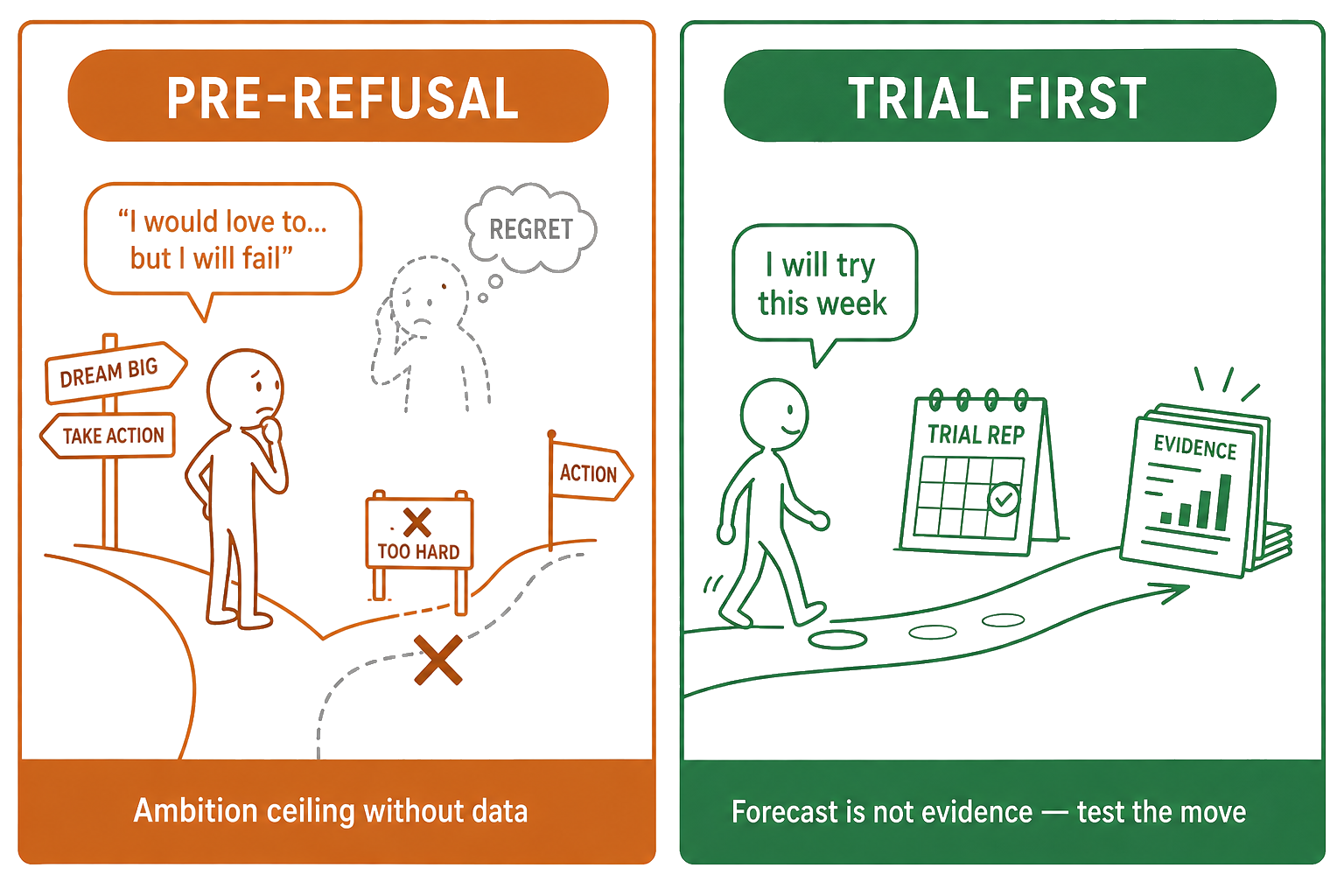
Pre-refusal versus trial first — forecast is not evidence. Pair Ambition · Problems at the Height of Ambitions.
Applications
When naming Ambition aloud, notice if projected regret narrates shutdown before action. Separate real risk (listable, time-bounded) from imagined regret (story). Pair with The Victory Journal — signed evidence stacks contradict pre-emptive failure scripts. Sharpen the upstream question (Quality of Questions) so the week does not run on a question whose honest answer is already “I will regret this.”
Sources
Cite
- Gilbert, D. T., & Wilson, T. D. (2007). Prospection: Experiencing the future. Science, 317(5843), 1351–1354.
- Zeelenberg, M. (1999). Anticipated regret, expected feedback and behavioral decision making. Journal of Behavioral Decision Making, 12(2), 93–106.
Related doctrine
Quality of Questions · Problems at the Height of Ambitions
Adjacent
Ambition · Visceral fear of falling · Daring · Future self bias