Definition
Ambition is the scale of future you admit you are building toward — not mood, not fantasy — tested by what problems and risks your body accepts when you say it out loud.
Origin
Goal-setting theory (Locke & Latham, 2002) treats specific, difficult goals as drivers of effort and persistence when commitment and feedback exist. The self-concordance model (Sheldon & Elliot, 1999) adds a second filter: goals aligned with developing interests and core values sustain effort and yield well-being when attained; goals answered from conditioning alone often stall after early compliance.
Mechanism
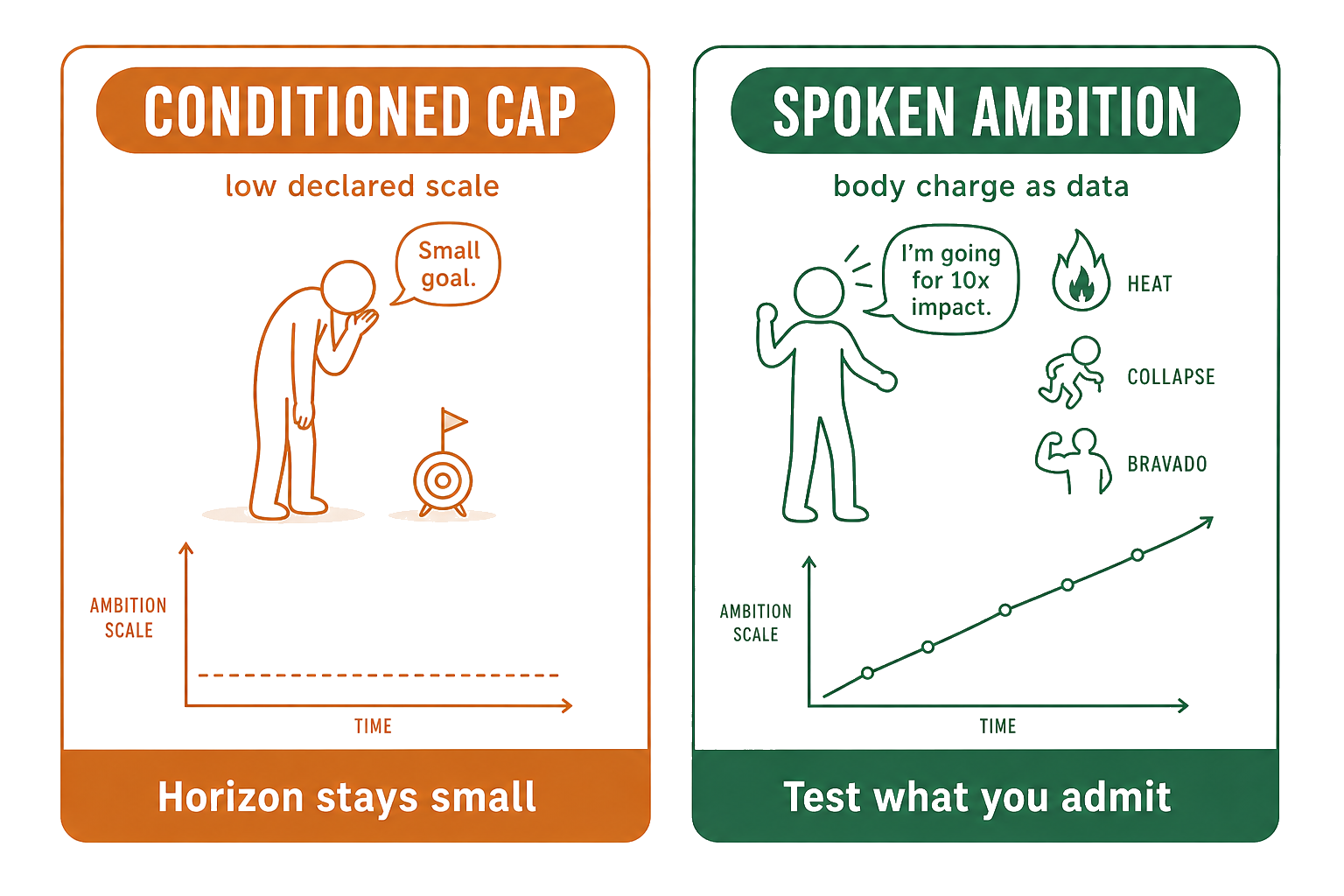
Conditioned cap versus spoken ambition — body charge when you declare scale. Pair Problems at the Height of Ambitions · Visceral fear of falling.
| Variable | Effect |
|---|---|
| Goal difficulty | Higher declared targets mobilise effort when belief and skill keep pace |
| Self answering | Conditioned self caps declared scale; chosen self may claim horizon without behaviour match |
| Public declaration | Speaking ambition surfaces body friction — collapse, hide, bravado — as data |
| Concordance | Ambition that fights core values burns out even when loud |
Projected regret often narrates why the declared scale must stay low. Daring and Visceral fear of falling oscillate around the same declaration — approach impulse versus fall-dread brake. BHAG names horizon scale; ambition names what you will admit this season.
Applications
Define ambition in writing, then speak it to another person or mirror; log body signal without fixing the label in the room. Separate child, alter-ego, and adult ambition voices when sorting identity layers. Pair with Vivid Vision for multi-year field; pair with Battle Of the Week for this week’s problem height.
Sources
Cite
- Locke, E. A., & Latham, G. P. (2002). Building a practically useful theory of goal setting and task motivation. American Psychologist, 57(9), 705–717.
- Sheldon, K. M., & Elliot, A. J. (1999). Goal striving, need satisfaction, and longitudinal well-being: The self-concordance model. Journal of Personality and Social Psychology, 76(3), 482–497.
Related doctrine
Problems at the Height of Ambitions · Vivid Vision
Adjacent
Daring · Agency · BHAG · Projected regret