Definition
Agency is the sense and practice that you can initiate change in your situation — even when the full ecosystem cannot flip at once.
Origin
Human agency in social cognitive theory (Bandura, 2006) is intentional self-development through forethought, self-reactiveness, and self-reflectiveness — people are contributors to life circumstances, not only products of structure. Social ecology models (Stokols, 1992) place behaviour inside nested environments; agency and field co-evolve rather than sitting in a person-versus-system duality.
Mechanism
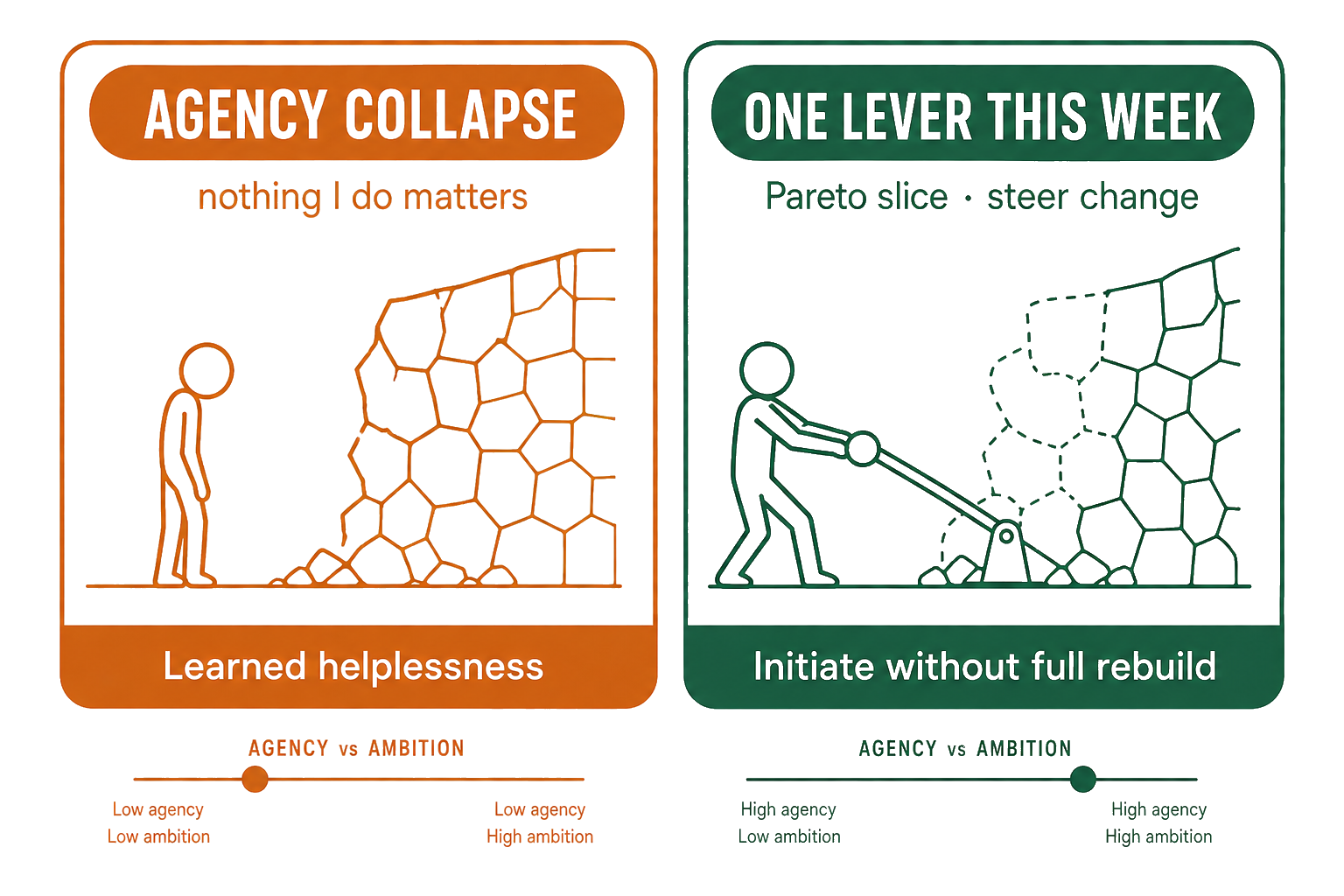
Agency collapse versus one lever this week — steer change without full ecosystem rebuild. Pair Be Your Real Boss · Ambition.
| Construct | Role |
|---|---|
| Ambition | Names the horizon scale |
| Agency | Names which levers you pull this week |
| Ecosystem | Names the field that carries or caps the move |
| Pareto slice | Often the hidden agency unit when full rebuild feels impossible |
Agency collapse (learned helplessness, chronic freeze) differs from accurate constraint (legal freeze, cash ceiling, caregiving load). The diagnostic move: list one action that changes felt progress without requiring total ecosystem replacement.
Applications
Map current ecosystem vs needed ecosystem, then underline one lever you control this week. When plateau reads as “nothing I do matters,” test a 20% environment slice before debating identity. Pair with Manual Of Me for operating recipes that survive field friction. When automation labour and organisational brand sit at the same table, name seats before you hand more reins (Tripartite reins).
Sources
Cite
- Bandura, A. (2006). Toward a psychology of human agency. Perspectives on Psychological Science, 1(2), 164–180.
- Stokols, D. (1992). Establishing and maintaining healthy environments: Toward a social ecology of health promotion. American Psychologist, 47(1), 6–22.
Related doctrine
Be Your Real Boss
Manual Of Me
Tripartite reins
Adjacent
Ecosystem
Ambition
Pareto principle
Realistic
Excellence hides in the nuance