Definition
Visceral fear of falling is the body-level dread that ambition will end in crash — shame, loss, humiliation — often louder than the actual risk ledger.
Origin
Fear of failure research documents multidimensional appraisal — shame, embarrassment, important-others-losing-interest — with somatic arousal and avoidance (Conroy, 2001). Performance settings show that threat appraisal often precedes rational risk accounting; interoceptive sensitivity can amplify predicted catastrophe before action.
Mechanism
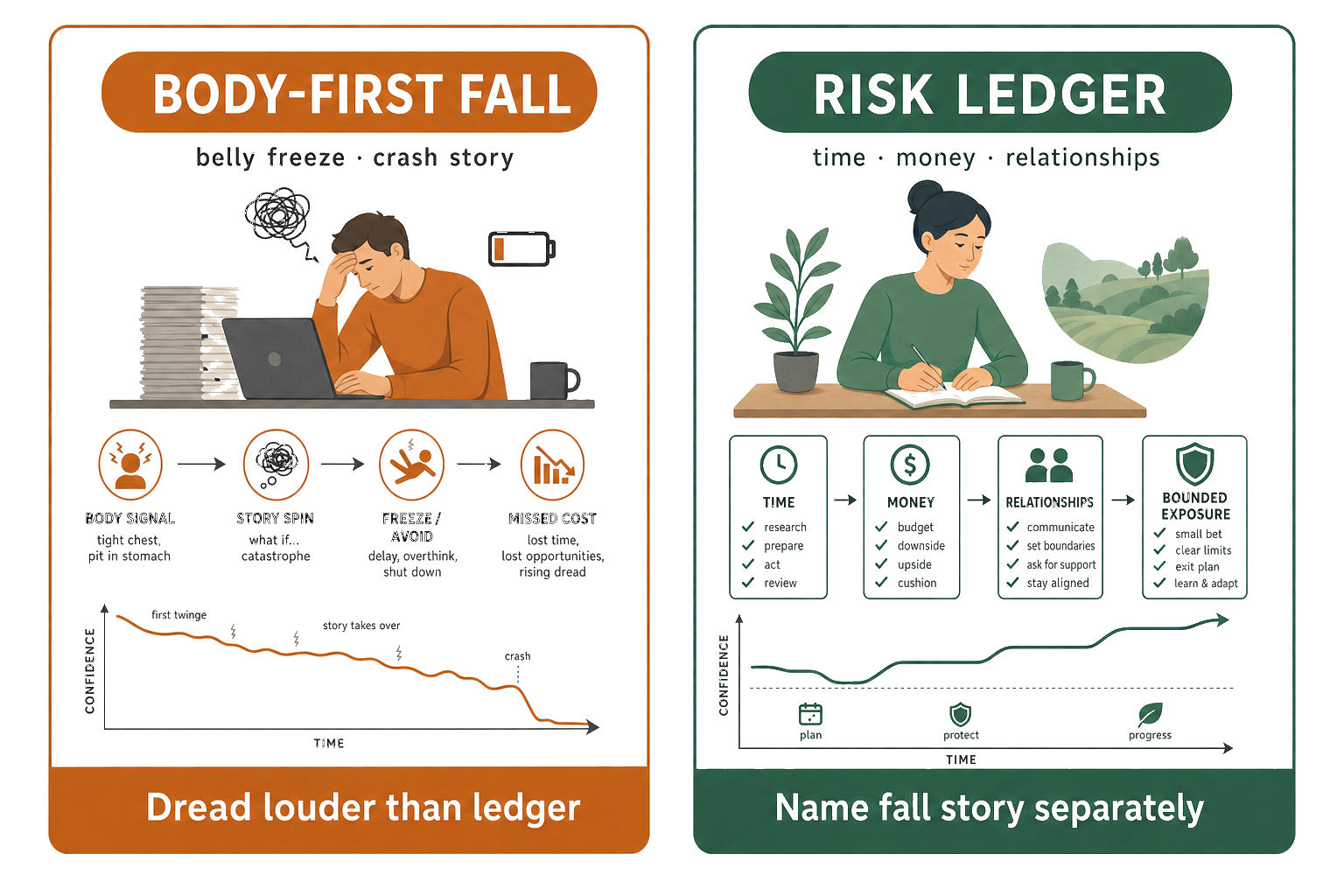
Body-first fall narrative versus late risk ledger — name the story separately. Pair Interoception · Ambition · Daring.
| Signal type | Typical content |
|---|---|
| Body-first | Belly contraction, freeze, heat — before spreadsheet |
| Fall narrative | Crash, humiliation, irreversible loss |
| Risk ledger | Often arrives late, if at all |
Pendulum with Daring: ambition pulls up, fall-fear pulls brake. Distinct from Projected regret (cognitive pre-refusal assigned to a future self). Right-sized Ecosystem changes reduce panic load; Fortitude and Tactical Stress train bounded exposure with stop rules.
Applications
When ambition work triggers belly contraction or freeze, name the fall story separately from a real risk list (time, money, relationships at stake). Pair body downshift with one micro-rep before full leap. Log interoceptive signal before rewriting the verdict (Interoception).
Sources
Cite
- Conroy, D. E. (2001). Progress in the development of a multidimensional measure of fear of failure: The Performance Failure Appraisal Inventory (PFAI). Journal of Sport and Exercise Psychology, 23(3), 290–305.
- Elliot, A. J., & Thrash, T. M. (2002). Approach-avoidance motivation in personality: Approach and avoidance temperaments and goals. Journal of Personality and Social Psychology, 82(5), 804–818.
Related doctrine
Interoception · Problems at the Height of Ambitions · Tactical Stress