Working definition
Rate the day’s training move on a 1–10 scale, at fixed times, so the body and brain receive feedback they can act on the next day.
How it works
What gets measured progresses. Without a score, the Battle Of the Week floats in a fog of “I think I tried.” With a calibration, you ends each day with a concrete number, a pattern across the week, and a delta to chase.
The protocol has three moves:
- One question, asked the same way every day. The question is built around the Battle’s true axis. The nuance matters: How comfortable was I being perceived as a troublemaker today? is different from How much of a troublemaker was I today?. The quality of the answer depends on the Quality of Questions.
- A trigger that does not depend on willpower. A phone notification at lunch, at end of day, or a recurring slot in the calendar. Two or three calibrations per day is enough — one before the exposure, one after, one at end of day.
- A weekly read. End of week, you look at the seven numbers, finds the pattern, and decides what to change for the next cycle.
Signature
The image is the 1–10 scale you cannot fake — Yann recurring: calibration is not optimism; it is naming where you are on the ladder before you argue with the critic — 2026-02-09.
More room passes mention this doctrine in replay narrative — search the Codex for Calibration or start from the latest entry on Weekly Sessions.
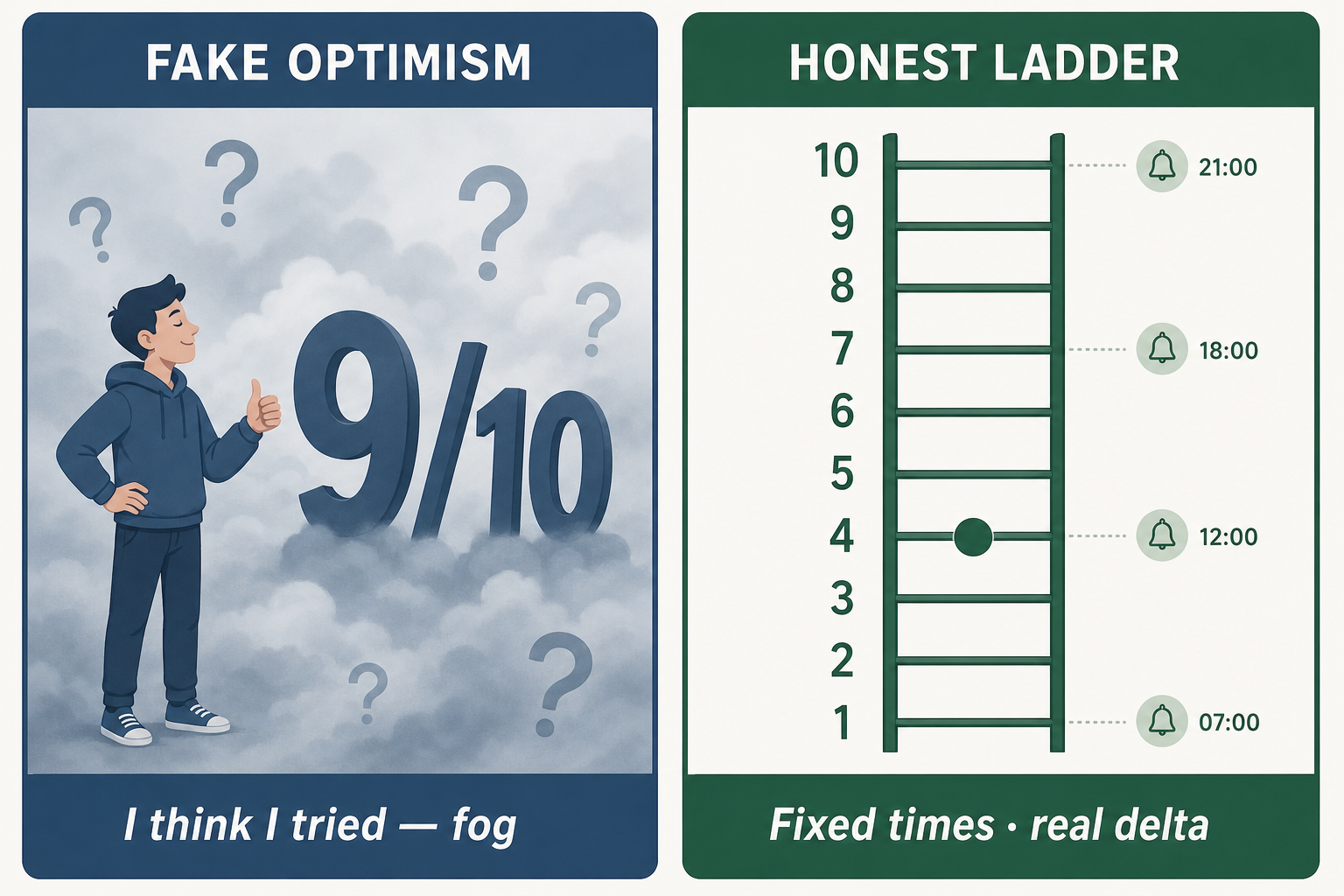
Fake optimism versus honest 1–10 ladder at fixed notification times. Your move: Your move this week.
Your move this week
This week’s micro-action (24–72 hours):
- Pick the one Battle question that matters this week.
- Set two phone notifications: one fifteen minutes before the exposure (preparation) and one fifteen minutes after (calibration).
- Friday evening, read the five numbers and ask: what do they tell me?