Working definition
Anchoring is the prepared ability to switch state on demand: observe the current state, activate the right anchor, and re-enter the internal condition required for the moment.
How it works
Anchoring is not motivation. Motivation waits for the right feeling. Anchoring prepares the conditions that let you create the right state when the feeling is absent.
The mechanism is a sequence:
- Observe the current state without being owned by it.
- Name the context: what state does this moment require?
- Activate a prepared anchor: music, clothing, scent, movement, phrase, breathing, posture, voice.
- Switch into action before the old state has time to negotiate.
The anchor has to be installed before it is needed. Yann’s electrician image is the rule: an electrician cannot fix the problem if the toolbox was never prepared.
Signature
The image is gesture, music, or scent that snaps the state back — paired with Conditioning on 2026-02-16: the anchor fires before the touriste monologue wins.
More room passes mention this doctrine in replay narrative — search the Codex for Anchoring or start from the latest entry on Weekly Sessions.
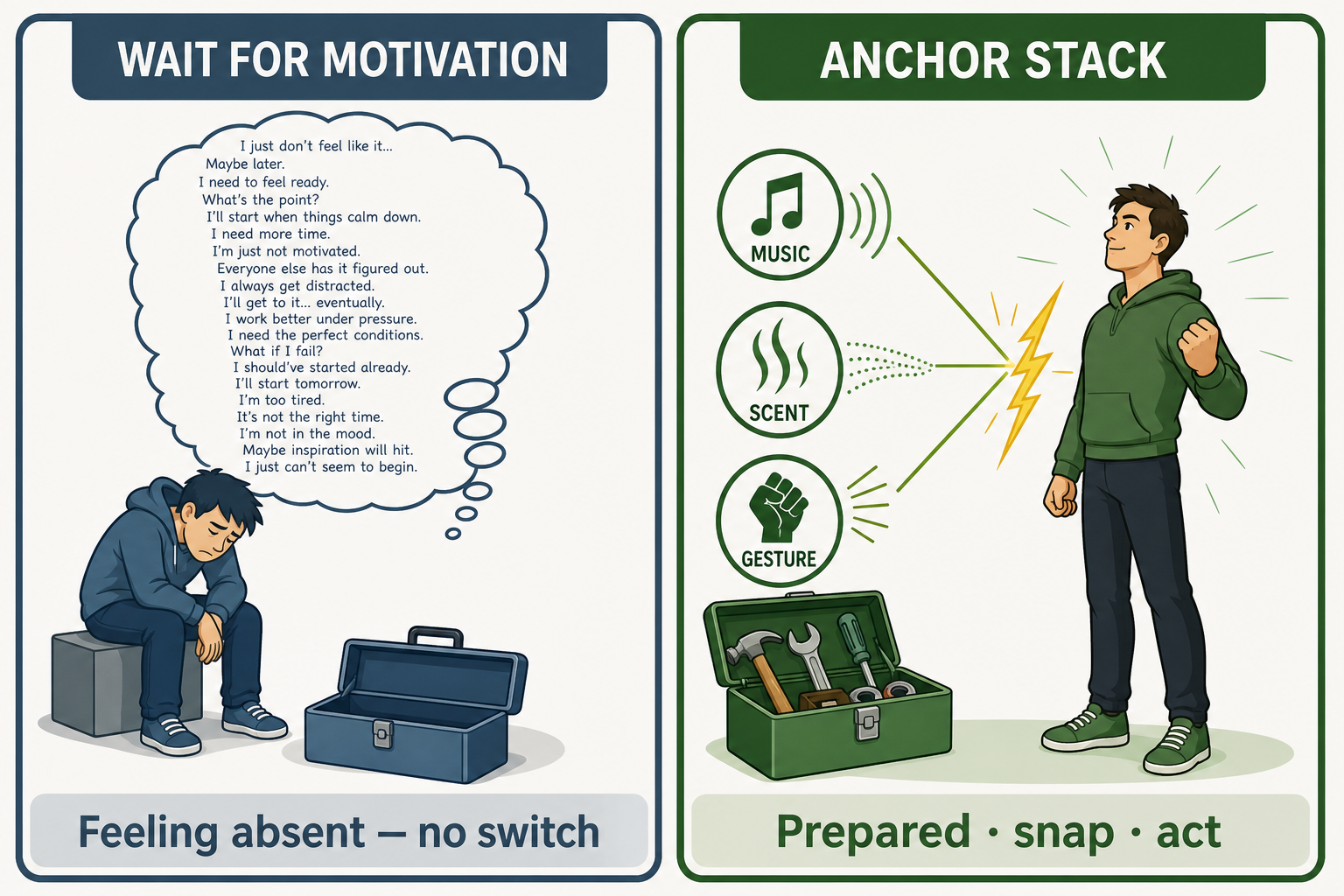
Wait for motivation versus prepared anchor stack — snap before the touriste monologue wins. Your move: Your move this week.
Your move this week
This week’s micro-action (24–72 hours):
- Build a three-anchor stack for one recurring context where you often wait for motivation.
- Choose one physical anchor, one sensory anchor, and one movement anchor.
- Use the exact same stack three times this week, then record what changed in the first two minutes after activation.