Definition
Self-esteem is a person’s overall evaluation of their own worth — a felt judgment of being adequate, capable, and worthy of respect.
Origin
William James (1890) framed self-esteem as a ratio of successes to pretensions: raise your achievements or lower your claims and the feeling rises. Morris Rosenberg (1965) operationalised it as a global attitude toward the self and built the Rosenberg Self-Esteem Scale, still the standard measure. Nathaniel Branden later argued self-esteem is earned through practices — living consciously, self-responsibility, integrity — rather than received as praise.
Mechanism
Self-esteem behaves like a running balance.
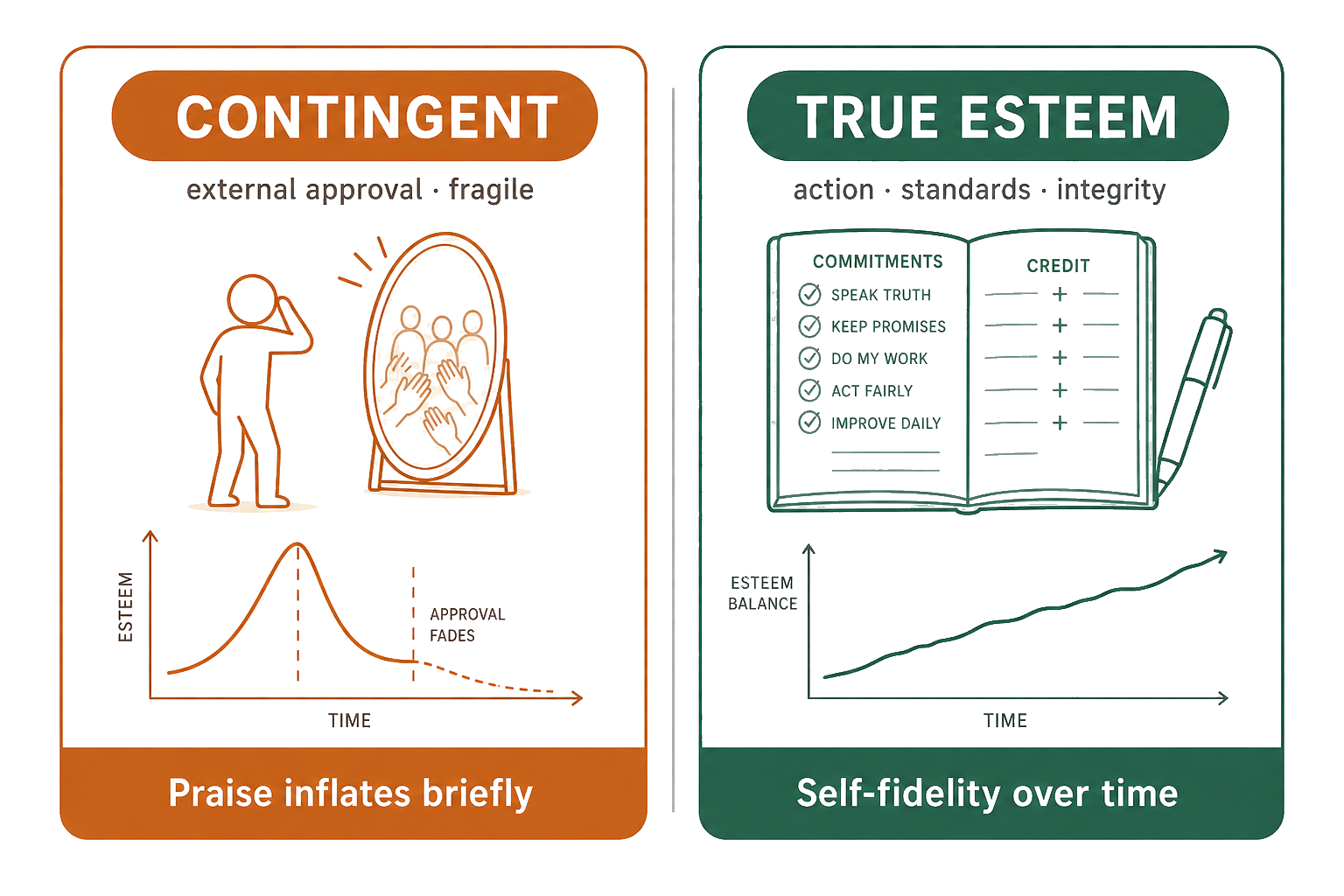
Contingent approval versus self-fidelity ledger — stable esteem from kept standards. Pair Esteem Matrix.
Each action consistent with one’s own standards credits the account; each breach of a self-made commitment debits it. Self-determination theory distinguishes true self-esteem, which rests on autonomous, value-aligned action, from contingent self-esteem, which depends on external approval and is therefore fragile. Because the judgment is internal, the most reliable lever is integrity over time, not reassurance from others.
Applications
- Behaviour change that ties new habits to identity raises esteem by accumulating evidence of self-fidelity.
- Approval-seeking inflates contingent esteem briefly while eroding the stable kind.
- Graded self-reading (rating and tracking esteem as a level) makes an otherwise vague state trainable.
Sources
Cite
- James, W. (1890). The Principles of Psychology. Henry Holt.
- Rosenberg, M. (1965). Society and the Adolescent Self-Image. Princeton University Press.
- Branden, N. (1994). The Six Pillars of Self-Esteem. Bantam.
- Deci, E. L., & Ryan, R. M. (1995). Human autonomy: The basis for true self-esteem. In Kernis (Ed.), Efficacy, Agency, and Self-Esteem. Plenum.