Definition
A diffuse neural network in the brainstem that acts as a sensory gatekeeper: it decides which signals reach awareness and which are filtered out, calibrated by what the system is currently looking for.
Origin
Moruzzi and Magoun (1949) showed that stimulating the reticular formation could wake a sleeping animal and that lesioning it produced coma — wakefulness as an actively maintained process. Simons and Chabris (1999) demonstrated inattentional blindness: observers counting basketball passes often miss a fully visible unexpected agent (the “gorilla”), because attention sets the filter, not retinal input alone.
Mechanism
The ascending reticular activating system sets a salience threshold. Stimuli that match current goals, instructions, or identity-relevant threats cross into consciousness; the rest never become conscious experience. Effects include: (1) priming — you notice what you are set to find; (2) blindness — you miss what you are not primed for; (3) attribution error — the report reflects the filter as much as the scene.
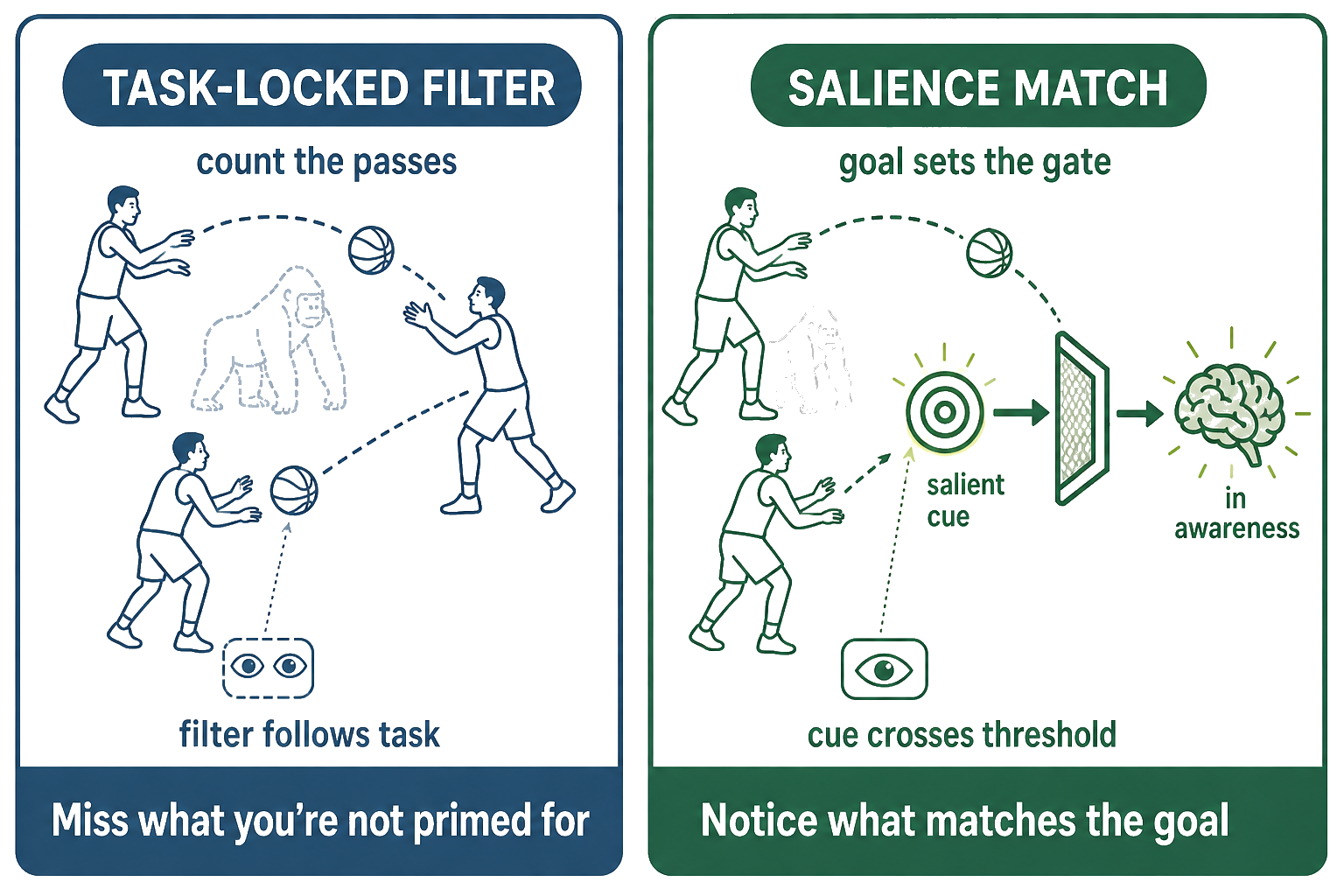
Task-locked filter misses the unprimed cue — salience match lets the goal-crossing signal through. Not a permanent dial; goal-directed gating.
Inattentional-blindness demonstrations (Simons & Chabris, 1999) depend on task load and stimulus similarity — not every unattended object is missed — so pop-psychology “RAS tuning” oversimplifies brainstem anatomy; the useful claim is goal-directed attention gating, not a single dial that permanently rewires perception.
Applications
Use explicit focus objects (one question, one metric, one relationship) when you need the environment to “offer” data. Place cues where the filter will catch them (lock screen, calendar title, physical object). Expect disagreement in shared rooms — different filters, different realities. After stacking wins, a single social-comparison cue can capture the filter and wipe the stack — pair with It will be better when when future-conditional distress follows.
Sources
Cite
- Moruzzi, G., & Magoun, H. W. (1949). Brain stem reticular formation and activation of…. Electroencephalography and Clinical Neurophysiology, 1(4), 455–473
- Simons, D. J., & Chabris, C. F. (1999). Gorillas in our midst: Sustained inattentional…. Perception, 28(9), 1059–1074
- Mack, A., & Rock, I. (1998). Inattentional blindness. MIT Press