Working definition
The reactions of other people — especially others in the room — are not noise: they are a feedback signal about which version of your identity is currently being broadcast.
How it works
You never see your identity directly. You see it bounced back by the people, contexts, and sensations around you. Three kinds of mirror operate:
- Resonant mirror. Something you say lands with someone else in the room because both share a strate of work. The recognition is information: the strate is real and active.
- Distorting mirror. Funhouse echo. You hear your voice come back amplified, deformed, or shamed. The deformation says nothing about your truth; it says something about the optic that captured it. Useful for noticing the filter.
- Blind-spot mirror. The reaction you did not expect. A sentence that lands somewhere unexpected, a behaviour that someone else names before you did. The information here is the highest because you could not have generated it alone.
The implication for the Club is operational: use the group not as an audience but as a high-resolution mirror system. On your Dashboard, the Mirror block is Yann’s personalised read of the same signal — see Members zone · Mirror.
Signature
The image is the bat with sonar and the funhouse mirrors at the fair — Yann on 2026-02-16: the same body looks tall, short, wide, thin; you read the optic, not just the image. One realises oneself through others — by reading the echo, not copying it.
More room passes mention this doctrine in replay narrative — search the Codex for Identity Mirror or start from the latest entry on Weekly Sessions.
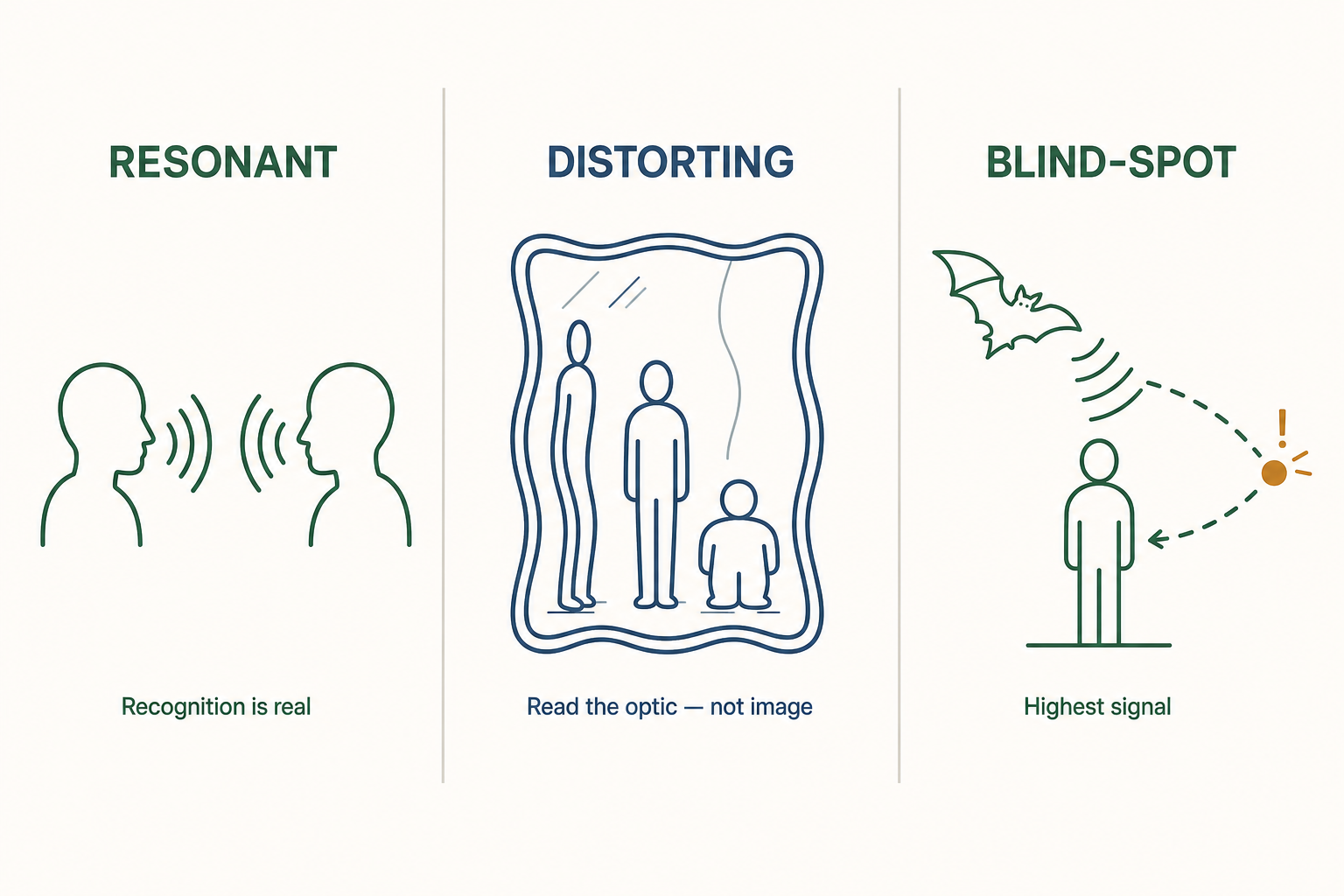
Three mirror types — resonant, distorting, blind-spot; read the echo, not the copy. Bat + funhouse detail stays in prose. Your move: Your move this week.
Your move this week
This week’s micro-action (24–72 hours):
- After every session and every Battle exposure, write down one sentence: what did the room reflect back to me about who I am right now?.
- Do not analyse.
- Just notice the echo.