Working definition
Being perceived as a troublemaker is the permission to let others experience discomfort, irritation, or resistance when the mission requires asking, insisting, negotiating, relaunching, or taking space.
How it works
You often block action not because the action is technically difficult, but because the action threatens the identity of being easy, nice, discreet, acceptable, or non-intrusive.
Business and leadership repeatedly require behaviors that can be read as annoying:
- relaunching a prospect;
- asking for a commitment;
- negotiating a price;
- insisting at the right moment;
- changing one’s mind at the counter;
- taking visible leadership.
The training is not to become permanently difficult. The master masters opposites: able to be smooth, able to disturb; able to join the feet, able to do the splits.
Signature
The image is permission to be the troublemaker — Johan on 2026-02-09: I want to be perceived as a troublemaker this week. Pascal gives the word; Yann turns it into identity permission when the mission requires discomfort.
More room passes mention this doctrine in replay narrative — search the Codex for Being Perceived as a Troublemaker or start from the latest entry on Weekly Sessions.
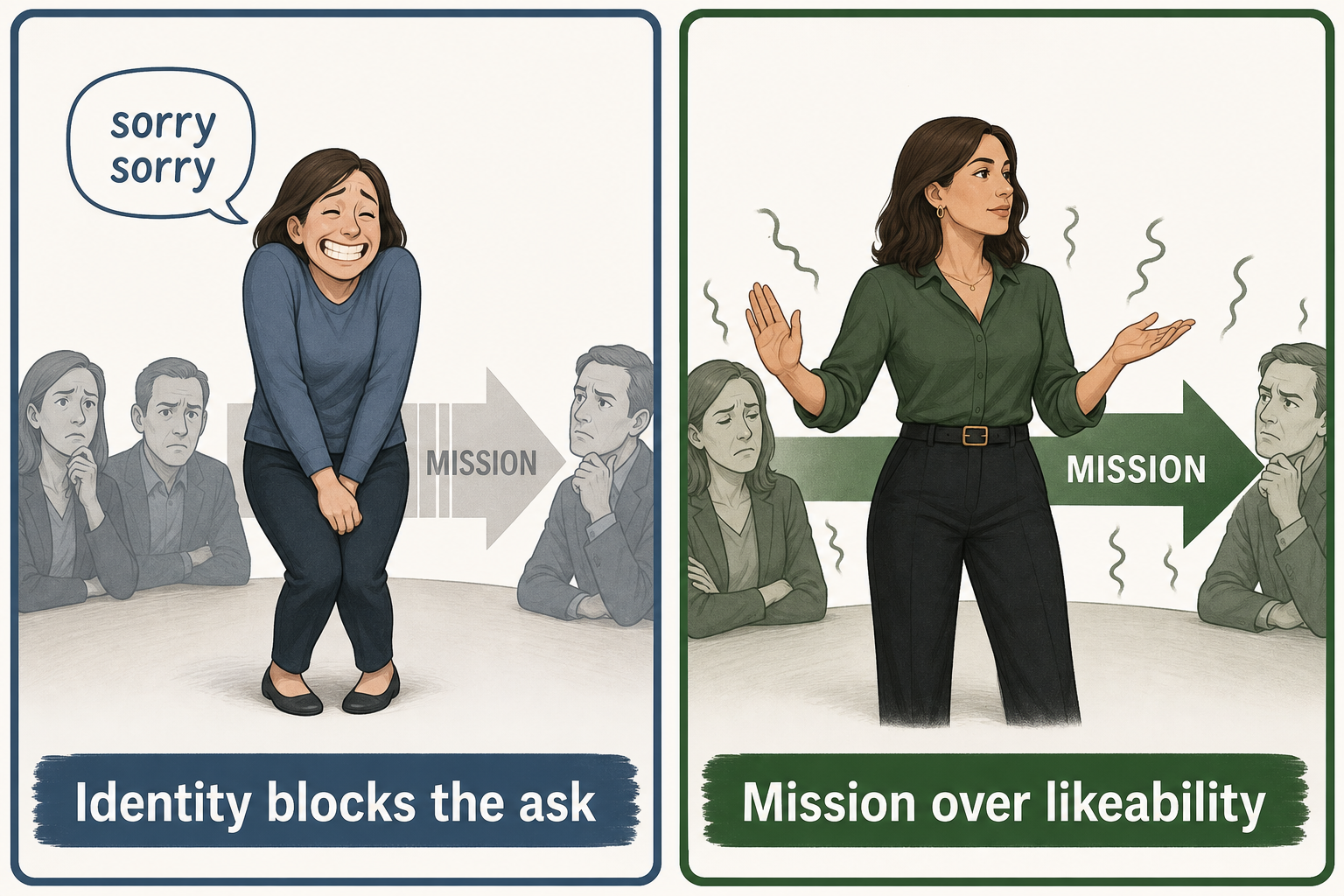
Please the room versus permission to insist when the mission requires discomfort. Your move: Your move this week.
Your move this week
This week’s micro-action (24–72 hours):
- Choose one clean, ethical action where the fear is not the action itself, but how you might be perceived.
- Do it once.
- Then write the actual cost and the imagined cost.
- Keep the delta.
The troublemaker matrix
The fear of being annoying stays unworkable while it is one fused word. The matrix turns it into a trainable map — three columns and a moving baseline:
- Levers (levels 1–10). The concrete reps that let you practise in a given context, with a given type of person — ask the time, ask directions, ask a shop assistant, order awkwardly in a bakery, negotiate a discount, call a stranger. The same act splits into sub-levels by context: a grandmother versus a group of strangers is not the same level.
- Definition. The story you tell yourself in that moment. Stop writing annoying or bothersome; find the precise words for what you feel the other person reflects back — because the words you use sharpen your thinking (Personal Definitions). This column is where the real nuance lives.
- Field data. What you actually collected after a rep — the precise example: his name was Pierre, red t-shirt, people around us, and here is exactly what it sent back. Precise examples in each cell, not abstractions.
Run a baseline through the grid like a red thread: the level you are at ease with today. As you train, it rises — the same way a baseline moves with how you manage it. Clarity is power (Personal Definitions): the clearer the grid, the more you can train it, share it, and screen-share it to others.