 | You separate everyday self from task self on purpose — borrowed permission, not denial. Trigger + avatar + context mark entry and exit so the role does not colonise home life. Herman codified what performers already did; Atlas holds the mechanism — this note holds the 2019 book. Todd Herman (2019) · HarperCollins · ISBN 9780062838636 |
|---|
Mechanism card ^mechanism-card
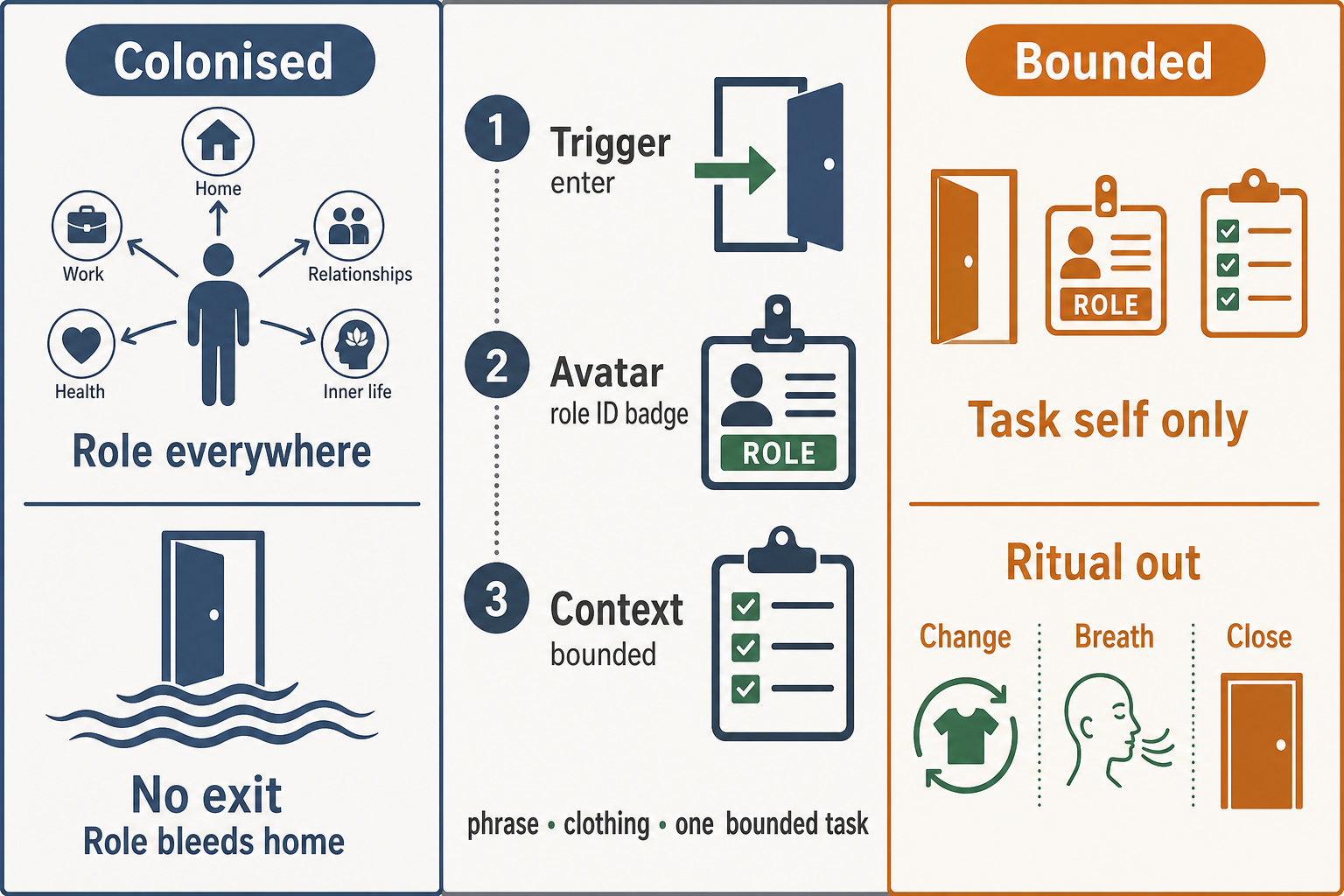
Spatial map — colonised role (everywhere, no exit) versus bounded task self with deliberate ritual out. Science: The Power of the Alter Ego. Your move: How.
Key principles
- Purposeful separation — Split everyday self from task self on purpose — borrowed permission for high-stakes performance, not denial of identity.
- Trigger + avatar + context — Entry ritual (cue, named alter ego, arena) marks when the role starts — exit ritual prevents bleed into home life.
- Borrowed permission — A crafted persona can access courage, focus, or boundaries the default self blocks — tool, not fraud.
- Performers’ logic codified — Athletes and artists already used alter egos — Herman names the mechanism for operators and leaders.
- Containment — The alter ego serves one domain — without boundaries, the mask colonizes relationships it was never meant to run.
- Doctrine pairing — Club teaches the move in alter-ego concept work; this file holds the 2019 book spine for citation.
Core science
Herman codifies deliberate persona separation — trigger, avatar, and bounded context so borrowed permission does not colonize home identity. See Deliberate persona separation on the Atlas shelf for the mechanism map.
Application
Reach for this volume when high-stakes performance needs borrowed permission with a clear exit — cockpit role, pitch, hard conversation — without letting the task mask run home life.