Definition
An alter ego is a named, designed self you invoke for a role — permission borrowed from a future or braver version, not denial of who you are.
Origin
Performance psychology. Athletes and performers have long used stage personas. Todd Herman’s The Alter Ego Effect (2019) codified trigger + avatar + context for non-athletes. Atlas cites the mechanism, not the book as doctrine.
Mechanism
- Separate the survival self from the task self (“not-me” projection) — the avatar for one bounded context.
- Trigger entry (clothing, phrase, location — the pilot’s “cockpit role” in performance framing).
- Exit deliberately — change, breath, or close-and-release — so the alter ego does not colonise home life.
Failure mode: using alter ego to avoid truth work instead of crossing Identity Gap.
Mechanism card
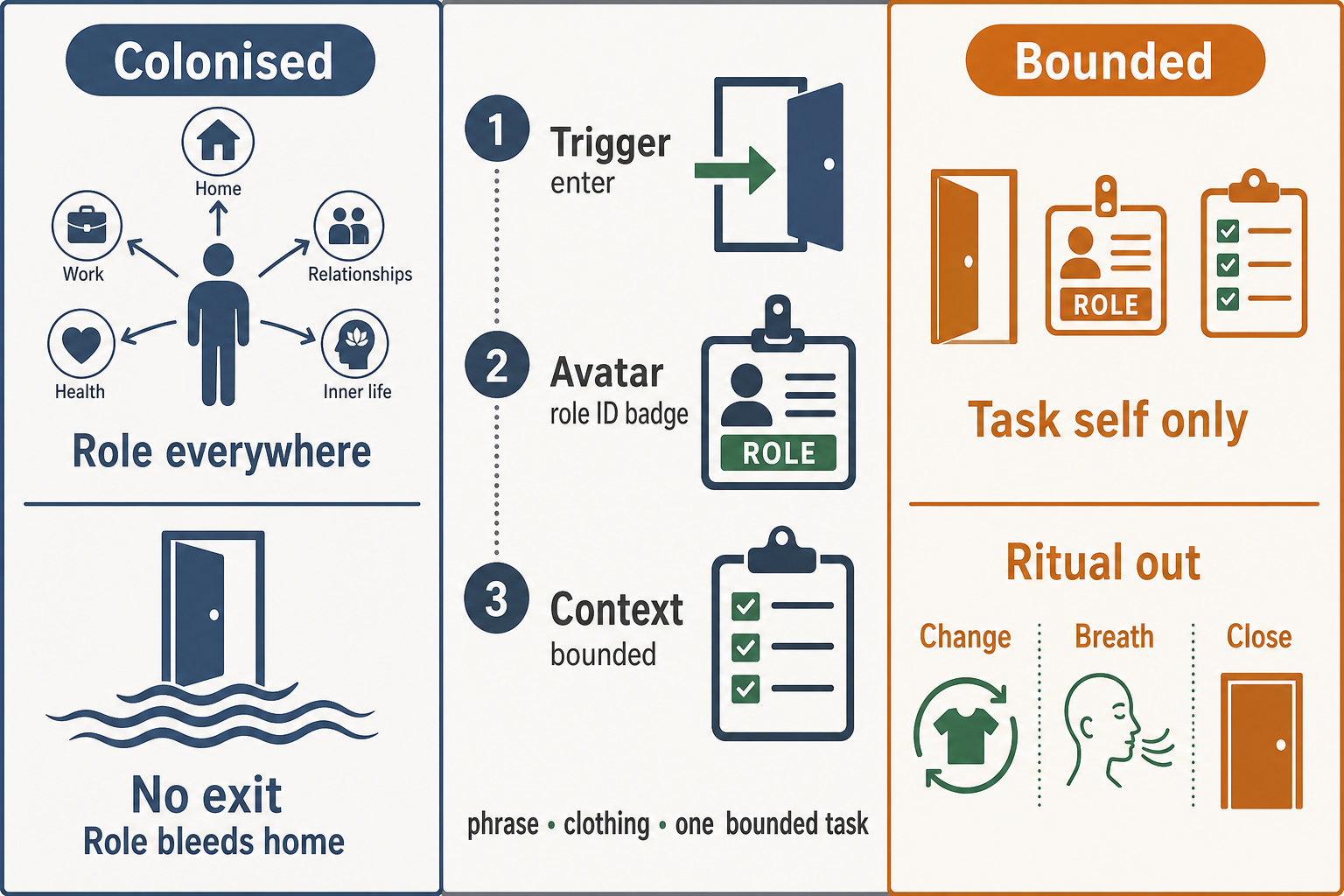
Spatial map — colonised versus bounded; trigger · avatar · exit. Shelf card: The Alter Ego Effect · move in book How.
Sources
Cite
- Herman, T. (2019). The Alter Ego Effect. HarperCollins
- Goffman, E. (1959). The presentation of self in everyday life. Anchor Books
Adjacent
Applications
Vision design through a future operator persona who is not trapped in today’s fear budget. Pair with Be Your Real Boss: authority is borrowed, then integrated into the Manual. Deliberate alter-ego framing supports niche and magnetism without confusing costume with avoidance of weakness.