Definition
Dopamine baseline is the habitual level of stimulation your nervous system treats as normal — when the baseline rises, the same Netflix, sugar, or workout hit produces less lift unless you deliberately lower input for a period.
Origin
Popular detox language maps onto two distinct literatures: Schultz’s reward prediction-error account (phasic dopamine tracks surprise relative to expectation, not a simple pleasure meter) and addiction neuroscience (chronic high-intensity rewards can blunt response to ordinary incentives).
Mechanism
Repeated reward spikes (screen, sugar, intensity) train higher expectation — the same cue produces a smaller prediction-error signal, so ordinary rewards feel flat. Schultz describes a two-component phasic response: brief unspecific detection, then valuation tied to subjective utility. Volkow and colleagues note that in addiction, blunted dopaminergic response can reduce motivation from everyday non-drug rewards — parallel to the coaching metaphor of a raised line. A structured input reduction window is operational shorthand for resetting salience; it is not a literal neurochemical washout timetable.
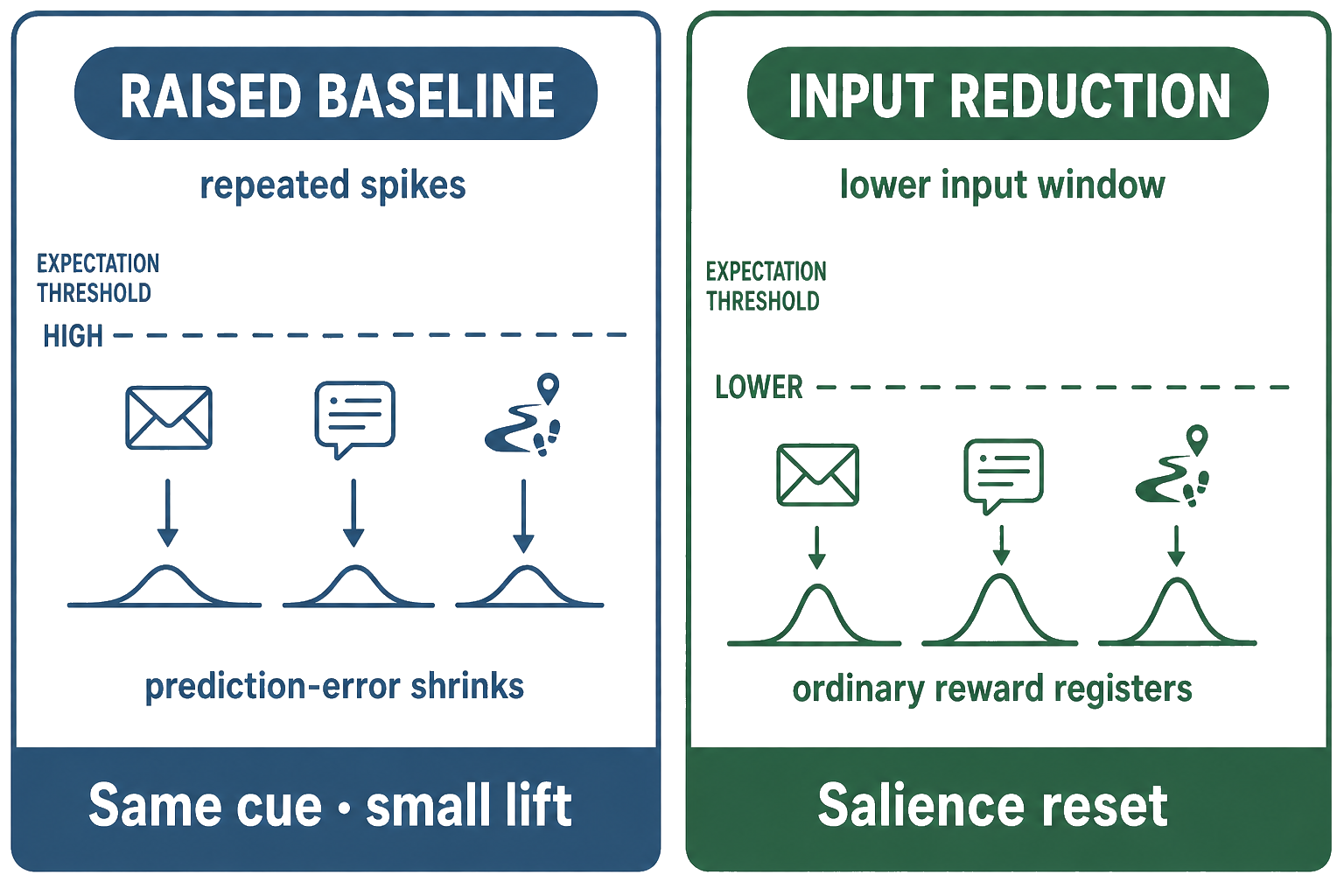
Raised expectation flattens ordinary cues — input reduction resets relative salience. Operational map: Manual Of Me.
Schultz separates this phasic prediction-error signal from tonic dopamine levels that sustain ongoing behaviour — so the coaching “baseline” is a salience-and-expectation map, not a single washout curve. The blunted-everyday-reward pattern is best documented in substance-use disorder models (Volkow et al.), not in validated screen-or-sugar detox protocols. Reviews of the dopamine theory of addiction also caution that striatal dopamine blunting and release patterns vary by drug class — the simple “all reward runs on one dopamine dial” story does not generalize cleanly across addictions (Nutt et al.).
Applications
Map default stimulants, one removed for a test window, and what reset you are measuring — measurement of your line, not moralism. Long-form neurochemistry: The Molecule of More · Behavioral change canon pillar 3.
Related doctrine
Manual Of Me · Be Your Real Boss
Sources
Cite
- Schultz, W. (2016). Dopamine reward prediction-error signalling: a two-component response. Nature Reviews Neuroscience, 17(3), 183–195.
- Volkow, N. D., Koob, G. F., & McLellan, A. T. (2016). Neurobiologic advances from the brain disease model…. New England Journal of Medicine, 374(4), 363–371
- Nutt, D., Lingford-Hughes, A., & Erritzøe, D. (2015). Dopamine theory of addiction: 40 years of highs and lows. Nature Reviews Neuroscience, 16(5), 305–312.