Definition
People-pleasing is organising behaviour to obtain approval or avoid disappointing others — even when the calendar cost hits your stated priority.
Origin
Documented across clinical psychology and social psychology as approval-seeking behaviour — over-adaptation, difficulty saying no, and conflict avoidance even when costs are high.
Mechanism
External praise (you are so committed) can reinforce an engaged-good-person self-image. Skipping a priority then feels like identity failure until friction → deliberate choice replaces autopilot. Côté and Moskowitz’s event-sampling work links agreeableness to when conciliatory interpersonal moves co-occur with positive affect — high agreeableness can make boundary-setting feel like self-betrayal even when the calendar cost is high.
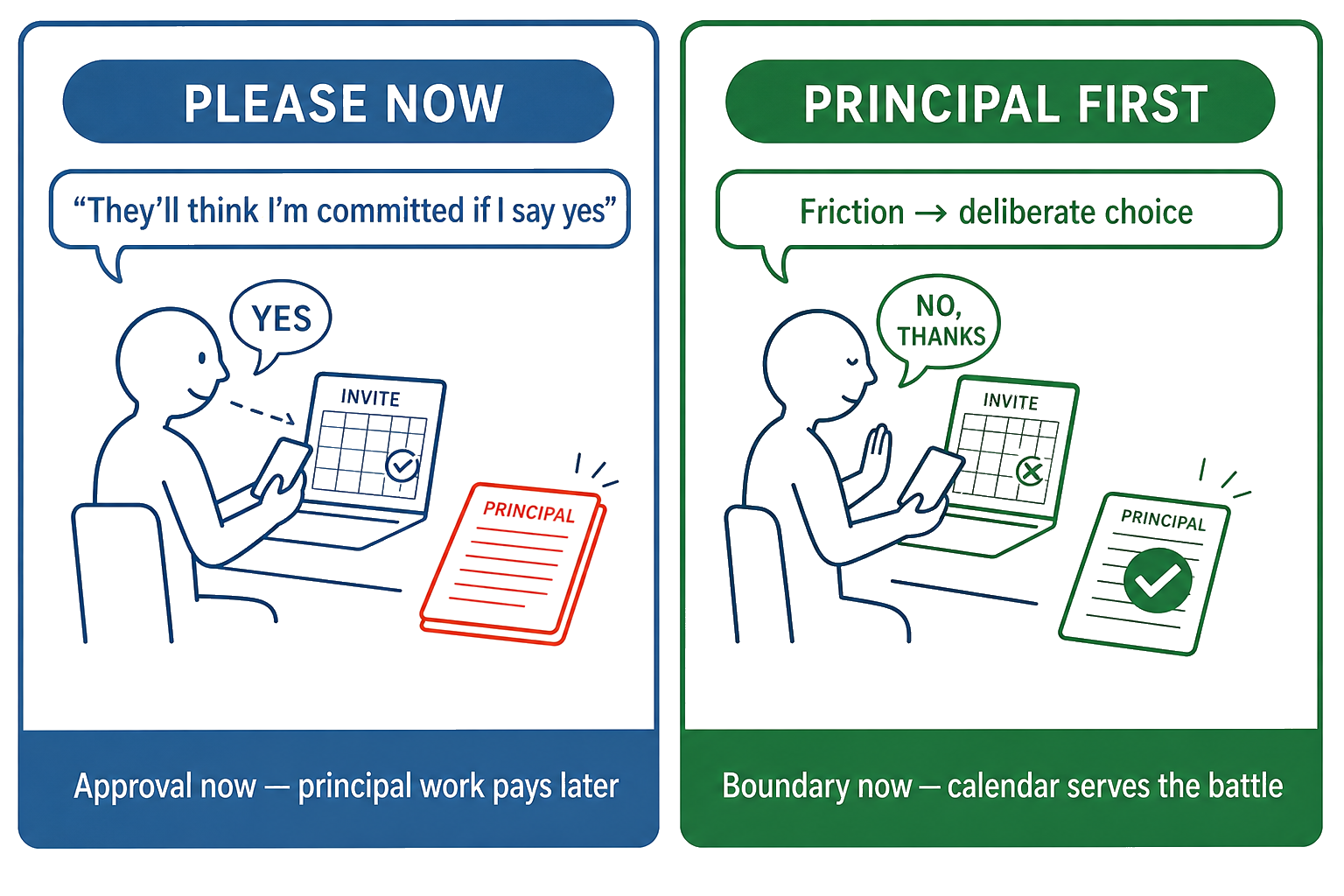
Please now versus principal first — boundary serves the battle. Pair FOPO · Identity Gap.
Applications
Useful in boundary work, fear-of-disapproval, and calendar audits where stated priorities lose to likeability.
Sources
Cite
- Millon, T., & Davis, R. (1996). Disorders of personality: DSM-IV and beyond (2nd ed.). Wiley
- Côté, S., & Moskowitz, D. S. (1998). On the dynamic covariation between interpersonal…. Journal of Personality and Social Psychology, 75(4), 1032–1046