Working definition
The Esteem Matrix is a 1–10 reading grid for self-worth — each level paired with the behaviour that earns it and the smallest move that raises it by one rung.
How it works
You cannot train what you cannot read. Low esteem is too coarse to act on; a graded matrix turns the felt state into three usable pieces: the level (1–10), the behaviour that holds it there, and the one rung you can climb this week.
It belongs to the same family as the troublemaker grid (see Being Perceived as a Troublemaker) and the responsibility grid — a reading grid applied to a dimension you used to treat as a mood. Esteem here is not praise from outside; it is the running balance of fidelity to yourself. Every kept standard credits the account; every breach of a commitment to the version of yourself you are building debits it — the mechanism the long effort protects, grounded in self-esteem.
Build it the way you build any matrix in the Club: harvest the lived data all week with Voicenotes, then let the grid assemble from real reps rather than authoring it by force.
Signature
Yann’s stated intent: a 1–10 esteem matrix sitting alongside the troublemaker matrix and the responsibility matrix — the same WOW each time, a number you can act on instead of a feeling you sit inside.
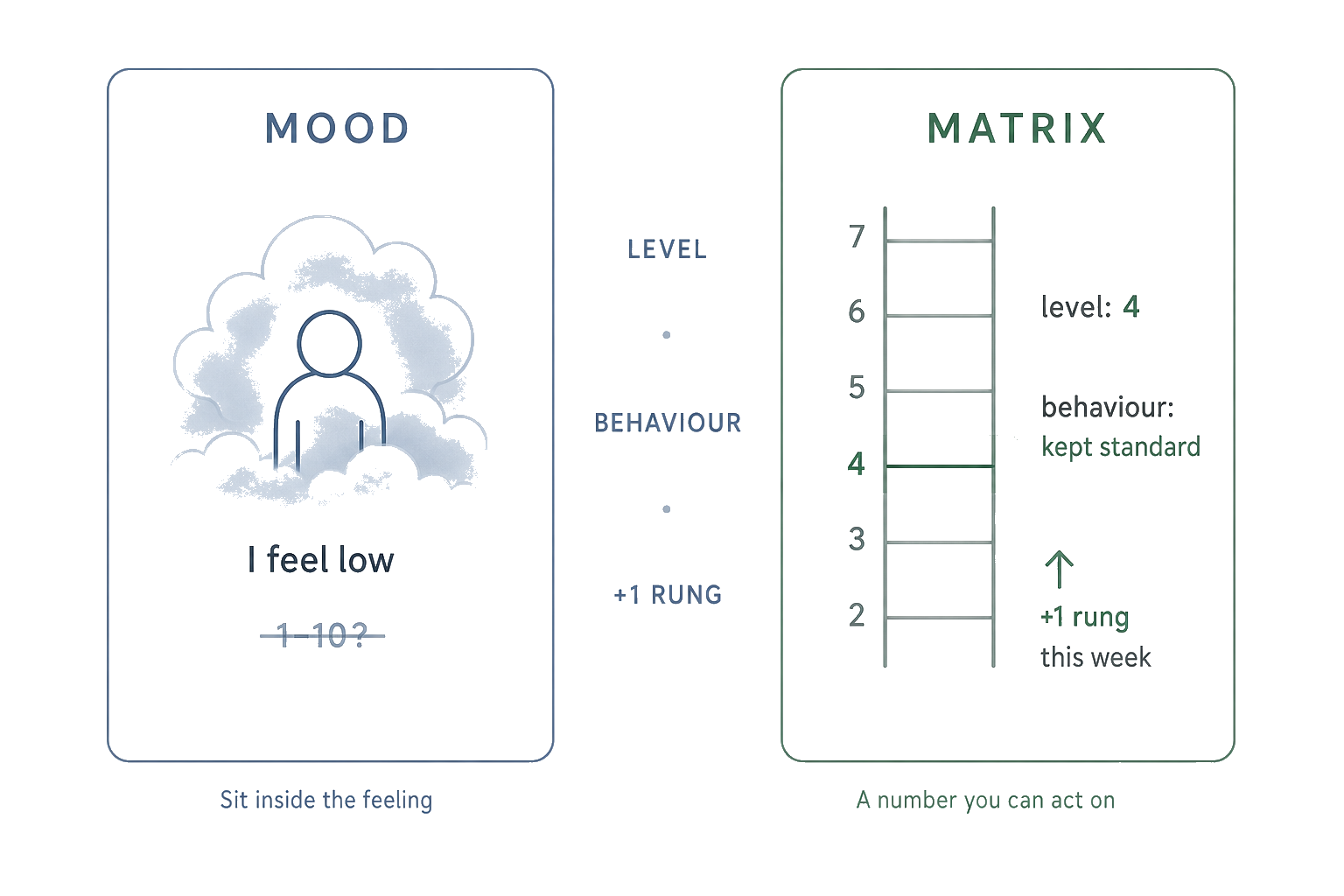
Mood you sit inside versus a graded matrix — level, behaviour, +1 rung. Route log: Voicenotes harvest. Your move: Your move this week.
Your move this week
Rate your esteem 1–10 today. Write the single behaviour that would move it up one rung — then run that behaviour once before the next session.
Adjacent
Self-esteem
Long Effort
Reading Grid
Being Perceived as a Troublemaker
Personal Definitions