Working definition
A Reading Grid turns one fuzzy identity story into measurable reps: context, level, and body signal captured in real time.
How it works
Pick one edge (for example, “troublemaker” or “reliability”), then map 8-10 levels of intensity across recurring contexts (team, client, family, public). Each rep is harvested quickly: what happened, which level, what the body did, what was chosen next. The grid shifts identity training from global self-judgment to observable data.
Signature
The image is the troublemaker matrix — eight to ten levels across contexts, filled by hourly harvest while memory is still honest, not by an end-of-week rewrite that smooths what happened. Yann on 2026-05-27: what gets measured progresses — the grid turns a flat identity story into trainable reps.
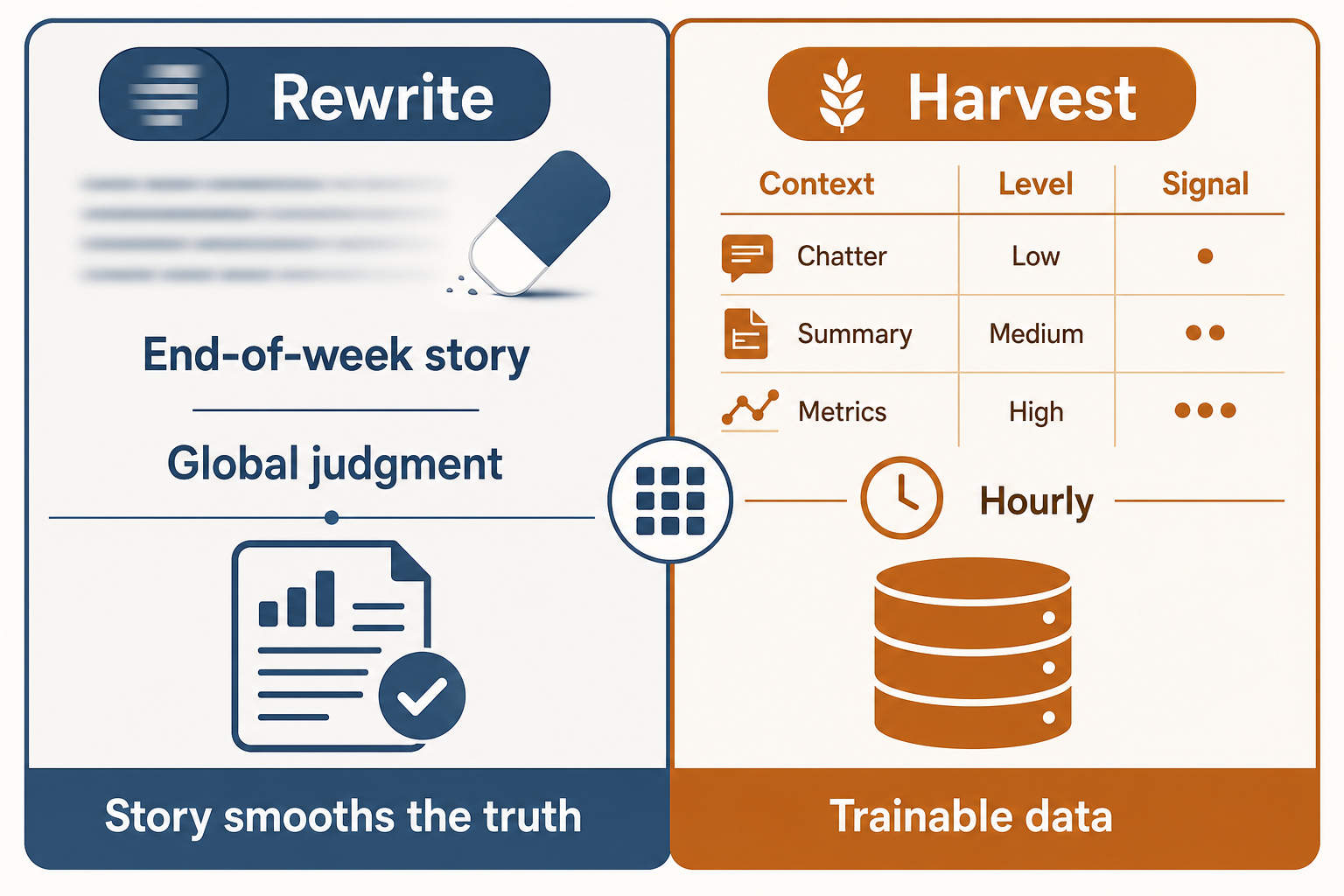
Spatial map — rewrite (end-of-week story, global judgment) versus harvest (3-row grid: context · level · body signal, captured hourly). Your move: Your move this week.
The WOW is Johan’s battle edge in the same block: levels, context, and reversibility replace I am not that person with data you can read.
More room passes mention this doctrine in replay narrative — search the Codex for Reading Grid or start from the latest entry on Weekly Sessions.
Your move this week
This week’s micro-action (24–72 hours):
- Create one 3-row starter grid: context, level (1–10), body signal.
- Set hourly harvest prompts on your phone for three waking days.
- Capture three reps before the next session — one line each, no narrative polish.
- Name which identity edge the grid tracks (troublemaker, reliability, or your Battle word).
- Friday: read the grid aloud — if every level looks the same, sharpen the contexts.