Definition
Self-image is the relatively stable picture a person holds of who they are — the identity template that perception, emotion, and action tend to organize around.
Origin
Maxwell Maltz (1960) coined the popular psycho-cybernetic frame after cosmetic surgery: patients who looked different but still felt like themselves showed that appearance change does not automatically rewrite identity. Morris Rosenberg’s Society and the Adolescent Self-Image (1965) used the same term sociologically — how reference groups mirror back a picture of the self during development — before operationalising global self-esteem as a measurable attitude. The two traditions overlap in language but not in mechanism: Maltz stresses steering toward a dominant picture; Rosenberg stresses evaluated worth inside social fields.
Mechanism
Self-image behaves like a dominant reference picture — not a wish list on paper.
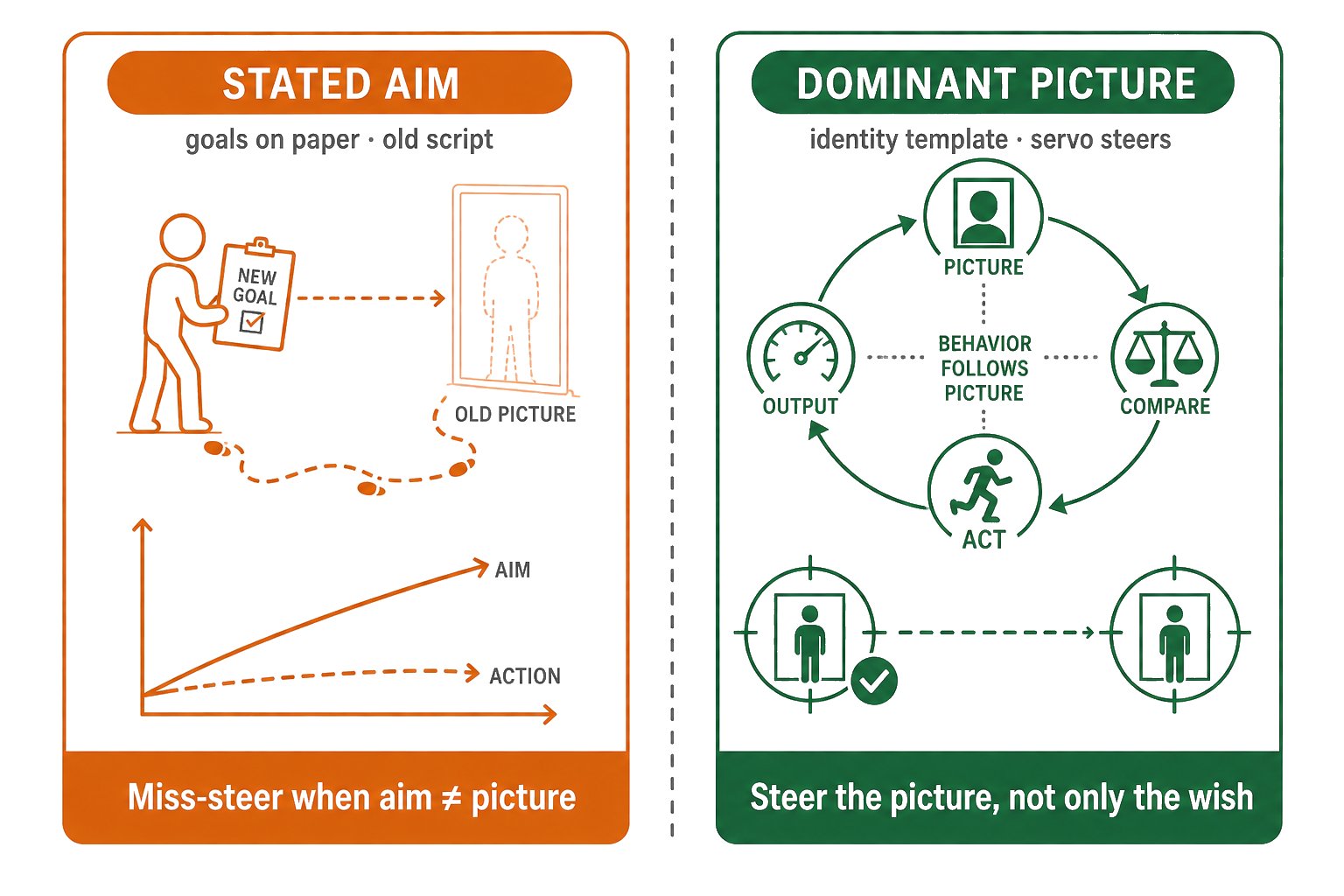
Stated aim versus dominant picture — behavior tracks the template you inhabit, not only the wish list. Pair Three Types of Imagery.
Maltz’s servo metaphor: the mind-body system miss-steers when stated aims conflict with the picture you actually inhabit; worry and vivid catastrophe rehearsal train the same channel as helpful mental simulation (Imagination as Reality). Self-esteem is a separate ledger — a running judgment of worth — that can rise or fall while the underlying picture stays fixed. Performed identity is the version curated for applause; when it diverges from the picture you privately hold, behavior feels incoherent until one side updates. Rosenberg’s Rosenberg scale measures global self-worth, not the full content of identity — useful baseline, not a map of the picture itself.
Maltz’s cybernetic vocabulary is clinical observation and success literature, not literal engineering proof — treat it as a steering metaphor, then ground change in vivid rehearsal, obstacle processing, and repeated receipts that match the new picture.
Example
You write a crisp Battle on Sunday: three outreach calls before Wednesday. Monday at 10:00 you have a clear slot — and you reorganize the inbox instead. The stated aim is on paper; the dominant picture still reads competent helper who never imposes — so the body picks a move that keeps that picture safe. Your self-esteem ledger can stay green (I’m working hard) while the picture keeps steering the miss. That is B1 miss-steer — you acted from the old identity picture, not from the real move you declared.
Applications
- When you declare a new aim but the body executes the old script, inspect the dominant picture, not only the goal statement.
- Mental rehearsal updates self-image when simulation is vivid, sequenced, and tied to real obstacles — not when it is empty affirmation.
- Identity interventions (skills, appearance, role change) stall until the picture they require is rehearsed and evidenced.
- Distinguish mood, self-esteem, and self-image before diagnosing friction — three different levers.
Sources
Cite
- Maltz, M. (1960/2002). Psycho-Cybernetics. Prentice Hall.
- Rosenberg, M. (1965). Society and the adolescent self-image. Princeton University Press.
- Goffman, E. (1959). The presentation of self in everyday life. Anchor Books.
Related doctrine
Three Types of Imagery · Identity Gap
Adjacent
Self-esteem · Performed identity · Imagination as Reality · Psycho-Cybernetics · Identity · Goal linkage