Definition
The Rosenberg Self-Esteem Scale (RSES) is a 10-item self-report questionnaire measuring global self-worth, and the most widely used instrument for self-esteem in research.
Origin
Developed by the sociologist Morris Rosenberg and introduced in his 1965 book Society and the Adolescent Self-Image. It was designed for large-scale survey research and became the standard measure against which later self-esteem instruments are compared.
Mechanism
The scale presents ten statements — five positively worded (“I feel that I have a number of good qualities”), five negatively worded (“At times I think I am no good at all”) — answered on a four-point agreement scale.
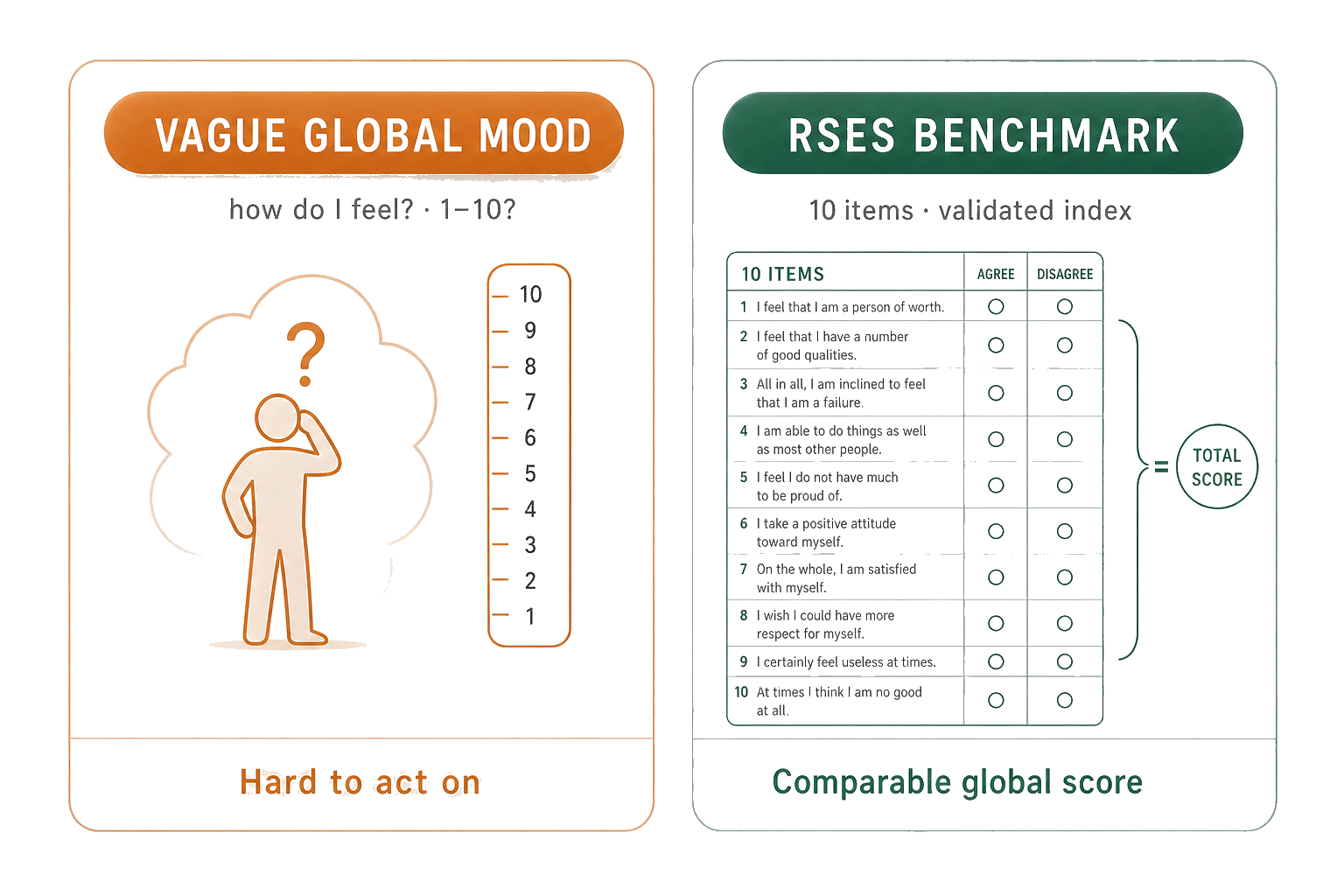
Vague global mood versus validated 10-item RSES index. Pair Esteem Matrix · Self-esteem.
Scores combine into a single global index of self-esteem. Its balance of positive and negative items guards against acquiescence bias, and decades of psychometric work confirm strong reliability and validity, which is why it remains the benchmark. Like any global self-report it captures felt self-worth at a moment, not the underlying sources of it.
Applications
- A quick, validated baseline and re-test for tracking self-esteem over time.
- The common yardstick that lets studies of self-esteem be compared.
- A measurement counterpart to the qualitative work of building self-worth.
Sources
Cite
- Rosenberg, M. (1965). Society and the adolescent self-image. Princeton University Press.
- Gray-Little, B., Williams, V. S. L., & Hancock, T. D. (1997). An item response theory analysis of the Rosenberg Self-Esteem Scale. Personality and Social Psychology Bulletin, 23(5), 443–451.