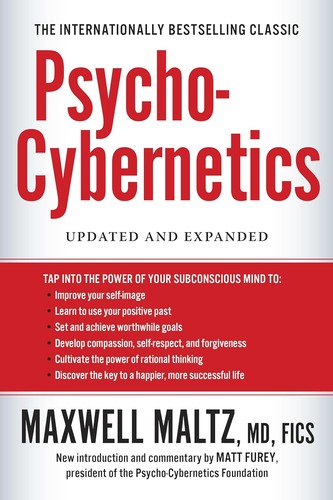
 | Maltz argues the mind-body system behaves like a servo-mechanism — it moves you toward the dominant self-image, not merely toward stated wishes. Cosmetic patients who looked different but felt the same taught him that identity picture gates change; the book maps success and failure mechanisms, creative imagination (rehearsal) versus worry (negative rehearsal), and rational thinking over empty affirmation. Maxwell Maltz First published 1960 - Updated (2002) · Prentice Hall · ISBN 9780735203886 |
|---|
Key principles
- Self-image servo — You steer toward the picture you hold of yourself — the dominant self-image, not the wish list on paper.
- Success mechanism — Built-in goal-striving guidance when the target picture is coherent — miss-steering when the image conflicts with the aim.
- Failure mechanism — Chronic miss-steering from a negative self-image — past labels treated as permanent identity.
- Creative imagination — Deliberate mental rehearsal trains the servo — same channel as worry, opposite sign.
- Worry as rehearsal — Catastrophic simulation rehearses failure — the mechanism cannot tell helpful from harmful vividness.
- Rational thinking — Self-suggestion aligned with evidence and aim — not blind positive thinking divorced from obstacle processing.
Core science
Psycho-Cybernetics is success literature and clinical observation from a surgeon’s practice — not a controlled-trial monograph. Its enduring contribution is vocabulary: Self-image as control system, imagination as training input. Modern bridges: functional-equivalence imagery (Imagination as Reality); mental contrasting limits of pure positive fantasy (Oettingen); performed identity and gap work (Performed identity). Do not equate Maltz’s cybernetic metaphor with literal engineering proof — use it as a steering metaphor, then ground reps in Club imagery protocol and field maps.
Application
Reach when self-image blocks a Battle rep — you declare an aim but the body acts the old picture; when worry feels like rehearsal you cannot stop; when mental prep needs Maltz’s servo frame before Three Types of Imagery; or when stereotype excellence scripts still steer the servo toward an inherited poster score. Open Identity for identity-cluster trails; open Habit when the new picture must be rehearsed until automatic.