Definition
Goal linkage is the set of mental associations that tie a goal to the means and sub-goals that advance it — the network through which intention connects to action.
Origin
Drawn from goal systems theory (Kruglanski et al., 2002), which models goals and means as an interconnected cognitive network rather than isolated intentions. Goals link to multiple means (equifinality) and single means can serve multiple goals (multifinality); the strength and structure of these linkages shape motivation and choice.
Mechanism
A goal with strong, clear linkages has an obvious path to action;
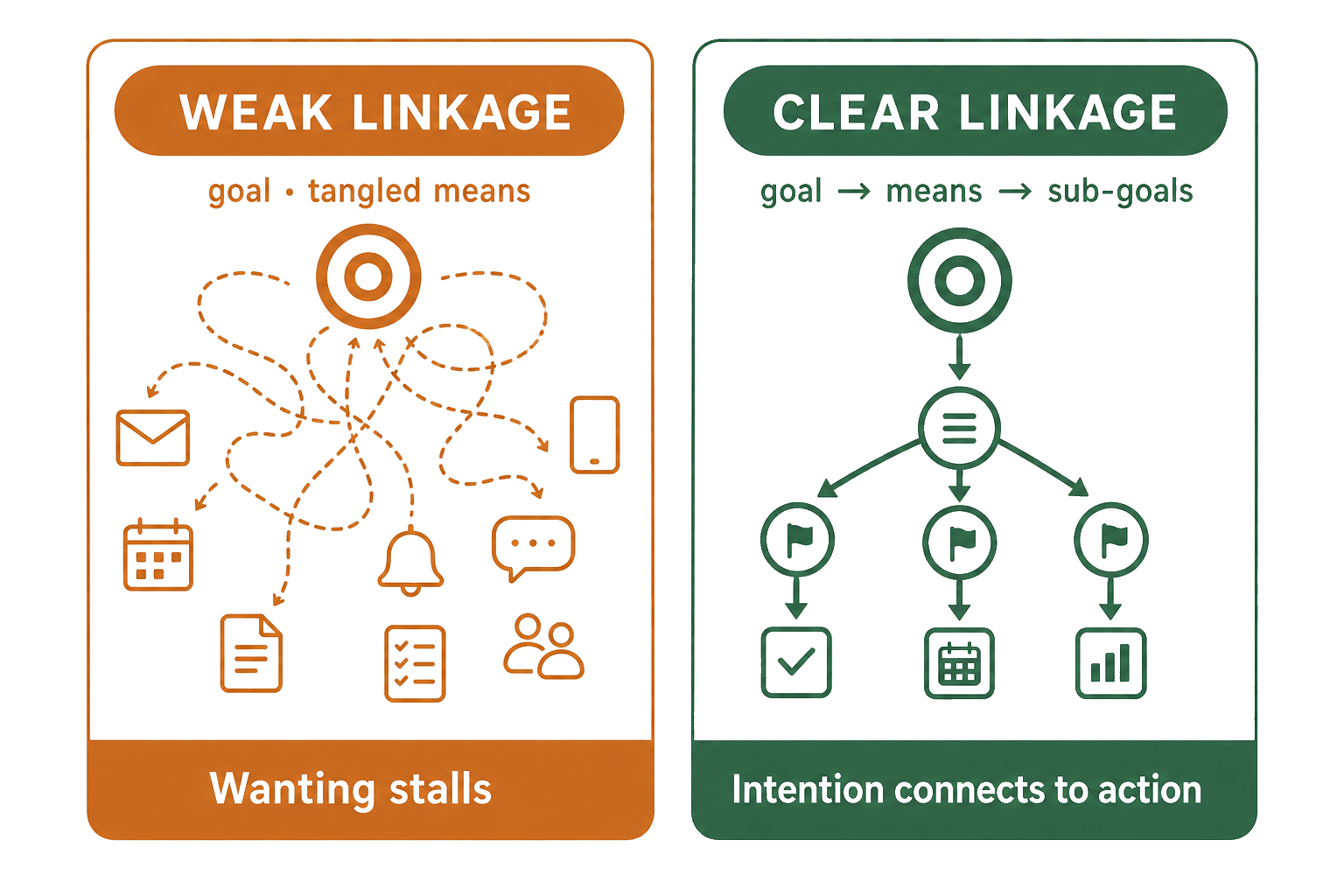
Weak means tangle versus clear goal→means network — pruning is motivational. Pair Signal vs Noise · Wildly important goal.
a goal with weak or tangled linkages stalls despite sincere wanting. Linkage structure also governs focus: tight, exclusive means-goal ties intensify commitment, while diffuse ties dilute it. Pruning means that do not genuinely link to a goal is therefore a motivational act, not just a scheduling one.
Applications
Auditing whether daily activities actually link to a stated goal; cutting “means” that serve no real end; strengthening the path between a vivid intention and the next concrete rep so that wanting converts into doing.
Sources
Cite
- Kruglanski, A. W., Shah, J. Y., Fishbach, A., Friedman, R., Chun, W. Y., & Sleeth-Keppler, D. (2002). A theory of goal systems. Advances in Experimental Social Psychology, 34, 331–378