Definition
Agentic properties are the active dispositions of a person — drive, curiosity, persistence, selectivity — that determine which experiences they seek and how forcefully they engage the world around them.
Origin
In Bronfenbrenner & Morris’s bioecological model (2006), the Person in PPCT is described through three kinds of characteristics: demand (what others react to on sight), resource (skills, knowledge, capacities), and force (the active, agentic dispositions). The force/agentic set is what selects and sustains the proximal processes that actually drive development.
Mechanism
Agentic properties act as a throttle on engagement.
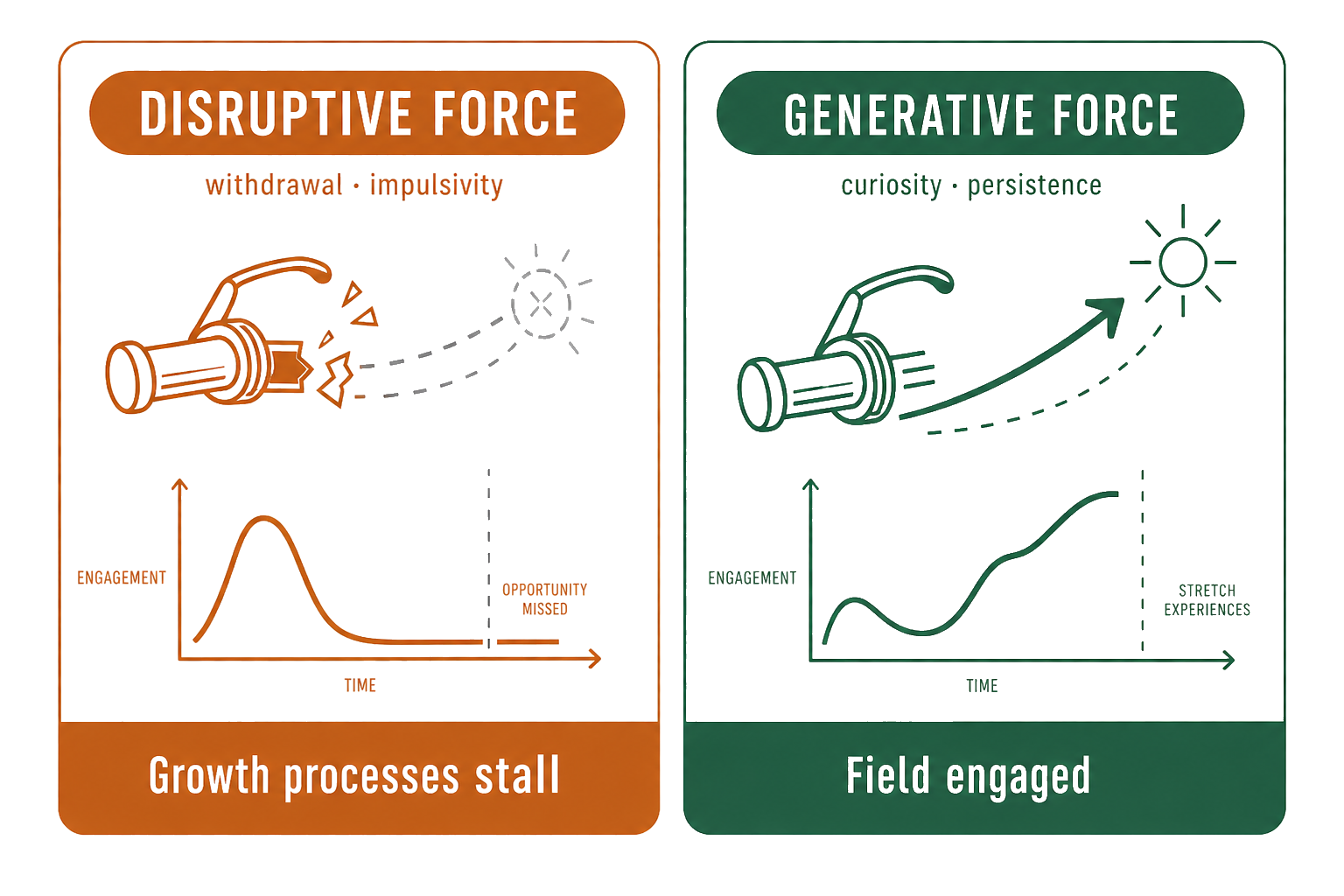
Disruptive force versus generative force — curiosity and persistence engage the field. Pair Conatus · Person in context.
Generative dispositions — curiosity, persistence, responsiveness — pull a person toward growth-producing interactions; disruptive ones — impulsivity, withdrawal, distractibility — interrupt them. Two people in the same field develop differently because their agentic properties seek and metabolise different experiences. These dispositions sit close to temperament but are expressed as directed action.
Applications
Cultivating the dispositions that pull you toward stretch experiences rather than away from them; recognising that environment alone is inert without the force that engages it; pairing field design with the deliberate exercise of persistence and curiosity.
Sources
Cite
- Bronfenbrenner, U., & Morris, P. A. (2006). The bioecological model of human development. In R. M. Lerner (Ed.), Handbook of child psychology (6th ed., Vol. 1, pp. 793–828). Wiley.
Adjacent
Person in context · Ecosystem · Temperament, attitude and personality · Goal linkage