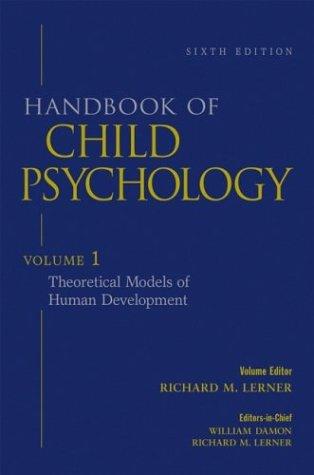
 | The handbook synthesizes developmental science at scale — Bronfenbrenner’s bioecological PPCT model (process–person–context–time) treats development as nested context, not isolated traits. R. M. Lerner (Ed.) (2006) · Wiley · ISBN 9780471272878 |
|---|
Key principles
- Bioecological frame — Development in living context — settings activate processes, not wallpaper.
- PPCT model — Process, person, context, time — four parameters for any developmental claim.
- Proximal processes — Recurring interaction quality — what actually drives development day to day.
- Nested contexts — Microsystem to macrosystem — change at one layer reshapes others.
- Person characteristics — Disposition meets context — agency and constraint co-define outcomes.
- Temporal dimension — History and timing matter — same event hits differently by life phase.
Core science
Volume 1 of the 6th edition anchors theoretical models in contemporary developmental science — the Bronfenbrenner chapter is canonical for Person in context and Agentic properties. Encyclopedic reference — cite specific chapters, not the whole shelf.
Application
Reach for this volume when developmental claims ignore context nesting — or when PPCT language is needed for person-in-environment work. Open Person in context on the Atlas shelf for the mechanism map.