Definition
Person in context holds that a person can only be understood together with the environment that surrounds them: the two co-define what is possible, and change in one reshapes the other.
Origin
Central to Urie Bronfenbrenner’s ecological and later bioecological model (PPCT: Process–Person–Context–Time; Bronfenbrenner & Morris, 2006). Development is not located inside the individual alone but in the ongoing transaction between person characteristics and nested contexts — from the immediate Microsystem out to the Macrosystem, across the Chronosystem of time.
Mechanism
Person characteristics (dispositions, resources, demands) meet contexts through proximal processes — the recurring interactions that actually drive development.
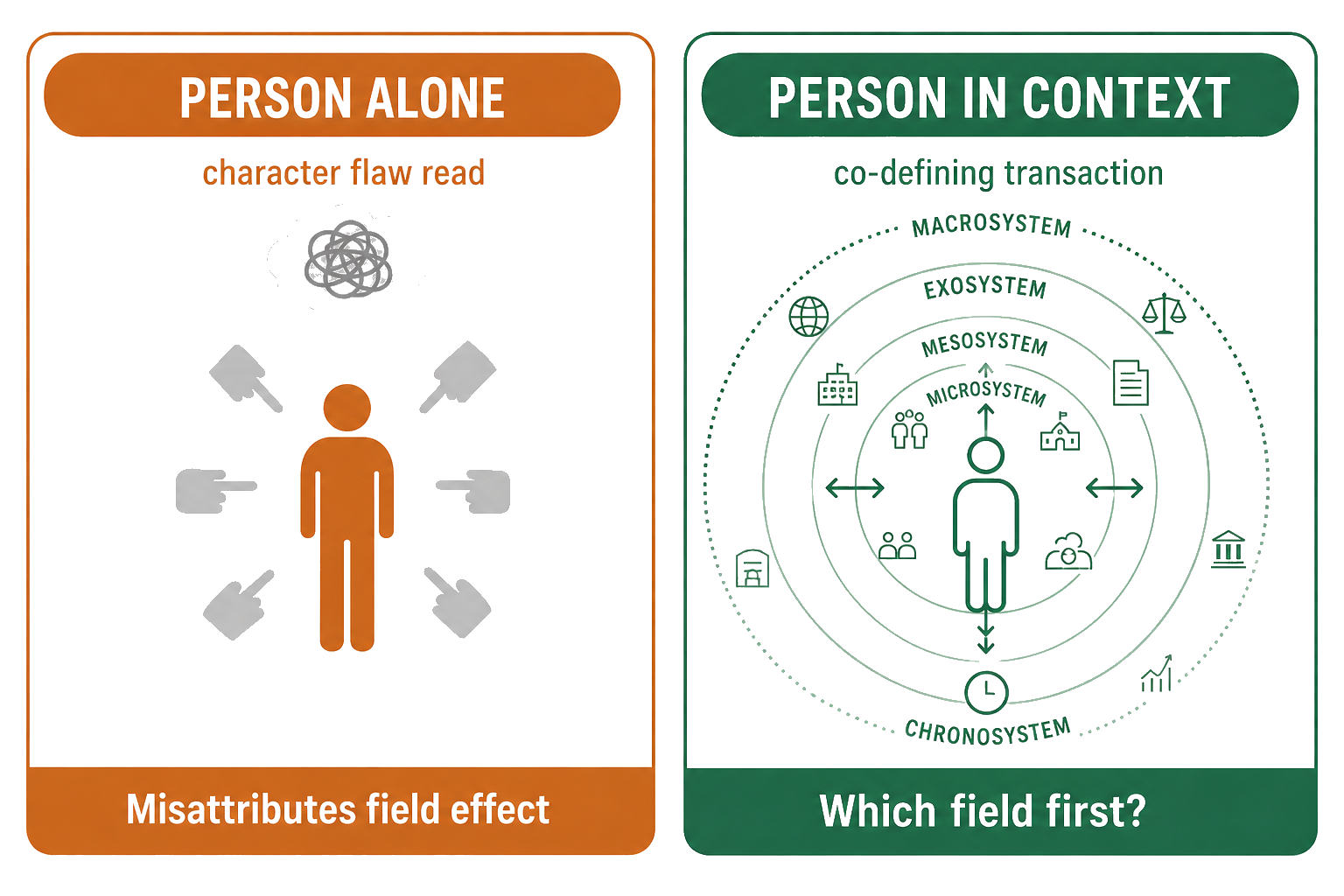
Person alone versus person-in-context — ask which field before which flaw. Pair Manual Of Me · Ecosystem.
Behaviour read out of context misattributes a field effect to character; the same person in a different field behaves differently. Diagnosis therefore asks which field before which flaw.
Applications
Reading a plateau as ecosystem mismatch rather than missing willpower; designing the field that makes a behaviour likely instead of relying on character; mapping yourself together with your relationships, rhythms, and commitments before deciding what to change.
Sources
Cite
- Bronfenbrenner, U., & Morris, P. A. (2006). The bioecological model of human development. In R. M. Lerner (Ed.), Handbook of child psychology (6th ed., Vol. 1, pp. 793–828). Wiley.
- Bronfenbrenner, U. (1979). The ecology of human development. Harvard University Press.
Adjacent
Ecosystem · Microsystem · Macrosystem · Chronosystem · Agentic properties