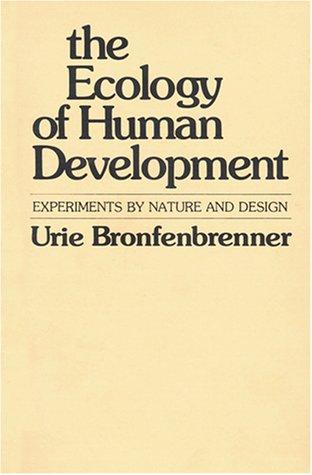
 | Bronfenbrenner’s ecological systems model treats development as person-in-context — never a trait chart ripped out of family, school, work, culture, or history. Nested shells from microsystem through macrosystem, plus change over time, explain why the same person expresses differently when the field changes — and why willpower-only coaching fails when the nest still trains the old pattern. Bronfenbrenner First published 1979 - Reprint (2006) · Harvard University Press · ISBN 9780674224575 |
|---|
Key principles
- Microsystem — Immediate face-to-face settings where the person acts — family, classroom, team — the innermost ecology.
- Mesosystem — Links between microsystems — whether home, work, and recovery rhythms reinforce or sabotage each other.
- Exosystem — Indirect settings that reshape options without your presence — employer policy, partner’s workplace, institutional rules.
- Macrosystem — Culture, ideology, and epoch — the outer shell that colours what microsystems treat as normal or shameful.
- Chronosystem — Change over time — history and life phase reweight the nest; development is not a snapshot.
- Person in context — Individual and environment co-define outcomes — not trait alone, not environment alone.
Core science
Bronfenbrenner (1979) reframed developmental psychology away from decontextualized variables toward nested systems — influential in education policy, family therapy, and prevention science. Later bioecological revisions emphasize proximal processes: recurring, progressively complex interactions between an active person and people, objects, and symbols in the immediate environment — the engine inside the shells. The PPCT frame (process–person–context–time) makes explicit what coaching often misses: identical motivation can read as discipline in one microsystem and avoidance in another because the interaction changed, not the moral ledger. The model is structural, not a lab-effect size paper — pair with Stokols 1992 when you need health-promotion ecology at adult scale.
Application
Reach when behaviour is explained as only who you are — or when plateau persists after inner work alone. Map which shell trains the pattern: live microsystem, broken mesosystem bridge, exosystem constraint, macro script, or chronosystem lag after a life-phase shift. Open Ecosystem for personal-field redesign (80/20 slices vs whole-rebuild panic); walk the layer trail Microsystem → Macrosystem when you need neutral vocabulary before rewriting character. Curated domain trail: Systems.