Definition
Context design is choosing where and with which tool you capture or review — the wrong room pulls the wrong behaviour, like bringing a dishwasher to the gym.
Origin
Fogg’s behaviour model treats ability and prompt as environment-dependent — tiny changes in context shift what actually runs. Thaler and Sunstein’s choice architecture adds that default paths (device, room, time block) predict outcomes as much as intention. Wood and Neal’s habit model shows context cues can trigger responses without active goal mediation once associations are learned.
Mechanism
Friction is not only internal. Phone unlock after voice capture often routes to scroll — the capture was honest, the context hijacked the next move. Wood and Neal note that goals can direct habits by promoting exposure to cues that trigger desired responses — context design is deliberate cue management, not willpower alone. Alternatives: mezzanine read (paper depolarisation), laptop at a fixed review spot for weekly extraction, gym for gym.
Pair with Data selfie: collect generously, but design the review surface so signal extraction actually happens.
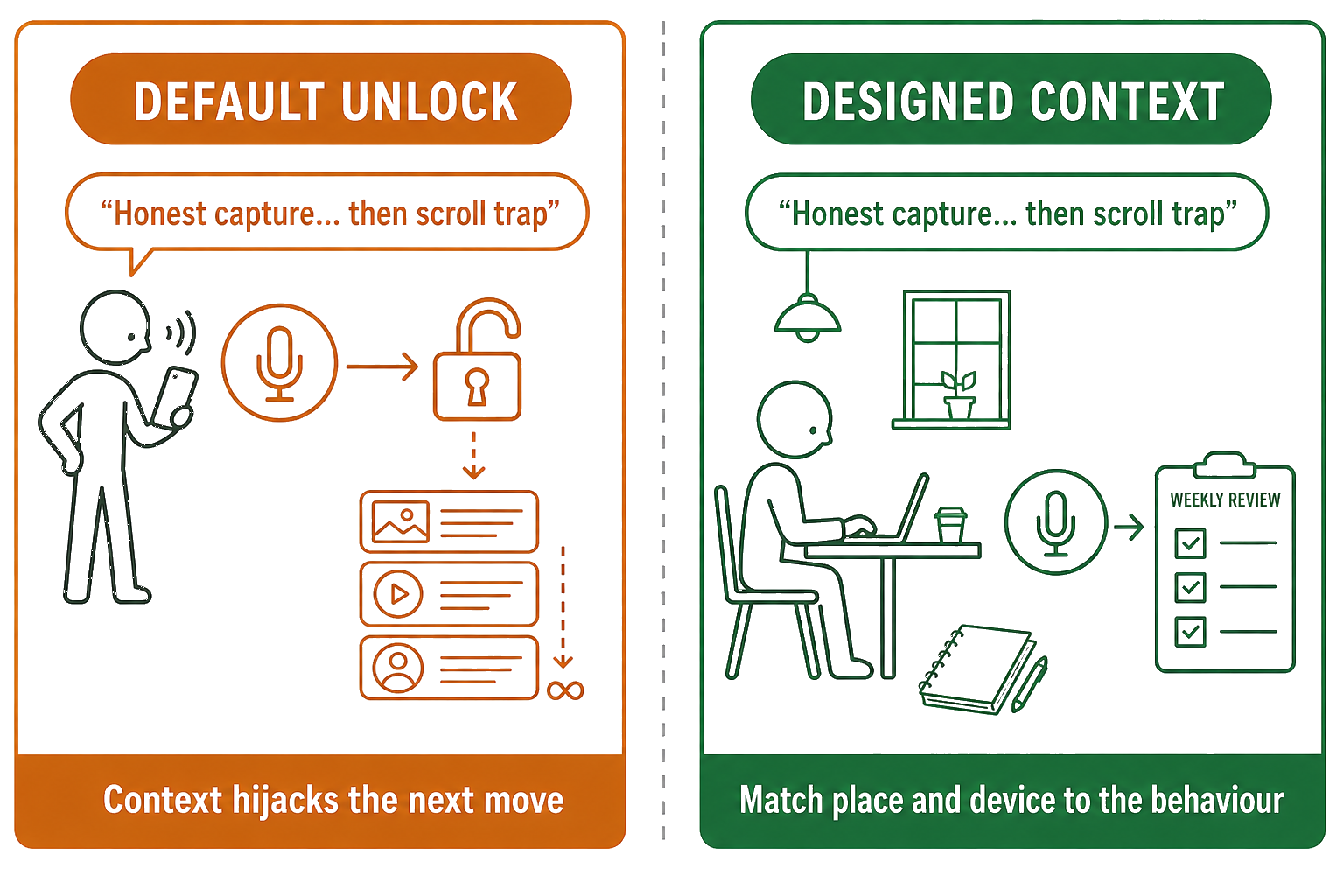
Default unlock versus designed context — match place and device to the behaviour. Pair Data selfie · Signal vs Noise.
Applications
After voice capture: one deliberate review context this week — not the default unlock path. Log where review happens without scroll hijack.
Sources
Cite
- Wood, W., & Neal, D. T. (2007). A new look at habits and the habit-goal interface. Psychological Review, 114(4), 843–863.
- Fogg, B. J. (2019). Tiny habits: The small changes that change everything. Houghton Mifflin Harcourt
- Thaler, R. H., & Sunstein, C. R. (2021). Nudge (final ed.). Penguin