Definition
A data selfie is the full portrait of data attached to you — voice memos, wearables, private notes — captured generously, interpreted sparingly.
Origin
Self-tracking communities treat the body as a measurable system (Quantified Self). Li, Dey, and Forlizzi’s stage model of personal informatics names five phases — preparation, collection, integration, reflection, action — with barriers that cascade when early stages fail.
Mechanism
- Capture first — do not optimise at the moment of friction; log voice, body, context.
- Extract later — scheduled review prompts pull signal (alignment gaps, recurring friction, energy patterns).
- Context design — where you capture and review matters (dedicated read spot vs phone-unlock scroll trap).
Failure mode: waiting for a magic automation layer instead of incremental capture — the selfie stays empty and the mirror has nothing to read. Li et al. note reflection and action stages are often under-designed relative to collection apps.
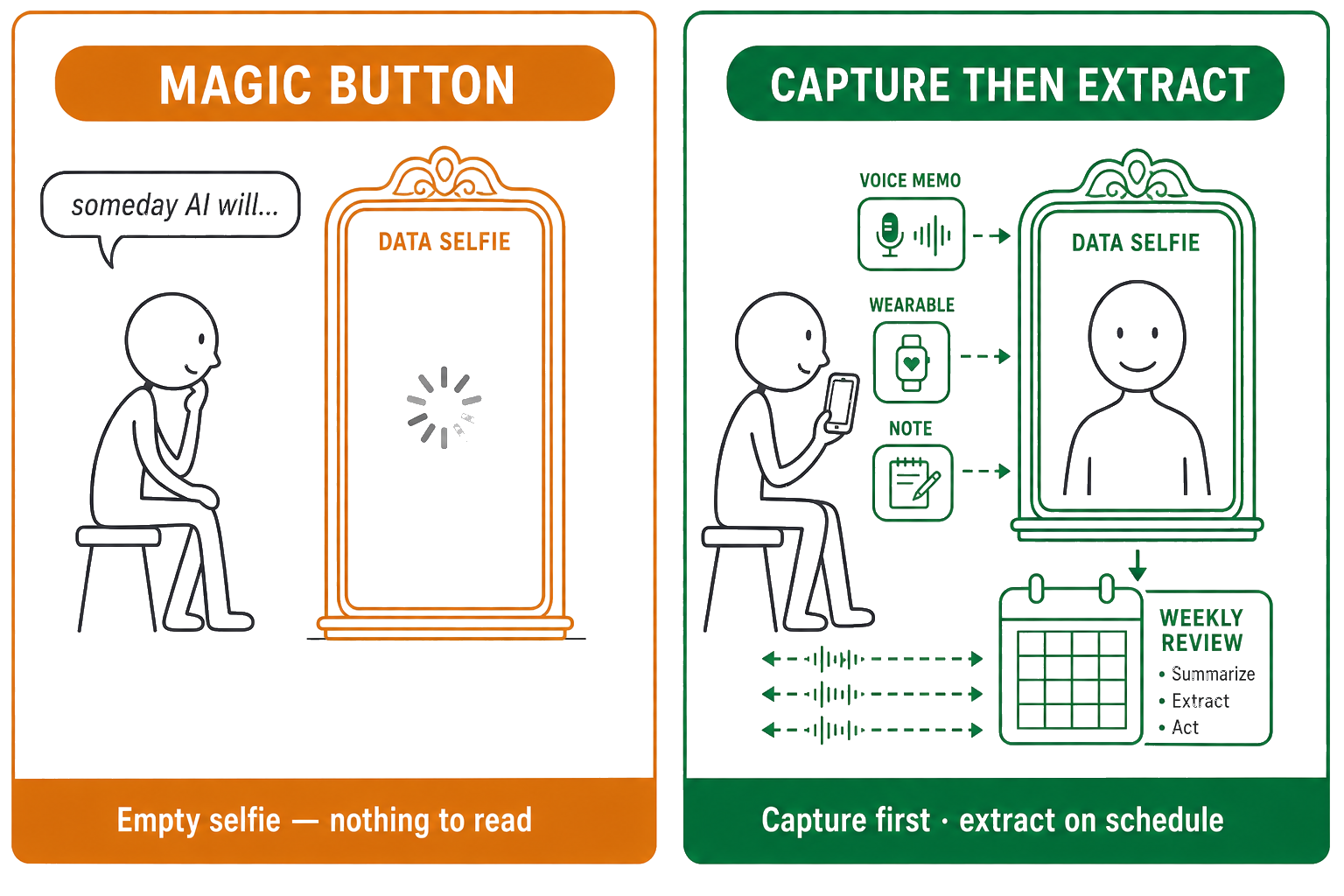
Magic button versus capture then extract — log first, review on schedule. Pair Context design · Weekly Review.
Applications
After a charged moment: one voice memo or note line before depolarisation. Weekly: one review prompt — what did my data selfie show about ambition charge or recurring friction this week?
Sources
Cite
- Wolf, G. (2010). The quantified self [Video]. TED Conferences. https://www.ted.com/talks/gary_wolf_the_quantified_self
- Swan, M. (2013). The quantified self: Fundamental prediction techniques. Big Data, 1(2), 85–99
- Li, I., Dey, A. K., & Forlizzi, J. (2010). A stage-based model of personal informatics systems. Proceedings of CHI 2010 (pp. 557–566). ACM