Definition
An inherited script is a rule you did not write — be nice, do not want too much, fix it before they criticise — that still runs your problem ledger.
Origin
White and Epston’s narrative therapy externalizes problem stories so a person can see rules they inherited rather than treating them as fixed identity. Satir’s family-systems model maps implicit survival contracts from upbringing. Berne’s transactional analysis adds script as a life plan learned in childhood — who you must be to stay safe or loved.
Mechanism
- Fear-assigned problems (people-pleasing, conflict avoidance) often serve the script, not stated ambition.
- Fragile-child labels in family lore can keep an Protective mother script running after objective competence rises — the inherited rule says you are the one who needs support, not you can generate it.
- Chosen problems break the script deliberately — couple clarity, bounded discomfort, safety inside action.
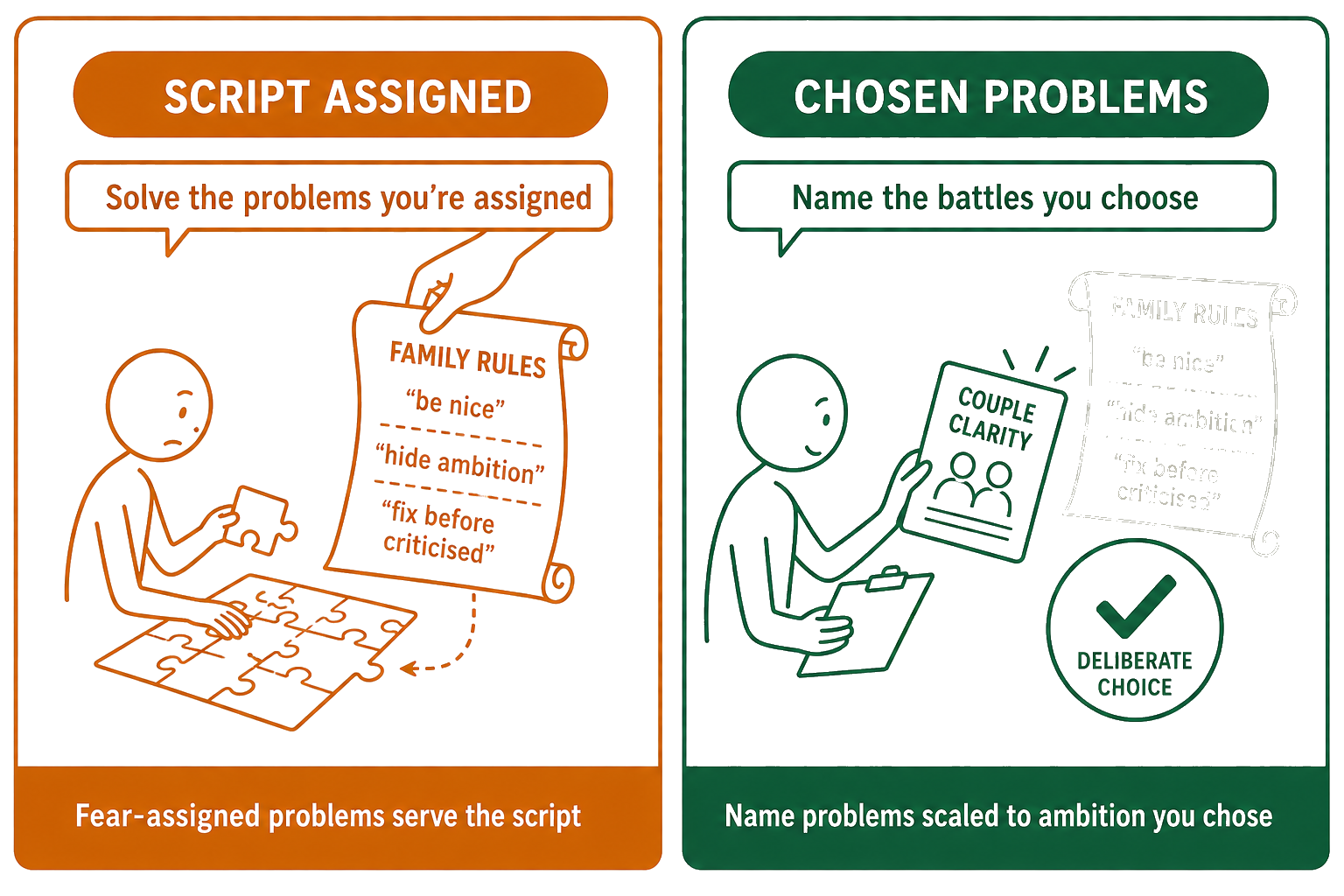
Script-assigned versus chosen problems — which battle serves ambition you picked. Pair Transgenerational shame · Problems at the Height of Ambitions.
Applications
Pair with Problems at the Height of Ambitions: one line — which problem am I solving because the script said so?
When I do not know how blocks Self-support work, treat the sentence as script material before skill training — the rule may be do not outgrow the fragile story. Ask which Russian doll layer still benefits from the old label.
Sources
Cite
- White, M., & Epston, D. (1990). Narrative means to therapeutic ends. Norton
- Berne, E. (1964). Games people play. Grove Press
- Satir, V., Banmen, J., Gerber, J., & Gomori, M. (1991). The Satir model: Family therapy and beyond. Science & Behavior Books