 | Beneath polite talk, people run games — patterned exchanges with a hidden payoff (strokes, blame relief, script confirmation). Berne’s transactional analysis names the moves so you can refuse the script without mistaking performance for intimacy. Berne First published 1964 - Reprint (2006) · Grove Press · ISBN 9780802140989 |
|---|
Mechanism card ^mechanism-card
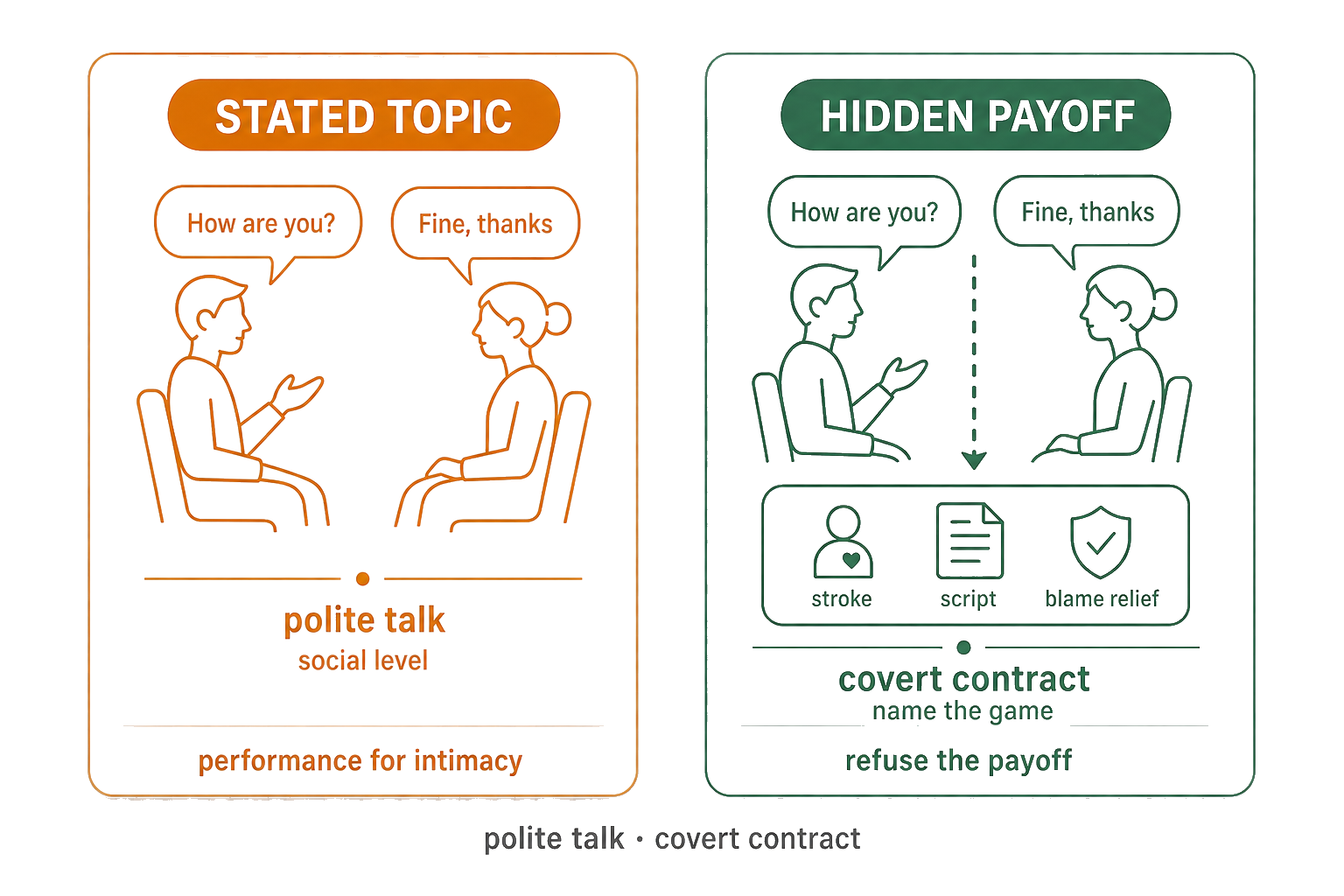
Mechanism card — stated topic (polite social level) versus hidden payoff (stroke · script · blame relief beneath the words). Science: Adapted Child Compensation. Your move: Application.
Key principles
- Stroke economy — Humans budget recognition transactions — attention, praise, scold — and will trade authenticity for predictable strokes when hungry.
- Ulterior transaction games — Social words carry a covert contract — the game is the payoff beneath the stated topic.
- Life-script payoff — Childhood writes a life plan toward a familiar endpoint — games rehearse the script’s finish line.
- Transactional level ladder — Social contact stacks from ritual and pastime through games toward intimacy — not every conversation is connection.
- Racket-and-stamp collecting — Stored resentments justify the next game move — slights filed as evidence for the script.
- Game-interruption naming — Seeing the pattern breaks automatic play — refuse the payoff without escalating the role.
Core science
Berne’s transactional analysis maps ego states and recurring interaction patterns as observable games with rules and payoffs — 1960s clinical-popular architecture that influenced later script and family-systems language. It is descriptive and memorable, not a modern RCT manual; pair with Satir on survival roles and with live Inherited script when fear-assigned problems outrun stated ambition.
Application
Reach for this volume when polite talk keeps landing in the same bruise — when you suspect a hidden payoff (be right, be needed, be innocent) more than a content disagreement. Name the game before renegotiating the agenda.