Definition
Self-support is the skill of meeting one’s own need for reassurance, regulation, or encouragement — distinct from isolating, and distinct from confusing a symbolic crutch with genuine inner care.
Origin
Attachment theory (Bowlby, Mikulincer & Shaver) distinguishes internal working models of care — whether soothing is expected from others only or can be generated internally. Neff’s self-compassion construct (kindness, common humanity, mindfulness) operationalises one form of self-support without narcissism. Linehan’s distress-tolerance and DBT self-soothe skills add behavioural specificity.
Mechanism
Early inherited scripts (fragile-child labels, hyperprotective caregiving — see Protective mother) can orient adulthood toward orchestrating external support. The belief I do not know how often functions as a Heuristic, not proof the skill is absent.
Definition trap: if self-support is imagined only as a golden crutch or fantasy caretaker, lived examples are missed. Counter-move: enumerate past instances of self-generated regulation before prescribing new behaviour.
External warmth and inner support can coexist (both/and), not merge into either-or.
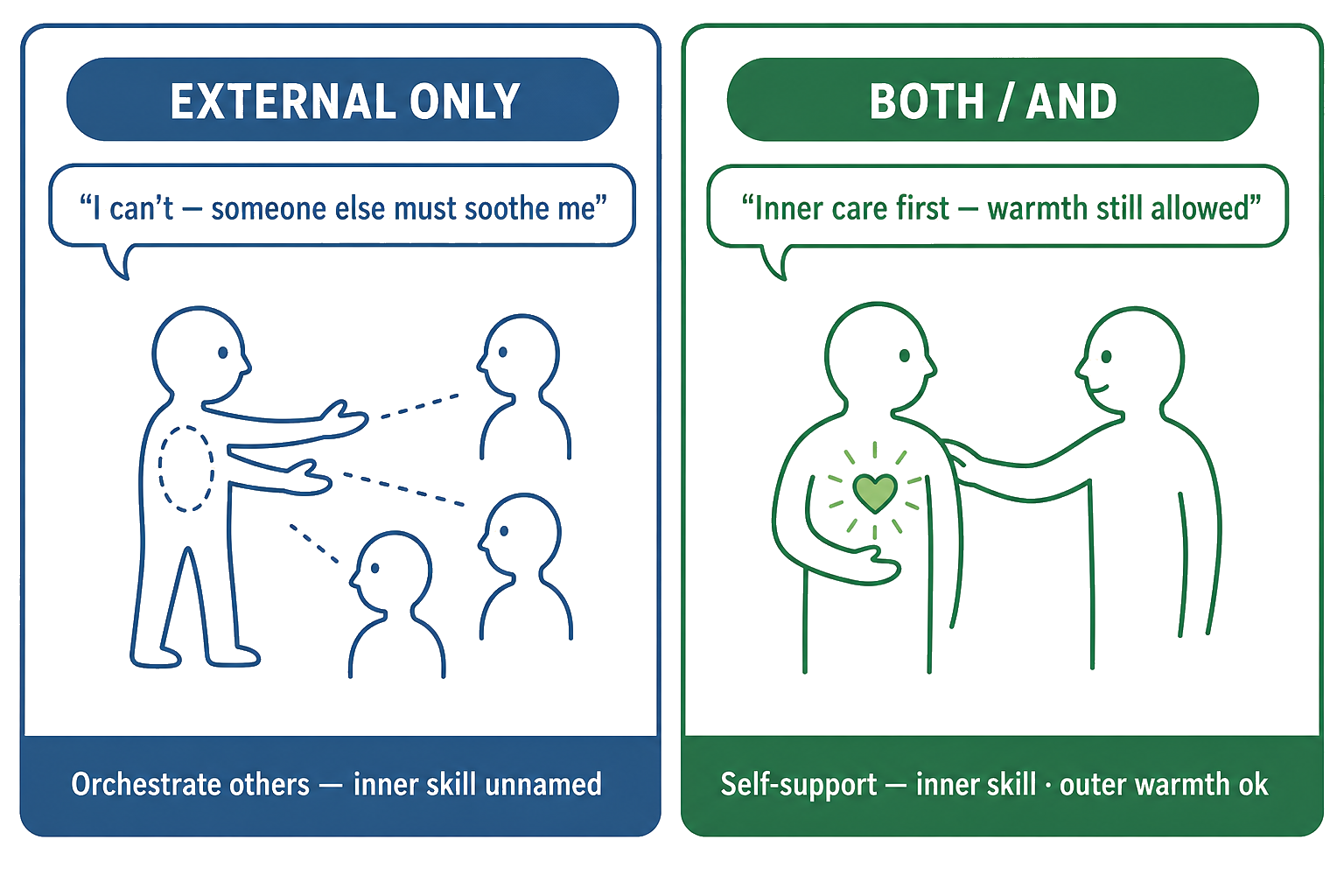
External only versus both/and — inner care first, outer warmth still allowed. Pair Master of Opposites · It will be better when.
Neff’s self-compassion construct is one operationalization of inner care — not identical to every coaching definition of self-support — and the broader literature treats self-compassion as correlates with well-being, not proof that any single inner-soothing rep generalizes across contexts without behavioural specificity.
Applications
Write an observable one-sentence definition grounded in past evidence. When future-conditional distress fires (see It will be better when), run an inner-support rep before rearranging the environment for external soothing. Parts-informed work: ask which younger self already supported itself under another form.
Sources
Cite
- Neff, K. D. (2003). Self-compassion: An alternative conceptualization of a healthy attitude toward oneself. Self and Identity, 2(2), 85–101.
- Mikulincer, M., & Shaver, P. R. (2007). Attachment in adulthood: Structure, dynamics, and change. Guilford Press.
- Bowlby, J. (1988). A secure base: Parent-child attachment and healthy human development. Basic Books.