Definition
Infantile conflict loops are recurring fights whose structure is pre-adult — protest, merge, punish, or flee — even when the surface topic looks grown-up.
Origin
Bowlby’s attachment frame treats protest and clinging as regulatory strategies when safety feels threatened — not only childhood behaviours. Johnson’s emotionally focused therapy (EFT) maps couple fights as attachment panics beneath the content. Schore’s affect-regulation work links early dysregulation to automatic fight–flight patterns that persist in adult conflict.
Mechanism
- The loop often starts inside one person before it projects onto the partner — dysregulated affect narrows the perceived option set.
- When two dysregulated attachment systems lock, a third psyche dynamic can amplify the loop (each person’s younger part answering the other’s).
- Recovery is not winning the argument — it is staying adult long enough to see the loop without feeding it (EFT: slow the cycle, name the attachment need beneath the protest).
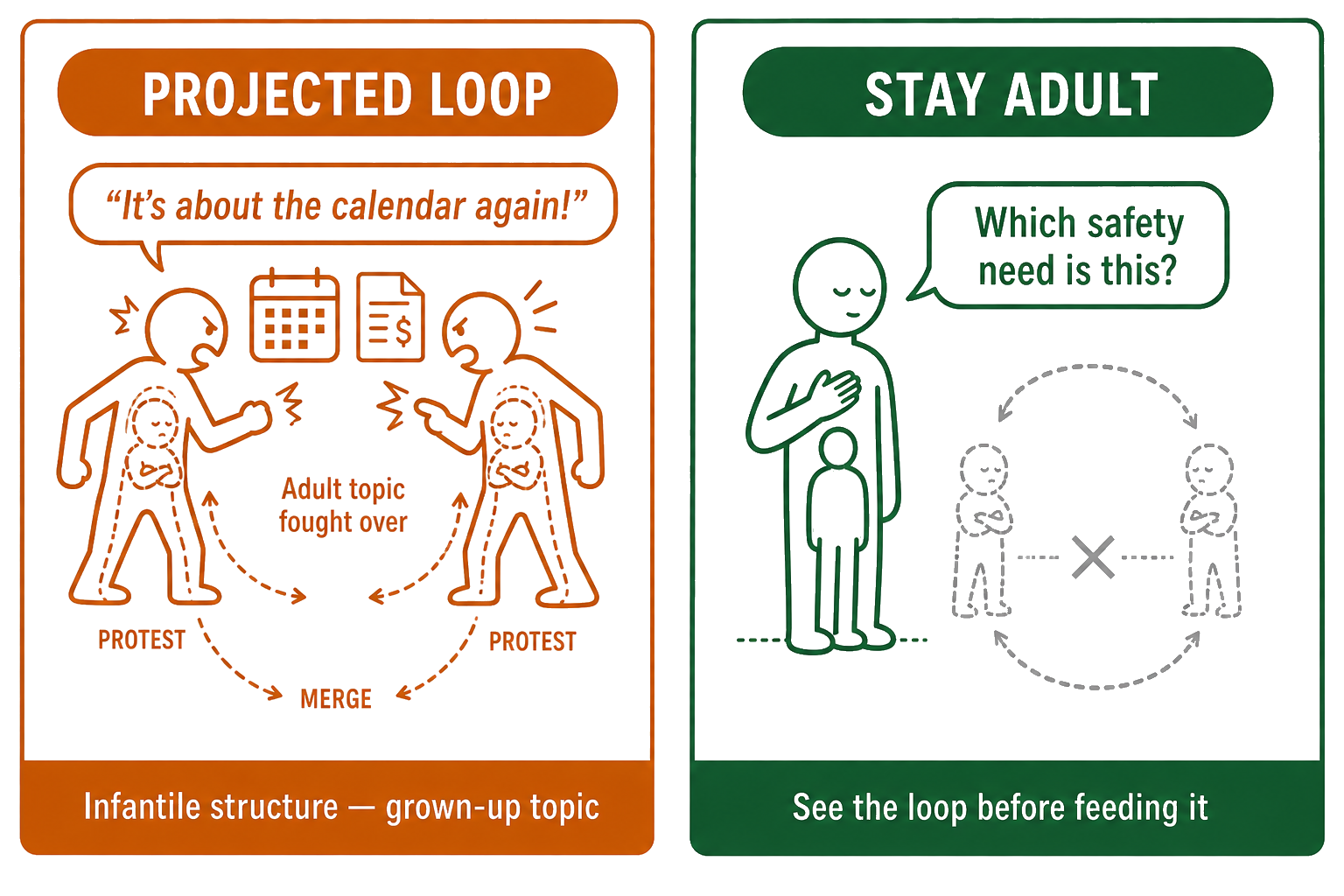
Projected loop versus stay adult — infantile structure, grown-up topic. Pair Third Psyche · Attachment system.
Applications
When every conflict feels disproportionate, ask: which safety or recognition need is this fight trying to secure? One structured log line after a charged moment — pattern before policy.
Sources
Cite
- Johnson, S. M. (2019). Attachment theory in practice: Emotionally focused therapy (EFT) with individuals, couples, and families. Guilford Press
- Bowlby, J. (1988). A secure base: Parent-child attachment and healthy human development. Basic Books
- Schore, A. N. (2003). Affect dysregulation and disorders of the self. Norton