Definition
A wildly important goal (WIG) is the single objective whose achievement would matter most — chosen deliberately and defended against the constant pull of urgent daily work.
Origin
The term comes from The 4 Disciplines of Execution (Chris McChesney, Sean Covey, Jim Huling), where Discipline 1 is “focus on the wildly important.” It rests on a robust finding in goal-setting research: specific, sufficiently difficult goals produce higher performance than vague “do your best” intentions — but only when attention is not fragmented across too many of them.
Mechanism
Execution has two competing demands: the whirlwind — the urgent, energy-hungry day-to-day operation that must keep running — and the WIG, the goal that moves you forward.
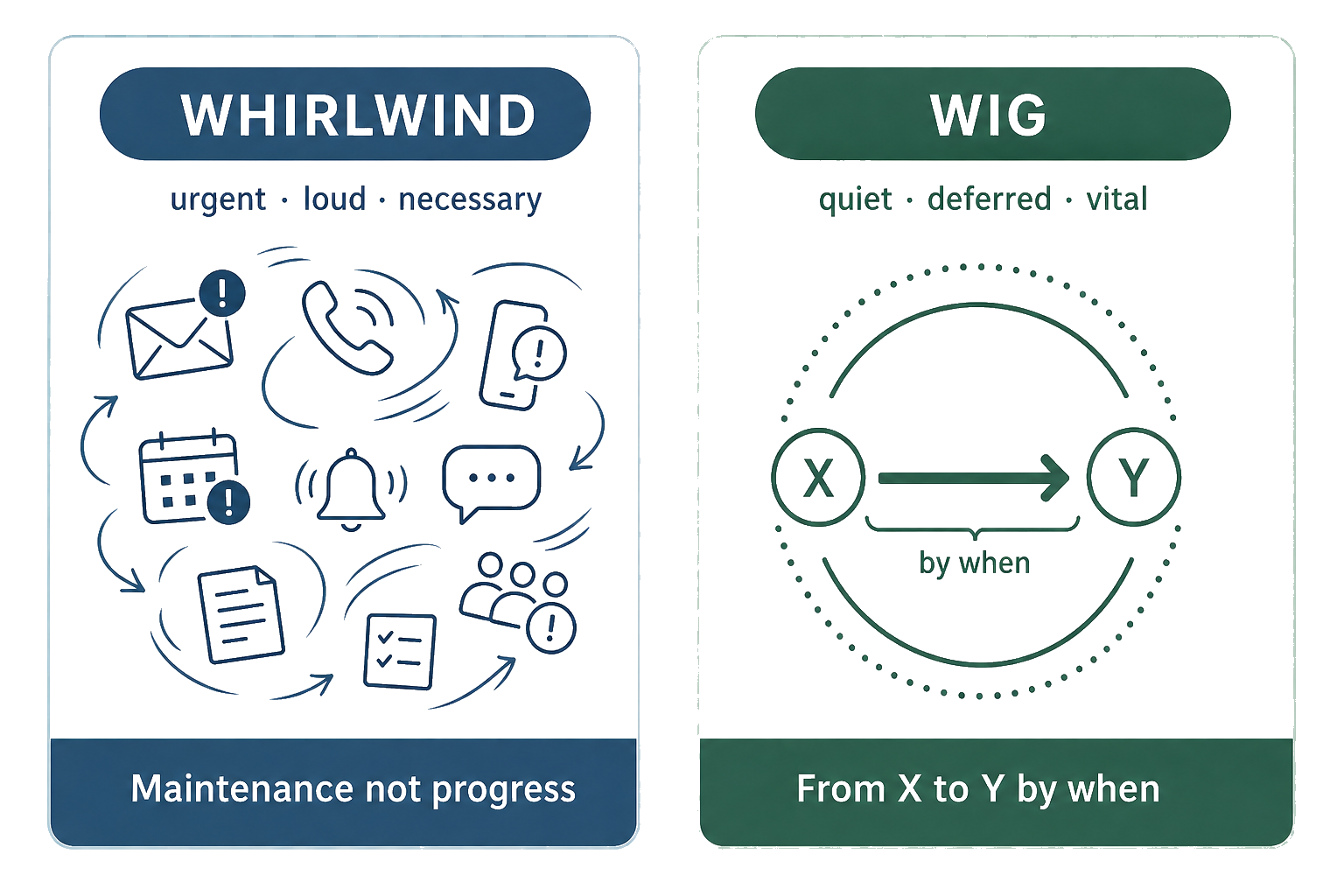
Whirlwind maintenance versus one WIG ring-fenced. Pair Signal vs Noise · 4DX. The whirlwind always wins by default because it is loud and immediate, so the move is to name a very small number of WIGs (ideally one) in the form from X to Y by when, and ring-fence attention and energy for them. Recognising the whirlwind for what it is — necessary maintenance, not progress — is the first act of focus.
Applications
- Reducing a long list of ambitions to the one goal that, if achieved, makes the others easier or irrelevant.
- Protecting a creative or strategic project from operational urgency.
- Naming the whirlwind explicitly so it stops masquerading as progress.
Sources
Cite
- McChesney, C., Covey, S., & Huling, J. (2012). The 4 disciplines of execution. Free Press.
- Locke, E. A., & Latham, G. P. (2002). Building a practically useful theory of goal setting and task motivation. American Psychologist, 57(9), 705–717.