Definition
Posture is the embodied expression of stance — how you hold breath, spine, shoulders, and weight — which both signals and feeds back into the attitude you occupy.
Origin
The layer is named explicitly in the Club four-layer map (Temperament, attitude and personality): posture is attitude made physical. Somatic traditions (Alexander technique, martial arts, performance coaching) treat carriage as trainable behaviour, not cosmetic appearance. Embodied-cognition research shows body state biases affect and appraisal — with important limits on simplistic “power pose” claims — but the feedback loop between carriage and readiness is well supported at modest effect sizes.
Mechanism
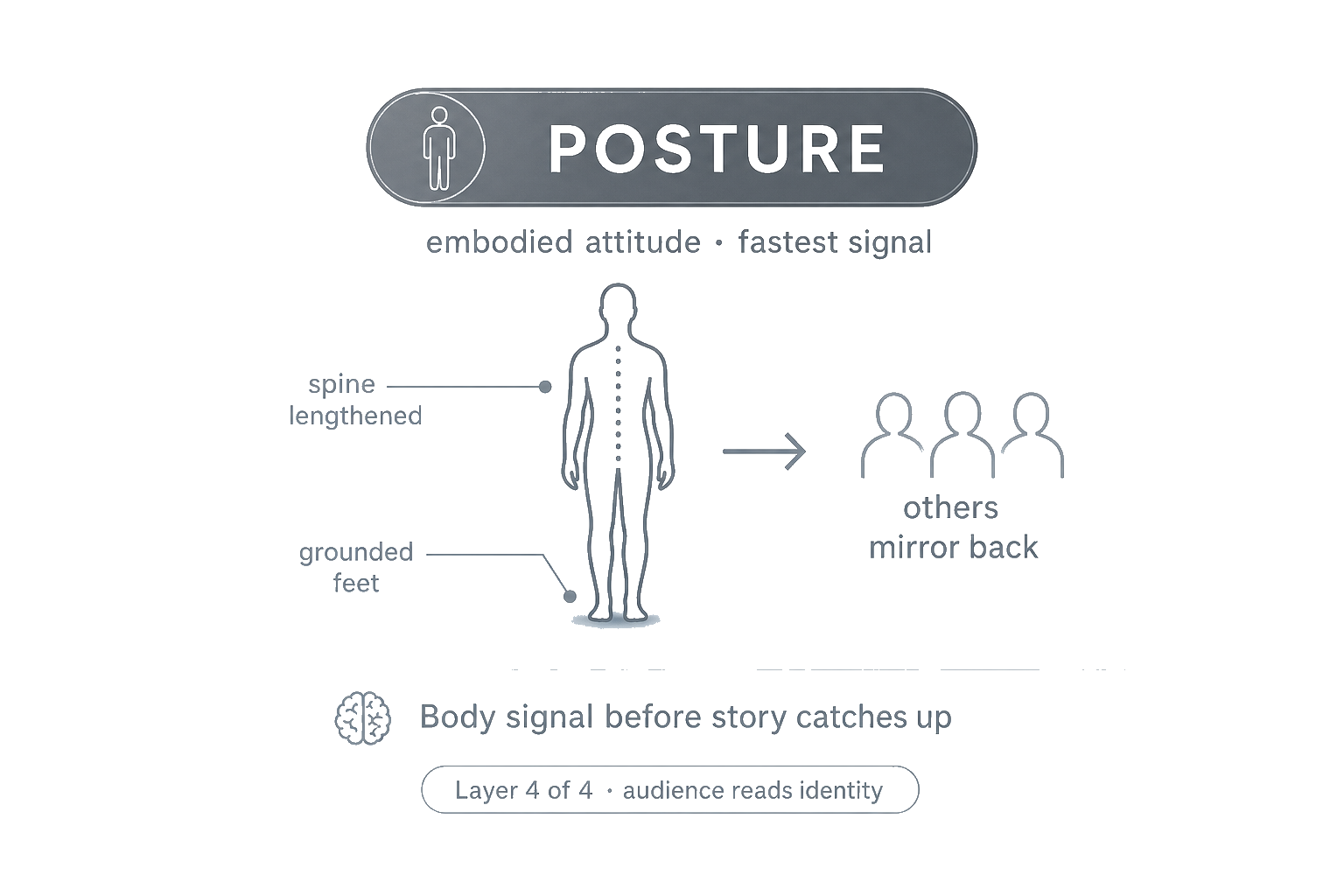
Posture closes a bidirectional loop:
- Top-down — Attitude shapes how you occupy space (collapsed, guarded, open, forward).
- Bottom-up — expanding breath, lengthening spine, and grounding weight shift interoceptive signal (Interoception) and appraisal before narrative catches up.
In depth-psychology terms, posture is where character meets the visible body: chronic collapse can express depressive personality patterns; ritual upright stance can support an attitude of dignity you have not yet fully internalised — a behavioural bridge rather than denial of Temperament.
Posture is the fastest lever in the stack because it operates in seconds, not seasons — useful when personality change is too slow and attitude talk alone stays abstract.
Identity link
Posture is embodied performed identity — what others read before your story finishes loading. Identity updates when named tension, repeated evidence, and audience align; carriage is the earliest audience-facing signal. Pair Interoception with Attitude so the body grants permission the narrative has not yet earned — a bridge, not denial of Temperament.
Applications
- Before a hard rep: one physical reset (breath, feet, eyes) → then name Attitude.
- Notice when Temperament high reactivity shows first in neck, jaw, breath — intervene at posture before story spirals.
- Do not confuse temporary carriage with Personality rewrite; repeat daily if you want it to consolidate.
Sources
Cite
- Carney, D. R., Cuddy, A. J. C., & Yap, A. J. (2010). Power posing: Brief nonverbal displays affect neuroendocrine levels and risk tolerance. Psychological Science, 21(10), 1363–1368. https://doi.org/10.1177/0956797610383437
- Cuddy, A. J. C., Schultz, S. J., & Fosse, N. E. (2018). P-Curving a more comprehensive body of power-posing research reveals clear evidential value for posture effects on feelings. Psychological Science, 29(7), 1073–1084. https://doi.org/10.1177/0956797617746749
Related doctrine
Adjacent
Temperament, attitude and personality · Temperament · Personality · Attitude · Identity · Performed identity · Granular Interoception