Definition
Temperament is the innate, partly heritable baseline of emotional and motor reactivity — the speed and intensity with which your nervous system responds before deliberate choice enters.
Origin
The construct predates modern psychology (Hippocrates–Galen four humours) but survives in empirical form: Jerome Kagan’s longitudinal work on behavioural inhibition and high-reactive infants; Hans Eysenck’s tie between temperament and arousal systems; Mary Rothbart’s decomposition into reactivity plus effortful control. Temperament is not destiny — it is the substrate on which Personality is built and through which Attitude must sometimes be chosen against the grain.
Mechanism
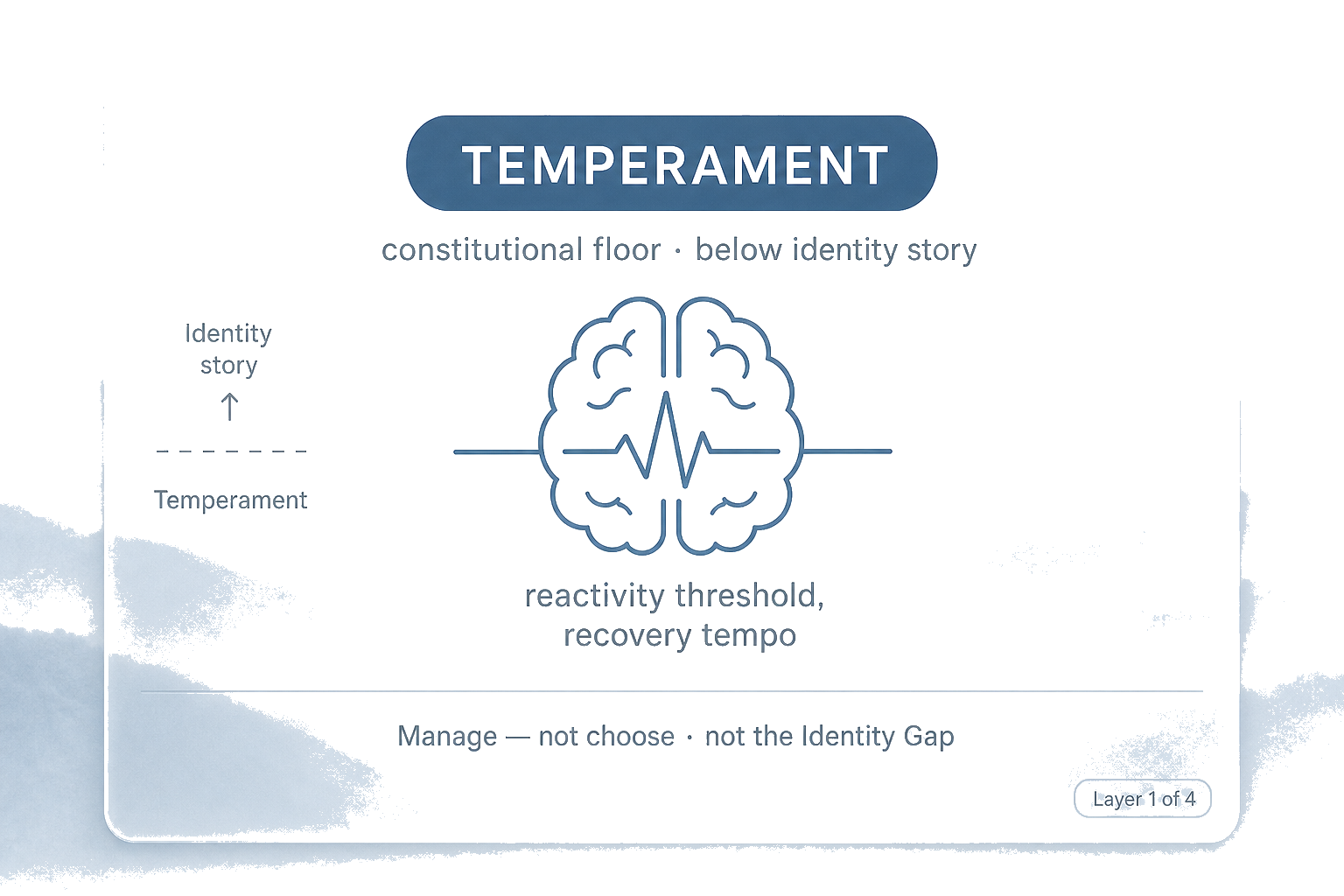
Temperament operates below narrative identity. It shapes:
- Threshold — how much stimulation triggers distress or excitement.
- Recovery — how fast the system returns to baseline after activation.
- Default tempo — sluggish, steady, or fast-moving motor and affective pacing.
In depth-psychology terms, temperament is closest to the constitutional layer: what the body brings to every scene before character or situation-specific stance. You do not decide to be high-reactive; you decide how to manage reactivity — sleep, pacing, exposure gradients, co-regulation — without confusing management with moral failure.
The classic error (named in Temperament, attitude and personality) is treating temperament as if it were Attitude: berating yourself for feeling what the baseline produces. The corrective move is differentiation — name the layer, then choose a response at the layer that is actually choosable.
Identity link
Temperament sits under Identity as the constitutional floor — James’s experiencing I before the known me. It is not where Identity Gap work lands: you manage reactivity; you do not rewrite it as a story claim. Identity work misfires when baseline arousal is moralised (“I am an anxious person”) instead of differentiated from Personality and Attitude. Affect theory architecture and Self-awareness help name the layer before narrative catches up.
Applications
- Before self-attack: ask is this my baseline or my stance?
- Design environments that match or gently stretch reactivity — not willpower alone.
- Pair with Agentic properties: force characteristics engage the field; temperament sets the initial throttle.
Sources
Cite
- Kagan, J. (1994). Galen’s prophecy: Temperament in human nature. Basic Books.
- Eysenck, H. J. (1967). The biological basis of personality. Charles C. Thomas.
- Rothbart, M. K., & Bates, J. E. (2006). Temperament. In Eisenberg (Ed.), Handbook of child psychology (Vol. 3, pp. 99–166). Wiley.
Related doctrine
Adjacent
Temperament, attitude and personality · Personality · Attitude · Posture · Identity · Person in context