Definition
Personality is the organised, relatively enduring pattern of traits, habits, and motivational tendencies that develops over years on a temperamental substrate — neither a single mood nor a momentary choice.
Origin
Gordon Allport (1937) framed personality as functional unity — traits are real psychological structures, not mere labels on behaviour. Modern trait models (the Big Five and successors) treat personality as rank-order stable across adulthood with meaningful change still possible through sustained new experience, therapy, and deliberate rep. Personality sits between Temperament (given) and Attitude (chosen now).
Mechanism
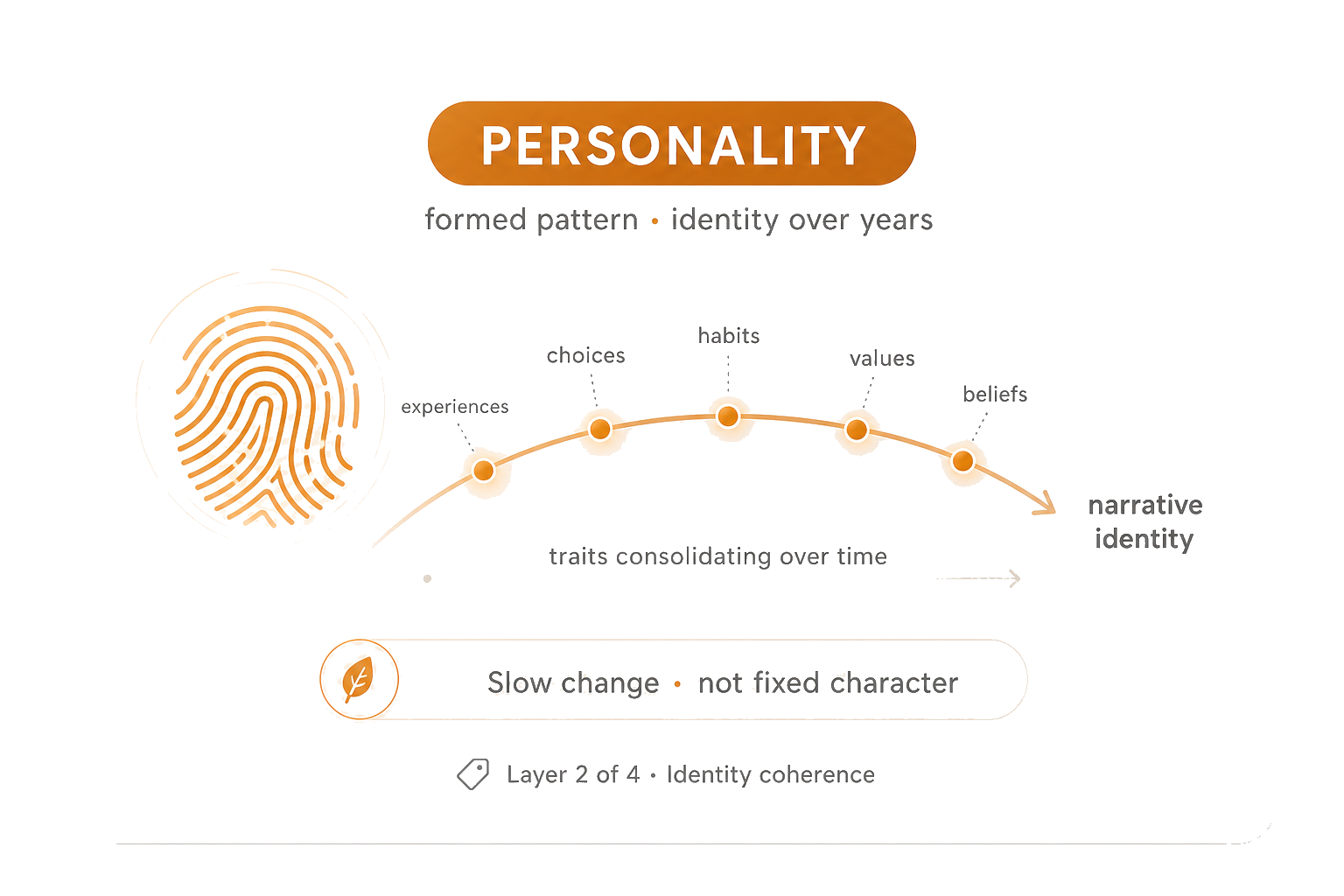
Personality is formed, not declared. Mechanisms include:
- Repeated pairing — situations and responses wire into default styles (see Conditioning).
- Trait consolidation — scattered acts become a named pattern others (and you) expect.
- Identity narrative — what you repeatedly do becomes what you are in story, not only in statistics.
In psychodynamic language, personality is the character layer: defences, object relations, and habitual relational moves that were once adaptive. It is slower than Attitude because it is distributed across many contexts and reinforced by social feedback loops.
The second classic error: treating a chosen Attitude as if it were fixed personality (“I am just not that kind of person”) — which freezes growth. The third: mistaking personality for temperament and concluding change is impossible when the work belongs at habit or stance level.
Identity link
Personality is where Identity consolidates over years — repeated acts become traits, traits feed narrative identity (“I am the kind of person who…”). When stated values and lived traits diverge, you get identity coherence strain — not a one-hour Attitude fix. Mythopoiesis authors the story layer; personality is the slower behavioural evidence the story must eventually match or revise.
Applications
- Long arcs: therapy, deliberate practice, and environment redesign reshape personality — not one affirmation.
- Short arcs: use Attitude and Posture when the moment needs a lever personality cannot supply instantly.
- Audit: which traits are temperament-amplified versus truly consolidated personality?
Sources
Cite
- Allport, G. W. (1937). Personality: A psychological interpretation. Henry Holt.
- McCrae, R. R., & Costa, P. T., Jr. (2003). Personality in adulthood: A five-factor theory perspective (2nd ed.). Guilford Press.
Related doctrine
Adjacent
Temperament, attitude and personality · Temperament · Attitude · Posture · Identity · Narrative identity · Self-esteem