Definition
Mythopoiesis is the making of myth — the activity by which a mind authors meaning, identity, and inner narrative out of raw experience, through symbol, story, and precise language.
Origin
From the Greek mythos (story) + poiesis (making). The pairing runs from Plato’s discussion of myth-making in education through the Romantics, and is revived in twentieth-century depth psychology: C. G. Jung treats the psyche as inherently image- and myth-producing, and James Hillman’s archetypal psychology makes mythopoiesis central — the soul does not merely perceive the world, it imagines and stories it. Paul Ricoeur’s work on narrative gives the philosophical hinge: human time becomes human only when it is configured into story.
Mechanism
A mind does not record experience neutrally; it narrates.
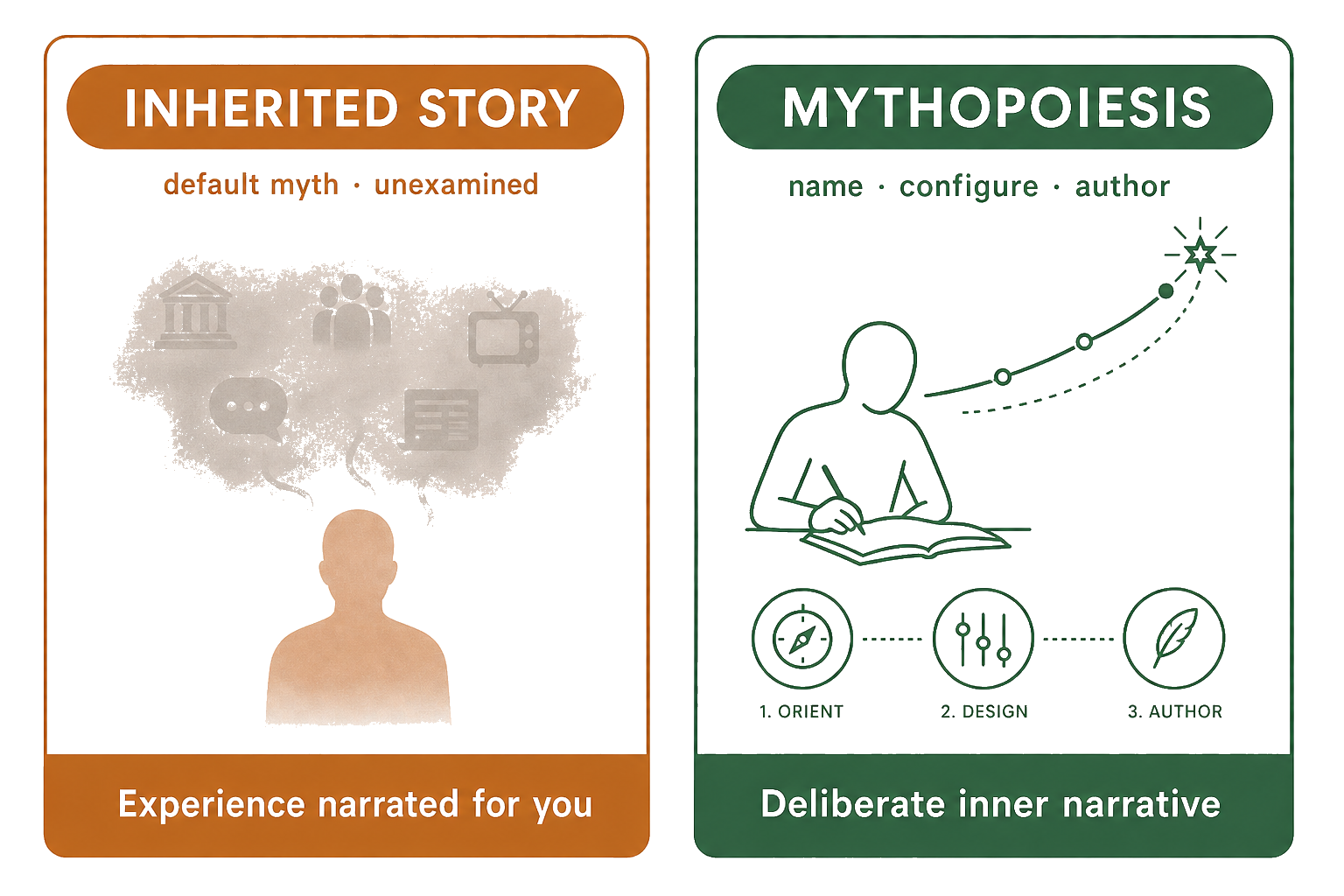
Inherited story versus deliberate authoring — name, configure, choose the myth. Pair Personal Definitions · Vivid Vision.
The same raw event becomes a different life depending on the myth it is folded into. Three moves recur:
- Naming. Putting a precise word on a felt state turns formless affect into something workable — the finer the language, the more of experience becomes available to shape.
- Configuring. Discrete events are linked into a plot with cause, meaning, and direction; this plot is what we experience as a self.
- Authoring. Because the story is constructed, it can be chosen. Mythopoiesis is the deliberate version: selecting and cultivating the inner narrative worth inhabiting rather than inheriting one by default.
Applications
Deliberate self-authoring (choosing the identity story you build toward); reframing in therapy and coaching; meaning-making after loss; the disciplined use of personal definitions so that what you can name, you can train. Personality and narrative identity are the slow layers mythopoiesis revises; Attitude and Posture are the same-day levers — see Temperament, attitude and personality. Mythopoiesis also reaches backward — integrating what was transmitted before conscious memory into a story one can live with.
Sources
Cite
- Hillman, J. (1975). Re-visioning psychology. Harper & Row.
- Ricoeur, P. (1984). Time and narrative (Vol. 1). University of Chicago Press.
- Jung, C. G. (1968). The archetypes and the collective unconscious (2nd ed.). Princeton University Press.
Related doctrine
Personal Definitions · Vivid Vision
Adjacent
Narrative identity · Personality · Temperament, attitude and personality · Imagination as Reality · Transgenerational memory · Archaic Psyche