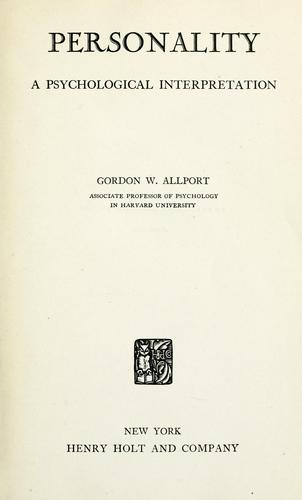
 | Allport launches trait psychology as organised dispositions — not type boxes. Functional autonomy explains how motives outgrow their origins; proprium names the felt self that integrates habits over time. Gordon W. Allport (1937) · Henry Holt · ISBN 9780804600682 |
|---|
Key principles
- Trait disposition — Enduring organisation of behaviour — traits are real patterns, not fiction of labels.
- Functional autonomy — Adult motives need not serve childhood origin — habits become goals in themselves.
- Proprium integration — Sense of self as evolving centre — identity is process, not static certificate.
- Idiographic respect — Unique life organisation matters — nomothetic laws never replace individual map.
- Attitude versus trait — Attitudes are narrower — trait language resists mood-of-the-week relabeling.
- Mature personality markers — Extension of self, warm relating, emotional security — development has direction, not types.
Core science
Personality: A Psychological Interpretation (1937) is the founding trait-psychology text — predating Big Five factor models but shaping personality science on Temperament, attitude and personality. Pair with Kagan (Galen’s Prophecy) for temperament–trait layering.
Application
Reach for this volume when personality language collapses into pop typology — or when you need trait vocabulary with developmental nuance. Open Temperament, attitude and personality on the Atlas shelf for the mechanism map.