Working definition
The intention–execution gap is the space between what you say you will install and the lead behaviours you actually measure — close the gap, or outcomes stay accidental.
How it works
You can intend calm, visibility, or a launch and still only measure results (calm score, likes, “did it feel better?”). When the result appears, you often cannot replay it — you never trained the recipe in the middle.
- Name the intention in precise language (not this thing).
- Map the gap as a chain / recipe: when, what you do, how you think, what you refuse.
- Measure lead behaviours in that gap — not only lag outcomes (Lag vs Lead Measure).
- Watch vanity metrics and Goodhart’s Law: optimising a convenient number can leave the gap untouched.
Failure Strategy twin: Explain step by step how someone continues not succeeding — that reverse map often reveals the gap faster than listing “what I should do.”
Distinction from Identity Gap: Identity Gap is who you are becoming; intention–execution gap is the behavioural bridge for a named intention this week or season.
Signature
Club room: intending a fresh doctrine topic every session, then teaching it last-minute — the gap was visible in the teacher. Same pattern in members who want calm but only score anxiety after the crash.
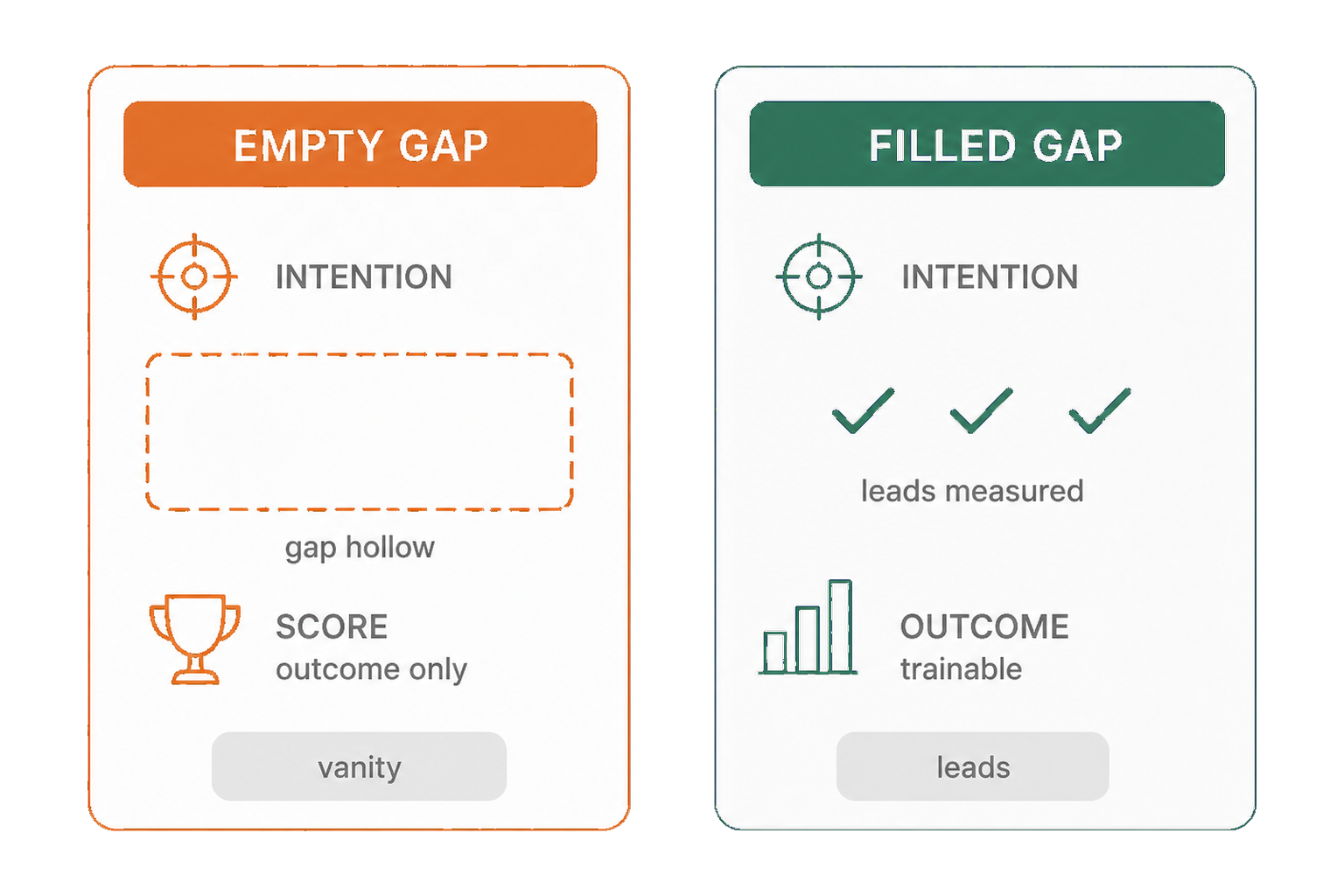
Spatial split — Empty gap (intention → hollow middle → vanity score) versus Filled gap (intention → leads measured → trainable outcome). Your move: Your move this week.
Your move this week
- Write one intention in one sentence.
- List three minimum behaviours that would close the gap if done this week.
- Track those three — not the outcome score alone — through Weekly Review.
Scientific grounding
Cite
- Gollwitzer, P. M. (1999). Implementation intentions: Strong effects of simple plans. American Psychologist, 54(7), 493–503.
- Sheeran, P., & Webb, T. L. (2016). The theory of planned behaviour and implementation intentions. In M. Fishbein & I. Ajzen (Eds.), Predicting and changing behavior (2nd ed., pp. 271–305). Psychology Press.
Implementation intentions (if–then plans) close the intention–behaviour gap by pre-linking cue to action — measuring only the intention leaves the gap open (Gollwitzer). Sheeran and Webb place that bridge inside planned-behaviour models: the Club’s lead behaviours in the gap are the when/where/how layer, not another outcome score.
Adjacent
Lag vs Lead Measure
Decision chain
Failure Strategy
Goodhart’s Law
Vanity Metric
Weekly Review
Personal Definitions