Definition
A Ulysses pact is a commitment made before the known defection. You bind the later self while the present self can still see the wreck. The bind removes a vote. It does not add a better argument.
Origin
The picture is old. Crossing the water, the sailor knows the voices can kill the ship. He does not promise to be brave when they start. He has the crew bind him, and he has their ears closed, while he can still choose the rope.
The modern name for that timing is a commitment device: an arrangement that raises the cost of changing your mind, or that removes the option, before the mood arrives. Ashraf, Karlan, and Yin (2006) tested one economic form in the field — a savings product that restricted withdrawal, offered under the title of tying Odysseus to the mast. Bryan, Karlan, and Nelson (2010) review the class: stakes, deadlines with another party, and options closed in advance.
Adjacent, not the same. Degree of constraint is how hard the fence has to be. Theory of constraints is which link eats the system. This note is only the timing: the bind is installed before the self who will defect arrives.
Mechanism
Evidence level: observational field product plus a review of economic devices — not a ranking of every physical bind.
- Name the ending you already know. The failure strategy is describable in advance. Surprise is no longer the honest story.
- Change the option set while you can still see it. Remove the object, move the instrument of the drift into another room, or put a person in the hour. A reminder on the same desk still leaves a vote.
- Let the later self meet a closed door. Eating the sweet costs a trip if it was never bought. Leaving the room is not available if the clothes are already gone. The departure that is already booked removes next month as a hiding place.
- Do not confuse the bind with a speech. Saboteur mechanics is the story you still treat as a fresh choice. Failure Strategy is the strategy you can write down tonight. The pact is earlier than both: the world no longer offers the step.
All Success Lies in Its Preparation is the file, the bind, and the deadline arranged before the hour that would renegotiate them. Master of Opposites asks which fence helps you stop negotiating, and which fence only punishes you for being alive. extreme discipline → extreme freedom is what a bind you keep actually buys. Freedom is what you can do once the defector has nothing left to trade.
Epistemic boundary. Ashraf, Karlan, and Yin measured take-up and savings balances on a restricted account in the Philippines. They did not time a sweet left at the shop, clothes taken from a room, or a laptop left behind. Bryan, Karlan, and Nelson review economic devices; Crossref confirms that 2010 review. Neither paper shows that every harder bind beats every softer one, or that a bind you resent is a good life. A deadline can remove dithering and become a whip. A closed door can free the hour and can punish being alive. Scite was not in this session; the two bibliographic lines are Crossref-confirmed shelf anchors, not a fresh Smart-Citation pass.
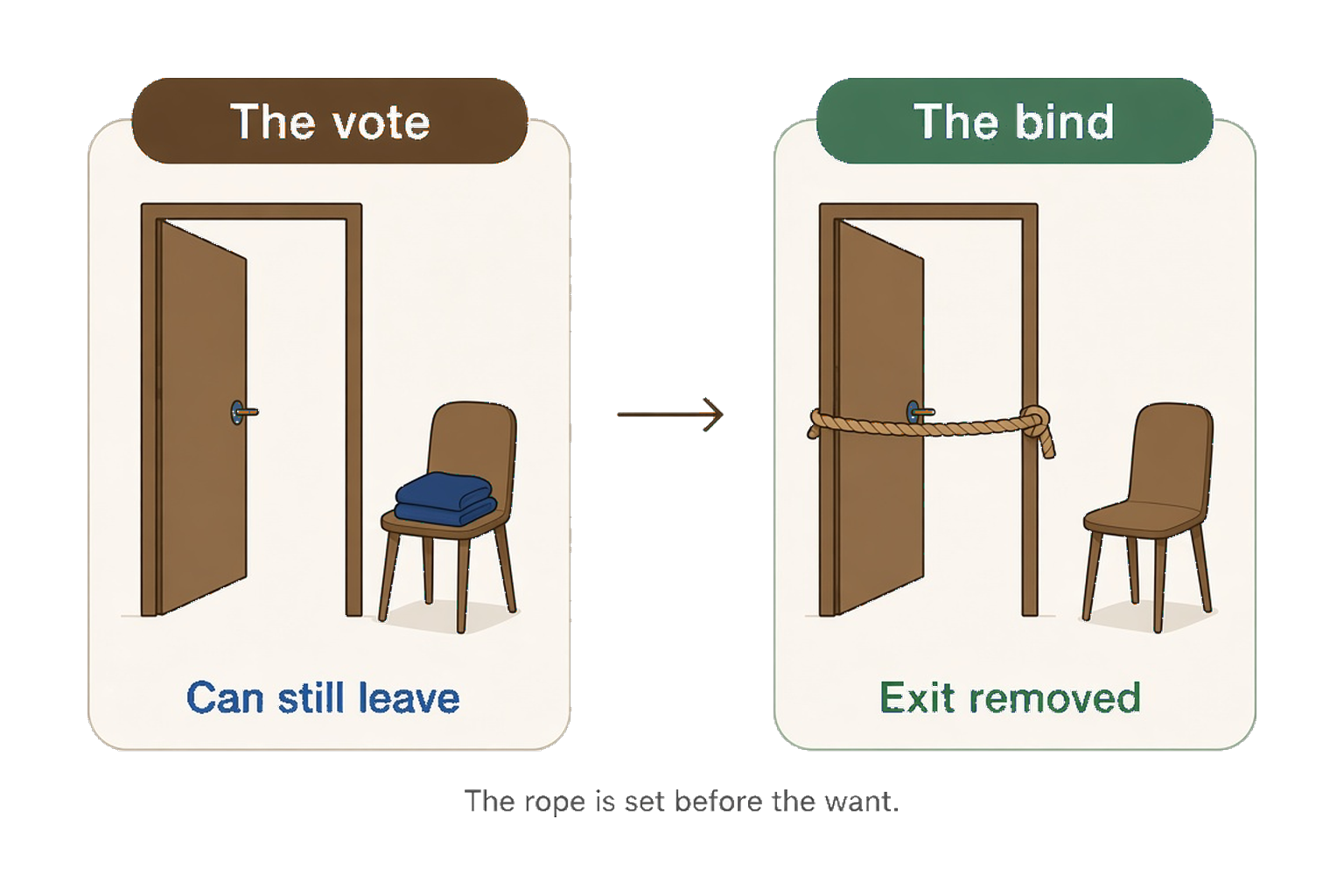
The door still has a vote. The rope removes the exit before the want.
Applications
- When you already know how you leave, install one bind before the want. The object is absent, the instrument is in the other room, or a person is expecting you.
- When a reminder fails, do not add a motive. Remove the vote the reminder still allows.
- Pair the bind with a question of fit. A fence that only makes the day smaller is not the pact. It is a punishment.
Failure modes
- Collector trap: a longer list of rules, with the known defection still able to vote.
- Overclaim trap: treating a savings field study, or a review of stakes and deadlines, as proof that any physical trick rewires character.
- Test today: name the defection you can already describe. Install one bind before it arrives. On the other side, write whether the vote was gone, or only harder to hear.
Sources
Cite
- Ashraf, N., Karlan, D., & Yin, W. (2006). Tying Odysseus to the mast. The Quarterly Journal of Economics, 121(2), 635–672.
- Bryan, G., Karlan, D., & Nelson, S. (2010). Commitment devices. Annual Review of Economics, 2(1), 671–698.
Related doctrine
- extreme discipline → extreme freedom
- All Success Lies in Its Preparation
- Master of Opposites
- Saboteur mechanics
- Failure Strategy