Definition
A friction cascade is what a deferred gate does to the calendar after the vote. The discomfort you refused was one sitting. The queue you re-entered has its own next slot, and that slot often names the next missing piece.
Origin
People have long noticed that a task avoided for mood’s sake comes back larger. Sirois and Pychyl (2013) gave that move a precise name: procrastination as short-term mood repair. The person gives priority to feeling better now. The cost is carried by a later self. Tice, Bratslavsky, and Baumeister (2001) had already shown a laboratory version of the same priority: when distress is up, repairing the feeling can take precedence over impulse control. This note is the calendar face of that repair, when the task is not a private file but a gate that other people open. A counter, an appointment, a document someone else must see. The mood literature does not measure those queues. It explains why the first vote prefers the café. The cascade is what that vote cannot see.
Mechanism
Three steps, easy to collapse into “I will do it tonight.”
- The gate has a queue that is not yours. A desk, a clerk, a form that comes back incomplete. Your forty-five minutes are real. Their next opening is a different object.
- The vote prices only the sitting. Discomfort now, relief now, a plausible evening. Micro-negotiations are this vote. Short-term mood repair is why relief wins the comparison: the later self is abstract, and the body is concrete.
- The deferral multiplies. You return on their next slot. They name the next missing piece. That piece needs another sitting, which misses the slot, which books another day. Efficiency, here, is not speed as a personality. It is the time and energy between where you are and the result. A cascade spends both on re-entry.
The counter-move is not a speech about discipline. It is doing the sitting while you are already at the gate, so the next slot is not purchased. An if-then plan can hold the sitting once you have named the cue. It does not, by itself, show you the queue you were about to buy.
Epistemic boundary. No paper in the sources counts Spanish bank days or proves that thinking about a task always lasts longer than the task. Sirois and Pychyl review a mood-priority account of procrastination and its cost to a future self. Tice and colleagues tested distress against impulse control in the laboratory. They do not rank administrative gates, and they do not say every pause is a failure. Recovery, a queue you cannot move, and a real evening limit are not cascades. The cascade claim is narrower: when you can act at the gate and you defer for relief, you often buy the next opening, not a cheaper version of the same hour.
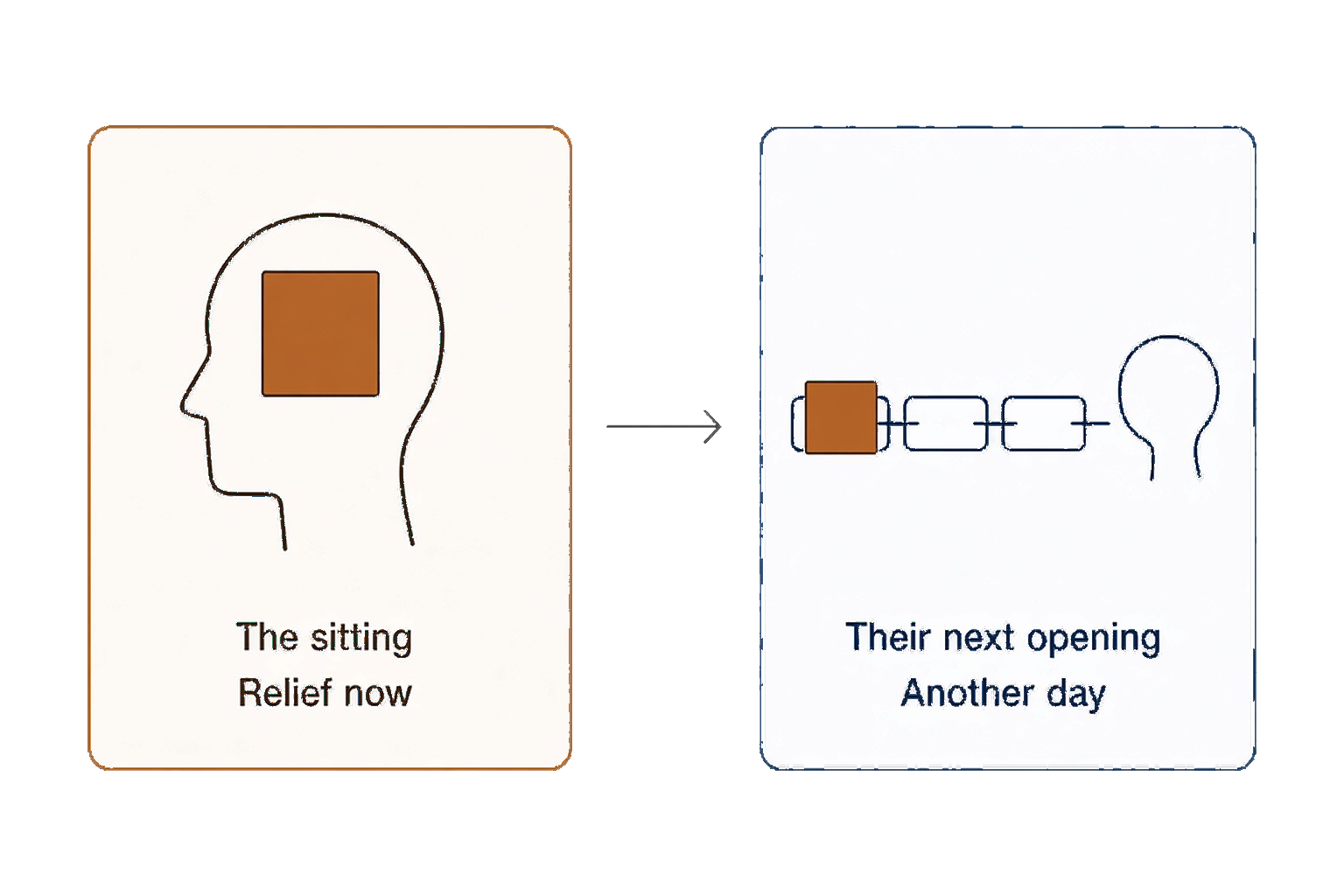
The vote prices the sitting. The exit buys their next opening.
Applications
- Before you leave a gate, write the next two delays the exit would purchase. If you cannot name them, you are pricing only the discomfort.
- If the sitting is available now, do it before you re-enter the queue. The evening version is a different object once someone else’s calendar is involved.
- When a task is private and has no queue, the mood-repair account still applies, and the cascade account does not. Do not import a clerk into a file only you can open.
Failure modes
- Collector trap: a log of every deferral, with the sitting still undone.
- Overclaim trap: treating rest, a closed office, or a missing document you cannot fetch as a character flaw.
- Test today: one gate you could clear in a sitting. Name the next slot your exit would buy. Clear it now, or keep the delay and write the slot in a sentence.
Sources
Cite
- Sirois, F. M., & Pychyl, T. A. (2013). Procrastination and the priority of short-term mood regulation. Social and Personality Psychology Compass, 7(2), 115–127.
- Tice, D. M., Bratslavsky, E., & Baumeister, R. F. (2001). Emotional distress regulation takes precedence over impulse control. Journal of Personality and Social Psychology, 80(1), 53–67.