Definition
The price of complexity is the bill a difficult arrangement still sends after you have stopped wishing it were simple. Someone pays it: your attention, another person, or a sequence you built so the minute no longer has to.
Origin
Work-design and cognitive-science traditions both refuse the fantasy that hard arrangements vanish when you understand them. Risko and Gilbert (2016) named one move already in use: a physical action that changes what a task asks of working thought. Launching a new skill has a related, older shape. The first repetitions cost more fuel than the repetitions that follow, because the sequence does not yet exist. This note is the assignment question underneath both. Not “how do I feel less complexity.” Who is paying, and is that the payer you meant.
Mechanism
Complexity here is not a mood and not a virtue. It is the number of decisions, exceptions, and links a result still requires. Three payers show up again and again.
- You, in the minute. Every exception is a fresh vote. The hour you meant to use for the work is spent reassembling the work. The demand did not shrink. It landed on attention.
- Another person. A colleague, a client deadline, a role you hired. The complexity is real. The bill moved. You still have to know what you handed over, or you have only hidden the payer.
- A sequence. Cues, defaults, a chain that starts without a speech. Cognitive offloading is the neighbouring mechanism: the action changes the processing requirement. A sequence is offloading extended across time. The first builds are expensive. After the chain holds, the same complexity can be paid by the arrangement instead of by a new act of will.
A novelty often has a launch cost. More effort, focus, or fuel is required to leave the ground than to continue once the path exists. A diary of one daily behaviour in a stable context found automaticity rising toward a plateau, not a moral about grinding. That is why “make it simple” fails as the only instruction. Simplicity, when it is real, is usually a payer who is no longer you.
Epistemic boundary. No single paper ranks these three payers or proves that every automated chain is wiser than attention. Offloading research shows that people move demand into the body and the world, and that the judgment of when to do so can be wrong. The habit curve is one chosen behaviour repeated in one context. It does not say your life should be a machine, and it does not name a person or a sequence as the correct payer. Complexity Trap is a different failure: adding intricacy because it feels like seriousness. This note assumes the complexity is already load-bearing, and asks only who carries it.
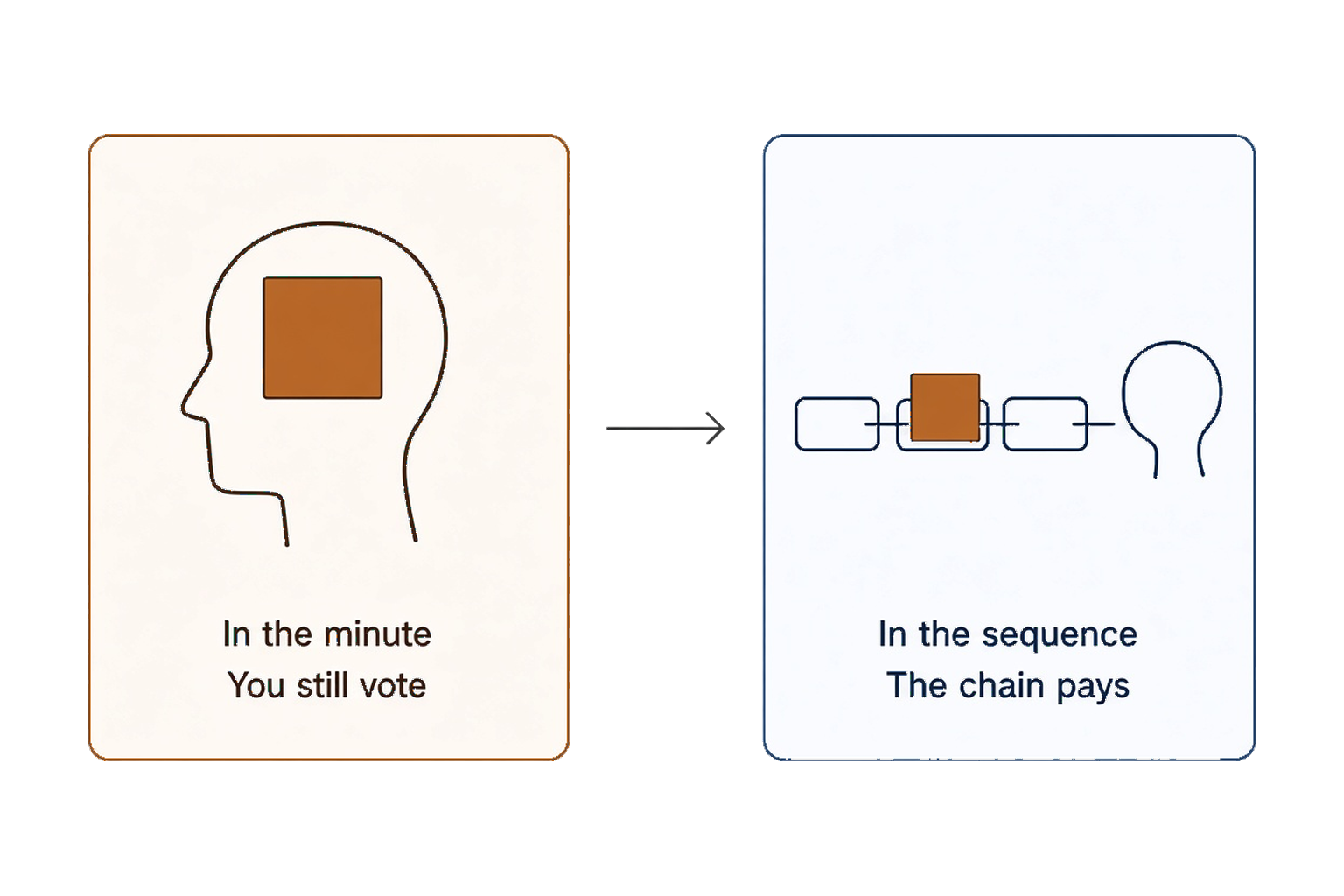
You still vote in the minute. A sequence can pay the same bill.
Applications
- When a new responsibility exhausts you, write the payer in one word: minute, person, or sequence. Do not redesign the whole system in the same sitting.
- If you are the payer of a chain you already understand, move one link into a cue or a default before you add a tool.
- If someone else is the payer, name what you still have to see. Delegation that you cannot inspect is a hidden bill.
Failure modes
- Collector trap: more tools that you still operate by hand, so the payer never changes.
- Overclaim trap: treating every friction as complexity to delegate, including the difficulty that is the work.
- Test today: name one repeating friction. Write who pays it this week. Move one decision out of the minute, or keep it and stop calling the cost a surprise.
Sources
Cite
- Risko, E. F., & Gilbert, S. J. (2016). Cognitive offloading. Trends in Cognitive Sciences, 20(9), 676–688.
- Lally, P., van Jaarsveld, C. H. M., Potts, H. W. W., & Wardle, J. (2010). How are habits formed: Modelling habit formation in the real world. European Journal of Social Psychology, 40(6), 998–1009.