Definition
Cognitive offloading is the use of physical action to alter the information-processing requirements of a task so as to reduce cognitive demand.
Origin
Risko and Gilbert (2016) reviewed a set of behaviours that had been studied apart and named the common move. Tilting your head to read a rotated image, and setting a phone to remember an appointment, are both offloading. The action changes what the task asks of you. The review asks two questions: what triggers the offload, and what the offload does to cognition afterward. The trigger is not only the size of the demand. It is also a metacognitive judgment of your own ability, and that judgment can be wrong, so the offload can be more, or less, than the task required.
Myelin is the biological fabric of excellence is a neighbouring biological claim: roads you travel get faster. Offloading is not myelin. It is the decision, often unnoticed, to travel a road outside the skull. Tesler’s Law is the systems claim beside it. Demand that leaves the head still has to be paid, by a tool, by a later reconstruction, or by a skill that thins because it was not used.
Epistemic boundary. The 2016 paper is a review and a framework, not a single experiment and not a verdict on any one technology. Do not teach “tools make people stupid.” Teach the move and its bill: demand relocated, a skill practiced less, a self-rating that can mis-fire.
Mechanism
- An action changes the task. A note, a photograph, a calculator, a prompt. The world holds what the head would have held.
- Demand and self-rating both pull the trigger. Hard inner work makes the offload attractive. So does a low opinion of your own memory or reasoning, even when that opinion is off.
- The short bill is relief. The step completes. Attention is free for something else.
- The long bill is what stops being trained. A procedure you always delegate is a procedure you no longer rehearse. An experiment that lets people store the material outside the head raises the immediate score and leaves a weaker memory of what was stored. Retrieval, estimation, and the feel of a step can thin.
- The offload can be the right design. Saving a date in a calendar is often wiser than rehearsing it. The design question is which capacities you still intend to own.
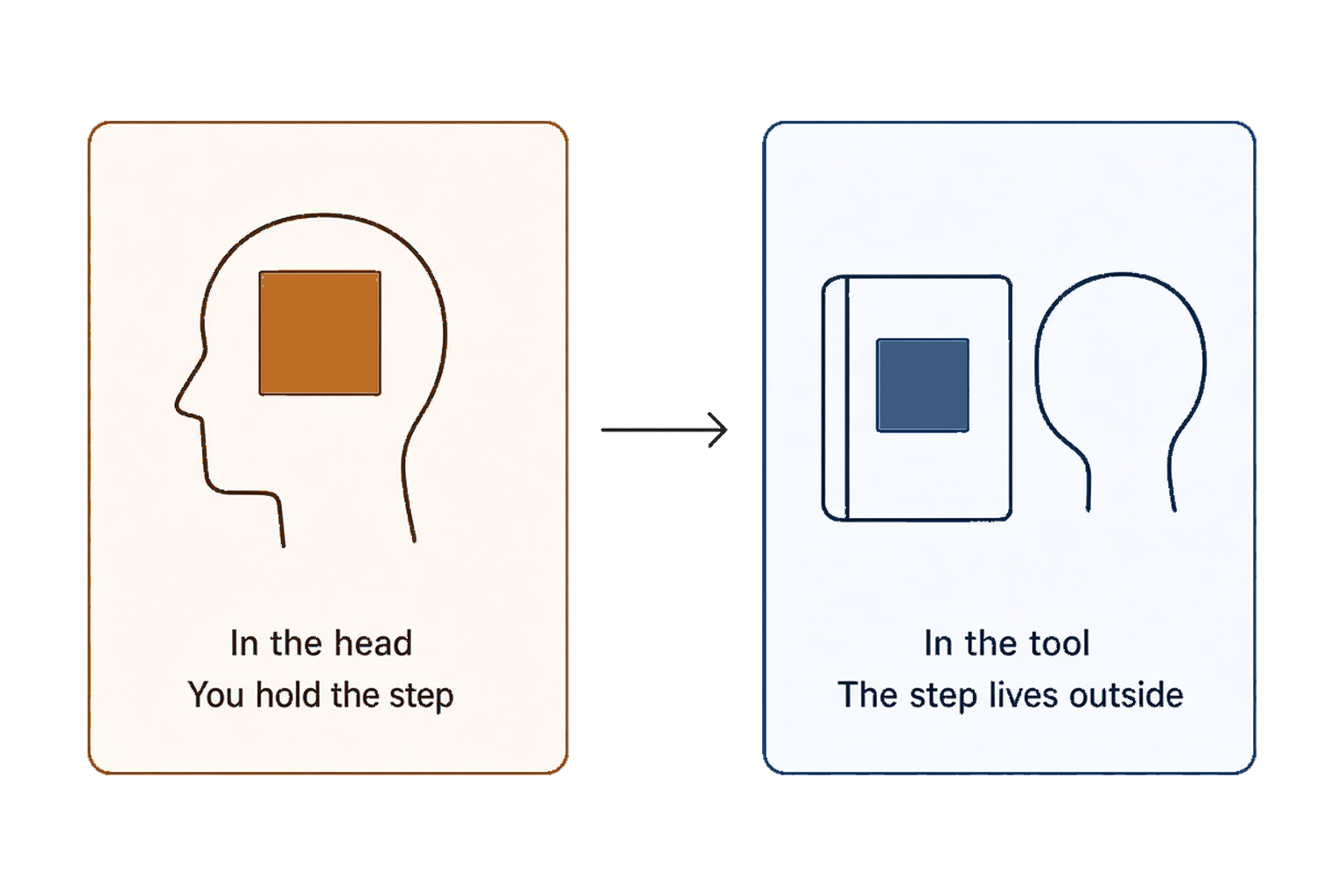
The step can sit in the head, or it can sit in the tool.
Applications
- Before you hand a how-to to a tool, name the skill that will get one less rep.
- Keep one rep of a capacity you still want: a sum in the head, a procedure from memory, a paragraph in your own sentences after a draft.
- When a self-rating says “I cannot do this without the tool,” test the rating once on a small instance. The rating is a cue, not a measurement.
Failure modes
- Collector trap: reading the review instead of noticing one offload you already made today.
- Overclaim trap: treating every tool as atrophy, or every memory lapse as proof the tool harmed you.
- Test today: one task you handed off, and one rep of the same task you still do yourself.
Sources
Cite
- Risko, E. F., & Gilbert, S. J. (2016). Cognitive offloading. Trends in Cognitive Sciences, 20(9), 676–688.
- Grinschgl, S., Papenmeier, F., & Meyerhoff, H. S. (2021). Consequences of cognitive offloading: Boosting performance but diminishing memory. Quarterly Journal of Experimental Psychology, 74(9), 1477–1496.