Definition
Experiential avoidance is the attempt to get away from unwanted inner experience — an emotion, a thought, a memory — even when that attempt shrinks the life you say you want.
Origin
Hayes, Wilson, Gifford and colleagues (1996) proposed experiential avoidance as a functional diagnostic dimension: many named disorders can be read as unhealthy efforts to escape private events (Hayes et al., 1996). Later measurement work (the MEAQ) treated it as a broad, multi-facet tendency distinguishable from neuroticism (Gámez et al., 2011). Club language avoid avoiding is an operational handle on this library idea — not a second syndrome.
Mechanism
The short-term move works: leave the form unnamed, leave the room, soften the word, and the inner state drops. The longer-term cost is that the avoided content keeps recruiting attention, and action stays smaller than the standard you already hold. Acceptance-based therapies treat contact with the inner state (not suppression) as the process target (Hayes et al., 2012, as cited in later reviews).
Epistemic boundary: the 1996 paper is a theoretical integration, not a single RCT. Scite records a large mentioning tally and a small contrasting set. Teach the process (escape of private experience → restricted action), not a claim that every delay is pathology. Approach–avoidance temperament (Approach-avoidance motivation) is a related but distinct layer (sensitivity to threat vs reward), not a synonym.
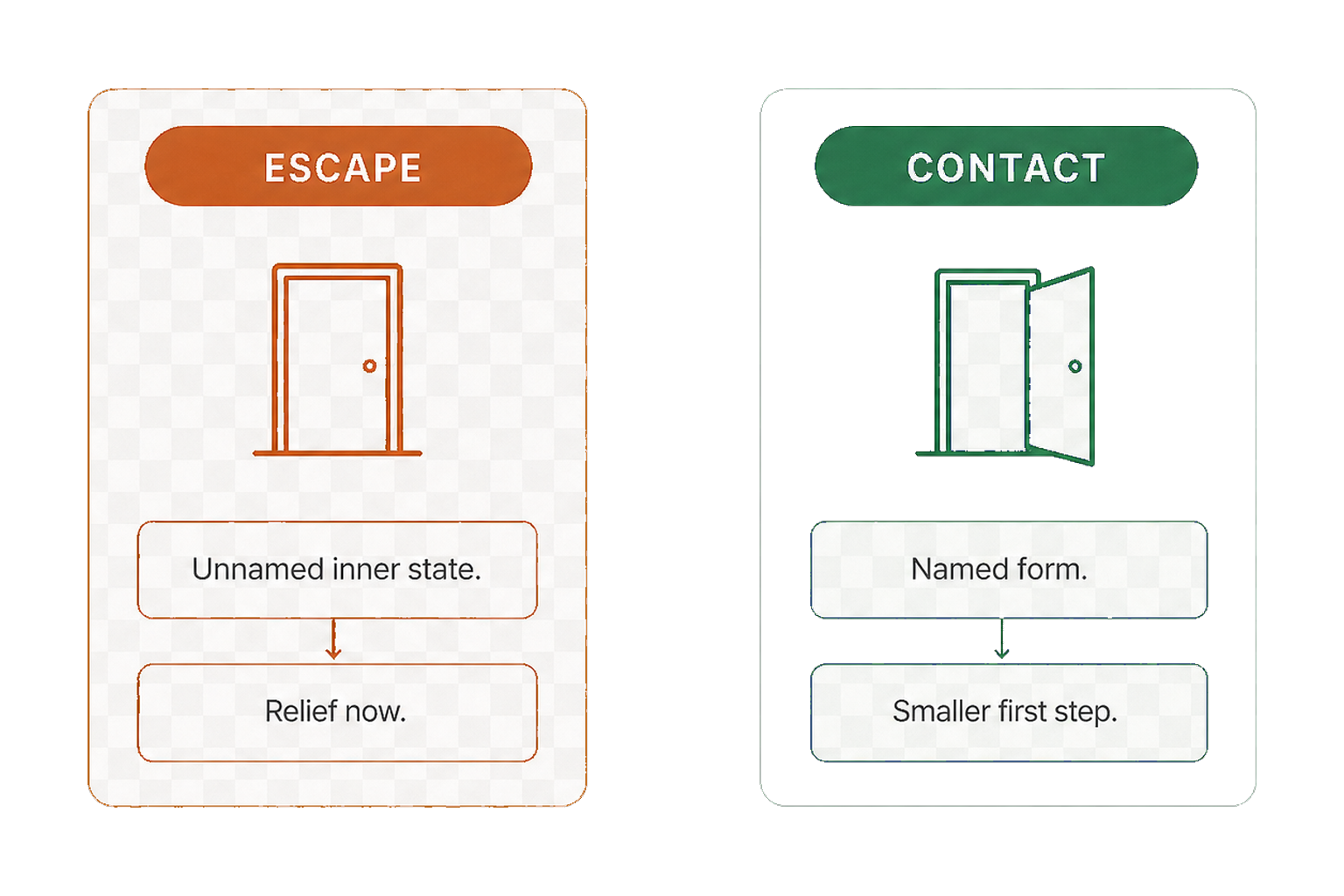
Escape vs contact — unnamed relief now, or the form named and a smaller first step.
Applications
- When a decision keeps sliding, name the inner state being escaped before you add another plan.
- Pair with Flight strategies when the escape wears courtesy, busyness, or “later.”
- Pair with Identity Gap when the avoided form is a self-standard you will not live in public.
Failure modes
- Collector trap: reading avoidance science instead of taking the smaller-than-the-domino step.
- Overclaim trap: calling every rest experiential avoidance.
- Test today: write the form you will not name — one sentence — then one action smaller than the real move.
Sources
Cite
- Hayes, S. C., Wilson, K. G., Gifford, E. V., Follette, V. M., & Strosahl, K. (1996). Experiential avoidance and behavioral disorders. Journal of Consulting and Clinical Psychology, 64(6), 1152–1168
- Gámez, W., Chmielewski, M., Kotov, R., Ruggero, C., & Watson, D. (2011). The Multidimensional Experiential Avoidance Questionnaire. Psychological Assessment, 23(3), 692–713