Working definition
Micro-negotiations are the repeated yes/no permissions you grant yourself in a day — usually unconscious — that tax mental load and kill congruence when perfection, legitimacy, or coherence boxes stay unchecked.
How it works
You do not only withhold big acts (Permission withheld). You pay a tax on every small authorization — publish this draft, keep rewriting, wear the same black shirt, answer the feedback that says we don’t recognise you. Without a system, those yes / no / I allow / I don’t decisions stack into fog: decision load without a named box.
The trap is identity: if I authorize enough, I lose the perfectionist I love. That is false polarity. Training a new palette does not delete the natural one — gymnast split does not erase standing with feet together (Master of Opposites). External feedback can yank you back into the old box; emancipation means behaviour and results can change while the self stays whole (congruence).
Distinction from Permission withheld: permission withheld names the acts still refused (axe before how). Micro-negotiations name the daily tax — the volume of unchecked yes/no that drains congruence even when the act list is clear. Distinction from Complexity Trap: the maze is redesign as reward; micro-negotiations are authorization friction inside an already-chosen path.
Signature
The image is the black T-shirt stack versus the open wardrobe — one default ends the fog; infinite options reopen the tax. Room: 2026-08-12 — Daily micro-negotiations without a system become mental load.
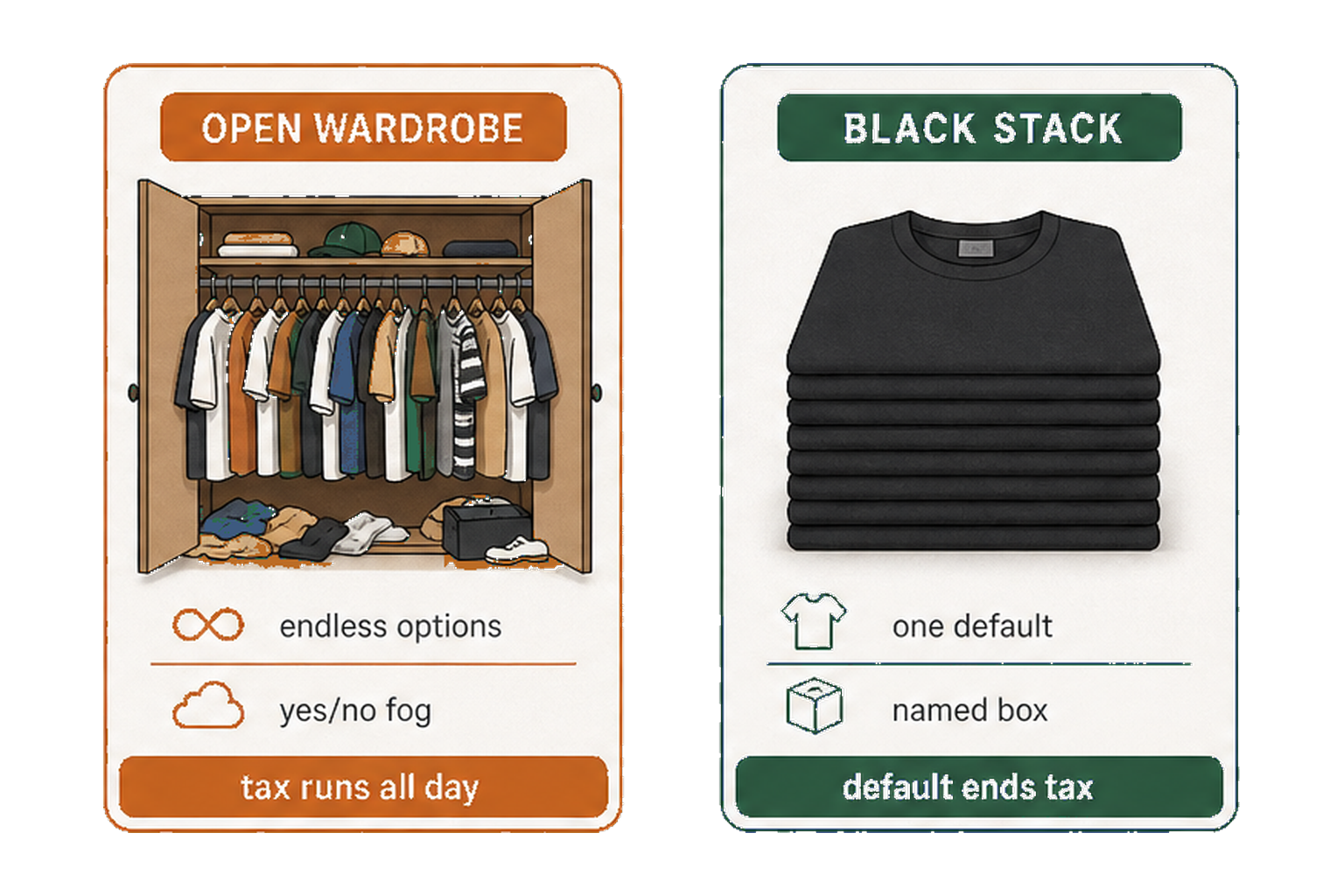
Spatial split — Open wardrobe (endless yes/no fog) versus Black stack (named box ends the tax). Your move: Your move this week.
The WOW: Name the box that said no — or the tax runs all day.
Your move this week
- Log five micro-negotiations in one day (yes / no / I allow / I don’t).
- For each, name the box that said no: perfection · legitimacy · coherence · other.
- Pick one box and write a default that ends that tax for seven days (one Alpha minimum).
Scientific grounding
Cite
- Muraven, M., Tice, D. M., & Baumeister, R. F. (1998). Self-control as a limited resource: Regulatory depletion patterns. Journal of Personality and Social Psychology, 74(3), 774–789.
- Kool, W., McGuire, J. T., Rosen, Z. B., & Botvinick, M. M. (2010). Decision making and the avoidance of cognitive demand. Journal of Experimental Psychology: General, 139(4), 665–682.
Limited self-control — prior regulatory effort impairs later control (Muraven et al.). Cognitive demand avoidance — people prefer options that reduce decision load when demand is high (Kool et al.). Micro-negotiations are the Club name for the daily authorization tax that spends that capacity without a system.