Working definition
The Complexity Trap is the pleasure of over-complicating that produces analysis paralysis and productivity in the wrong place.
How it works
You feel smart while the system grows — more steps, more polish, more “almost ready.” That pleasure is the trap: complexity becomes the reward, so the move that would transfer certainty never ships. What gets measured progresses — score product certainty and delivery certainty on a 1–10 through the day (Observability) instead of redesigning the stack again.
Wire to Saboteur mechanics: the stop is not laziness; it is busywork that protects you from the unfinished ask. Pair with Alpha Milestone — a minimum viable behaviour collapses the trap into one reviewable week. Sales and publishing fail here first: you decorate in the corner while someone with weaker delivery but higher certainty closes (Transfer of Certainty).
Distinction from Saboteur mechanics: saboteur is the family of stop-patterns; Complexity Trap is the specific pleasure-of-complexity flavour. Distinction from Busy versus truly productive: busy vs productive names the scoreboard; Complexity Trap names why the scoreboard fills with the wrong work.
Signature
The image is the shortcut past the maze — measure certainty, don’t rebuild the labyrinth. Room: 2026-08-10 — Shortcut the Complexity Trap.
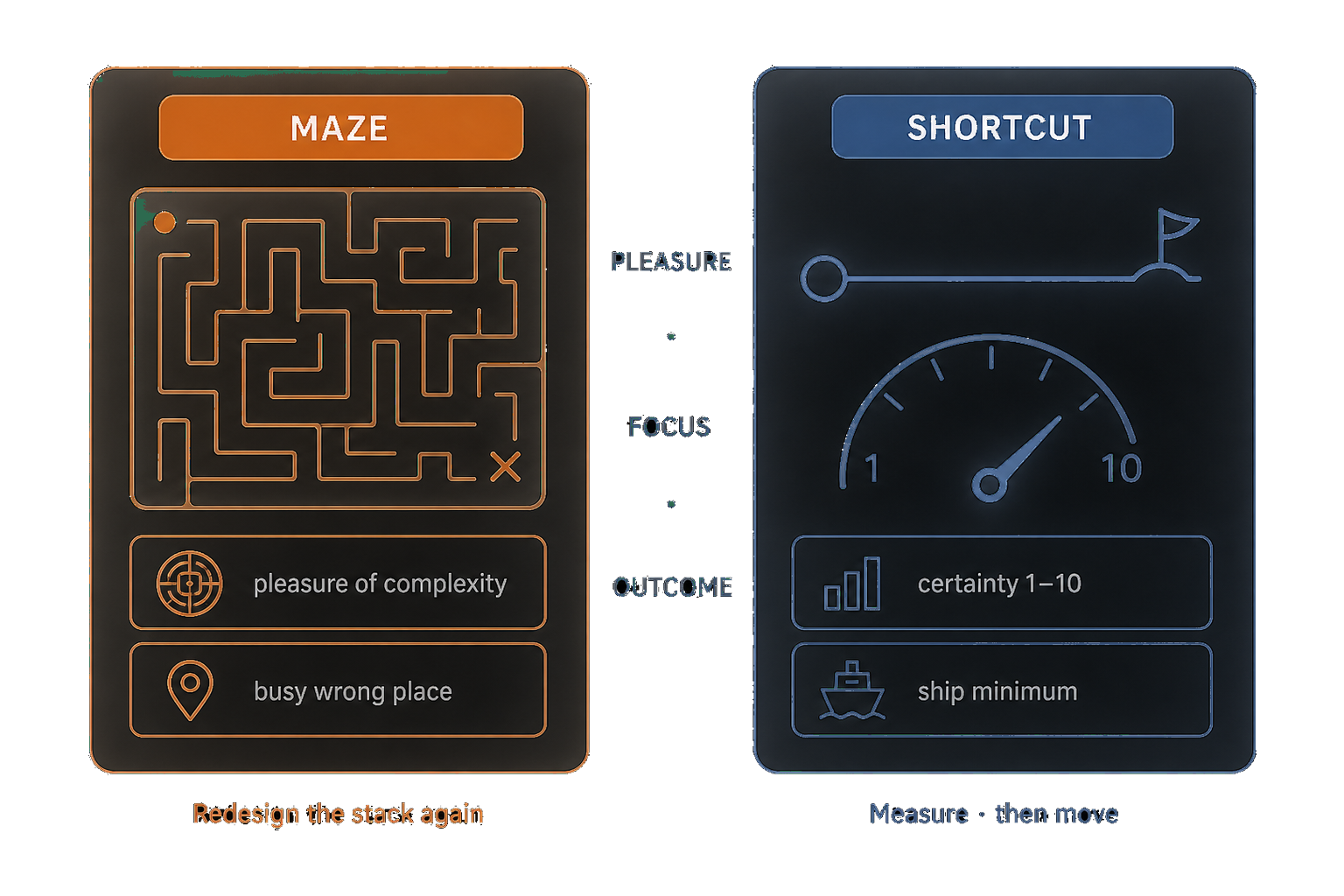
Spatial split — Maze (pleasure of complexity · busy wrong place) versus Shortcut (certainty 1–10 · ship minimum). Your move: Your move this week.
The WOW: Over-complicate for the pleasure of complexity → analysis paralysis → busy in the wrong place.
Your move this week
- Write one sentence: where I am busy in the wrong place this week.
- Score certainty 1–10 once today on the real offer (product · delivery).
- Replace one complex redesign with one Alpha minimum for 24–72h.
Scientific grounding
Cite
- Schwartz, B. (2004). The Paradox of Choice. Harper Perennial.
- Iyengar, S. S., & Lepper, M. R. (2000). When choice is demotivating: Can one desire too much of a good thing?. Journal of Personality and Social Psychology, 79(6), 995–1006.
Choice overload — more options can raise regret and lower satisfaction even when objective quality rises (Schwartz). Demotivating choice — limited menus (≈6) beat extensive arrays (24–30) for purchase, satisfaction, and performance (Iyengar & Lepper). Complexity Trap is the Club name for when building the maze becomes the reward.