Definition
Degree of constraint is the hardness of the fence you choose so a behaviour starts without a fresh vote — a notification, a physical cue, an appointment with another person, or a consequence you cannot talk your way out of.
Origin
Implementation-intention research shows that an if-then plan — when situation X, I do Y — raises goal attainment by tying action to a cue and cutting fresh deliberation (Gollwitzer, 1999). Commitment-device work studies fences that raise the cost of defection: money staked, deadlines with another person, options closed in advance (Bryan, Karlan, and Nelson, 2010). Degree of constraint is the dial between those findings. It is not the goal. It is how hard the fence has to be for this link, today.
Adjacent, not the same: Constraints-as-liberation is what a chosen limit buys (attention freed from infinite options). Theory of constraints is which link is the bottleneck. This note is only the hardness.
Mechanism
A soft cue still leaves a vote. You can see the notification and negotiate. A physical cue — the object in the only place the chain can start — removes one negotiation and leaves the next. An appointment with a person, or a consequence arranged in advance, removes the vote entirely: the class happens whether you feel like the class.
- Locate the link that does not start. Later steps are decoration until that link moves.
- Read the current hardness. If a reminder fails, the fence is below the vote.
- Raise one notch. Tape on an object. A time with someone. A consequence you set before the mood arrives. Do not jump to a punishment you will not keep.
- Progressive, or you shoot yourself in the foot. A fence harder than the life around it gets ripped out. Daily Adversity Time is adversity you designed, including edges the day already has. Problems at the Height of Ambitions is the overbuilt ideal that collapses.
Micro-negotiations are the tax the soft fence still charges: ten passes of half a minute on an errand you already decided. extreme discipline → extreme freedom sits on the other side of a fence that holds — freedom inside the constraint, not freedom from having one.
Epistemic boundary: Gollwitzer (1999) supports if-then plans that automate a cue, not a claim that every harder fence outperforms every softer one. Bryan, Karlan, and Nelson (2010) review economic commitment devices; Crossref confirms that review. Neither paper ranks a personal dial. Do not treat the hardness as a personality score.
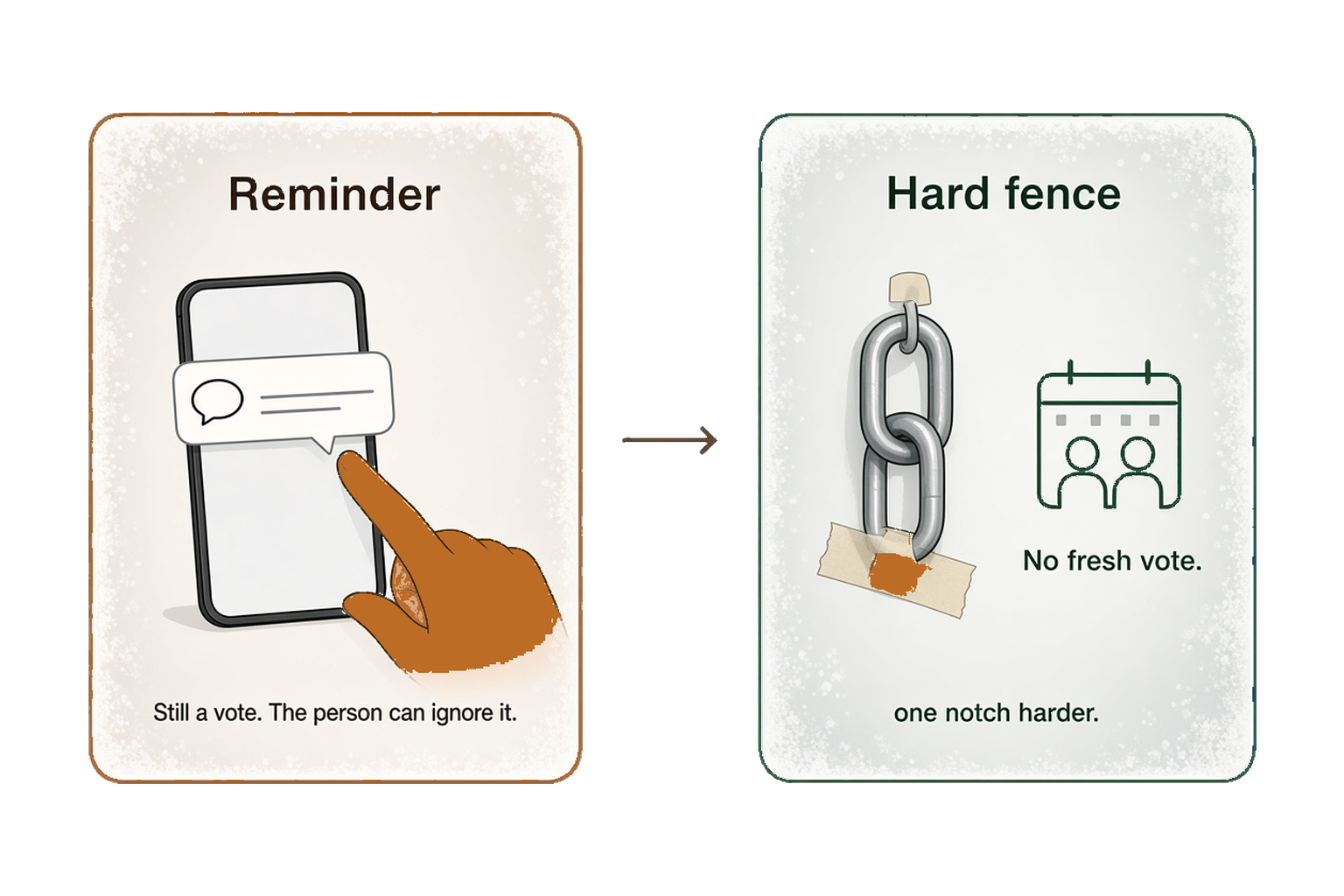
A reminder still leaves a vote. The hard fence does not.
Applications
- When a reminder is ignored, move one notch up — object, appointment, or person — before you add a new reason.
- When a chain only runs under an external promise, that promise is the current degree. Keep it until a softer cue actually starts the link.
- Pair with a pre-mortem: name what will kill the start, and set the fence before that moment.
Failure modes
- Collector trap: designing a harder system instead of raising the one link that fails.
- Overclaim trap: treating a taped object as proof of character, or a missed notification as a moral event.
- Test today: name the link that does not start, and raise its fence one notch you will still respect tomorrow.
Sources
Cite
- Gollwitzer, P. M. (1999). Implementation intentions: Strong effects of simple plans. American Psychologist, 54(7), 493–503.
- Bryan, G., Karlan, D., & Nelson, S. (2010). Commitment devices. Annual Review of Economics, 2(1), 671–698.
Related doctrine
- Micro-negotiations
- Daily Adversity Time
- extreme discipline → extreme freedom
- Problems at the Height of Ambitions