Definition
The theory of constraints says a system’s throughput is governed by its single tightest constraint. Work on any other link does not raise the output of the chain until that constraint is exploited, and the rest of the chain is subordinated to it.
Origin
Eliyahu M. Goldratt developed the theory of constraints as an operations method: find the bottleneck, decide how to exploit it, subordinate every other step to that decision, then elevate the constraint and watch the next one appear. The popular statement lives in a business novel. The shelf cites the review literature: Rahman (1998) on the philosophy and its applications, and Watson, Blackstone, and Gardiner (2006) on how the idea became a management philosophy.
The transfer out of the factory is structural, not biographical. A personal chain — morning, preparation, errand, rehearsal — also has a throughput. The constraint is often the first missing condition, not the skill you keep polishing.
Adjacent, not the same: Degree of constraint is how hard the fence is. Constraints-as-liberation is what a chosen limit buys. This note is only which link is currently the bottleneck.
Mechanism
Local improvement is a trap when it lands off the constraint. A later step can be beautiful and the chain still produces nothing, because the first condition never became true.
- Identify. Which single condition, if absent, stops every later step? An object not in place. An appointment not made. A preparation with no start cue.
- Exploit. Get the maximum out of that constraint before you buy a new system. Use the link you already have.
- Subordinate. Stop feeding work that piles up behind a start that is not happening. Measure finishable units at the constraint, not global busyness.
- Elevate, then repeat. When that link holds, the next constraint shows itself. Do not freeze the first diagnosis into an identity.
All Success Lies in Its Preparation is often the hidden constraint on work someone already loves: the live performance is not the bottleneck; the preparation that will not start is. build imperfect personal checklists is a subordination tool — a short list aimed at the constraint, not a catalogue of every improvement.
Epistemic boundary: this note names Goldratt’s operations claim and a structural analogy. Rahman (1998) and Watson, Blackstone, and Gardiner (2006) are Crossref-confirmed reviews of that operations literature. Neither reports an effect size for personal behaviour, and neither licenses diagnosing a life from a factory metaphor.
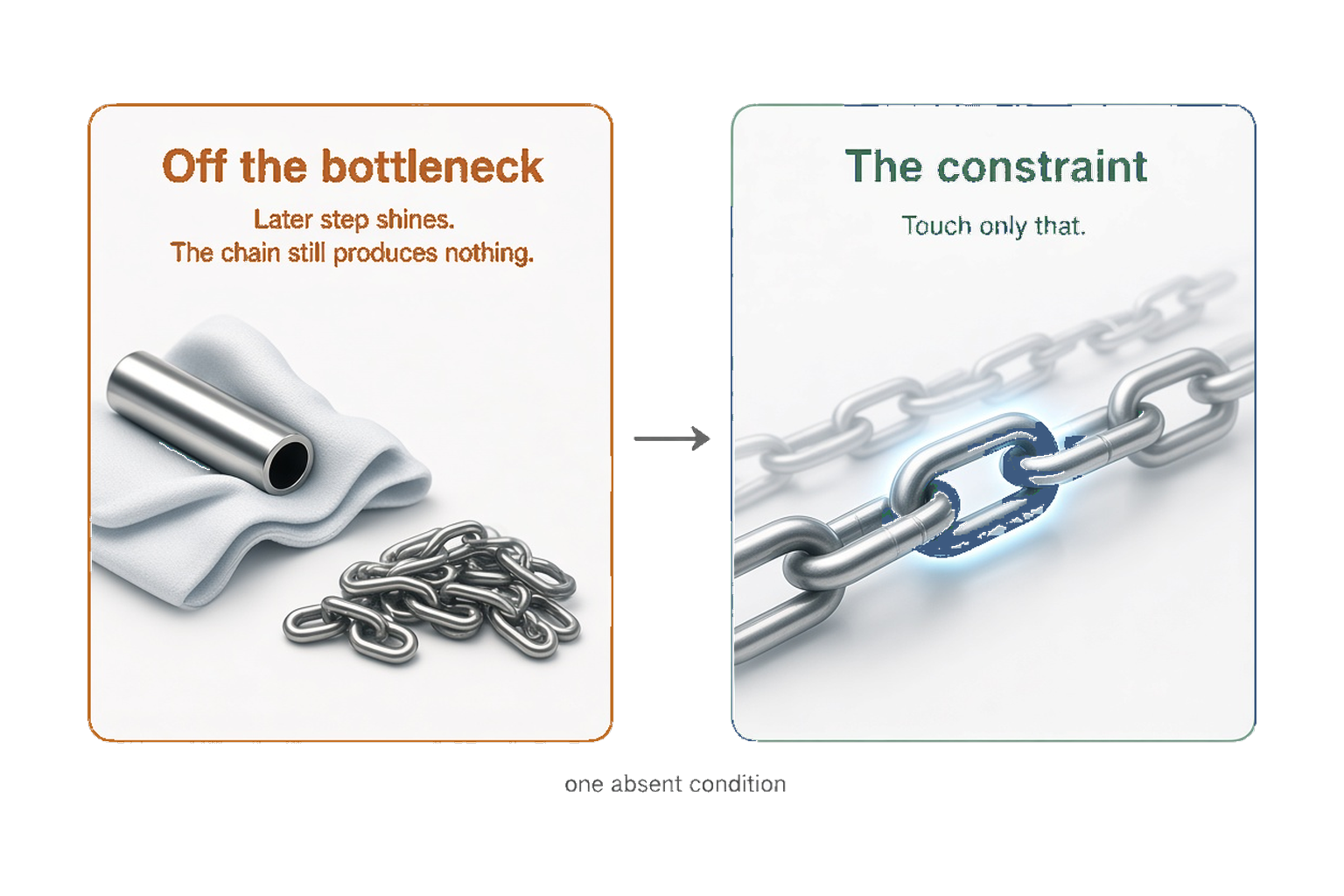
A shining later step is not the constraint. Touch the link the chain is waiting on.
Applications
- When effort is high and output is flat, stop adding steps. Name the one condition that is absent when the chain fails to start.
- When preparation is hated and the performance is loved, treat the preparation start as the constraint. Customize that start. Do not rehearse your love of the performance.
- After the constraint moves, look for the next one. A solved bottleneck is not a finished system.
Failure modes
- Collector trap: optimizing every link because the map looks complete.
- Overclaim trap: calling every preference a bottleneck, or citing a novel as clinical evidence.
- Test today: write the one condition that, if missing, makes the rest of the chain impossible — then touch only that.
Sources
Cite
- Rahman, S. (1998). Theory of constraints: A review of the philosophy and its applications. International Journal of Operations & Production Management, 18(4), 336–355.
- Watson, K. J., Blackstone, J. H., & Gardiner, S. C. (2006). The evolution of a management philosophy: The theory of constraints. Journal of Operations Management, 25(2), 387–402.